There is a scale in the American Southwest that recalibrates visitors: horizons that run for sixty miles, silence with actual texture, geology that makes human timescales feel like a rounding error. It is also, not coincidentally, the finest road-tripping terrain in the country — the distances are grand but manageable, the roads themselves are half the scenery, and the highlights cluster into loops that fit real vacations. Seven routes cover the region’s essential experiences, from the five-park Grand Circle to a two-day pilgrimage to Monument Valley. They overlap, combine, and scale: pick one for a long weekend, chain two for a week, and know that every one of them rewards the driver who stops often and rushes never.
1. The Grand Circle: the complete argument
The flagship. Roughly 1,400 miles and seven to ten days, looping from Las Vegas or Salt Lake City through Zion, Bryce Canyon, Capitol Reef, Arches, and Canyonlands, with the Grand Canyon as the loop’s great anchor — start your reading with the National Park Service’s Grand Canyon guide if the South Rim is your entry point. The Circle’s genius is variety at short range: Zion’s vertical walls give way to Bryce’s hoodoo amphitheaters, Capitol Reef’s empty folds, and Moab’s twin parks, no two days alike and no drive wasted. Seven days is the minimum that does it justice; ten lets you add the hikes instead of just the overlooks. Gateway towns do the sleeping: Springdale for Zion, Moab for Arches and Canyonlands, Tusayan for the Grand Canyon. This is the route to choose if the Southwest gets exactly one trip.
2. Route 66, the Southwest stretch: neon and Americana
Four to seven days across the surviving mother road of Arizona and New Mexico, and a completely different Southwest — this one is cultural rather than geological. The drive strings together Kingman, Seligman (the town that fought to resurrect 66 and won), Flagstaff, Winslow, Holbrook’s Wigwam Motel teepees, Gallup, and into Albuquerque and Santa Fe. The stops are diners, trading posts, murals, and motels with neon that has buzzed since before the interstate existed. It pairs naturally with the Grand Canyon, an hour north of the route at Williams, and it rewards slowness more than any other route here: the attraction is not a destination but a texture. Drive it in the shoulder seasons, when the desert light is kind and the classic-car crowds have thinned.
3. Big Bend and Marfa: the remote masterpiece
Three to four days in far West Texas, and the most solitude per mile of any route on this list. Big Bend National Park is where the Rio Grande bends through mountains-meets-desert country — Chisos peaks, river canyons, hot springs at the water’s edge, and night skies among the darkest measured anywhere. Pair it with Marfa, the tiny art town three hours northwest, where minimalist installations and the mysterious Marfa lights make the desert feel curated. This route demands respect for distance: fuel, water, and supplies are planned, not assumed, and cell coverage is a rumor for long stretches. In exchange it offers the Southwest with the fewest other people in it. Winter and early spring are its seasons; summer here is a serious proposition.
4. Sedona and the Verde Valley: the gentle introduction
Three to four days, and the most accessible route for a first Southwest trip or a shorter window. Sedona’s red-rock country is scenery you live inside rather than look at — Cathedral Rock and Bell Rock as the town’s skyline, Oak Creek running cold and clear below, and Slide Rock State Park turning a natural sandstone chute into a swimming hole. The Verde Valley adds the counterpoints: Jerome, a mining town clinging picturesquely to its hillside and reborn as an arts colony; Montezuma Castle’s cliff dwellings, among the best-preserved in the region; and Flagstaff an hour north, all ponderosa pines and cool air, as a second base. Pair Sedona with the Grand Canyon two hours north and the short trip becomes a full week — which is exactly route five.
5. Grand Canyon and Sedona: the Arizona greatest hits
Five to seven days built from the two most famous names in Arizona, and the right answer for travelers who want depth over breadth. Give the canyon itself real time: a day on the rim is a postcard, but the park rewards two or three — a hike below the rim on the Bright Angel or South Kaibab trails (even an hour down changes the place entirely), a sunrise and a sunset at different viewpoints, and the east rim’s Desert View drive. Then drop south through Oak Creek Canyon to Sedona for the red rocks, the galleries, and the easier pace. The pairing works because the two landscapes argue with each other productively: one is about immensity seen from above, the other about beauty at arm’s length. Book park lodging far ahead — inside-the-park rooms are the scarcest resource in Arizona travel.
6. US-50 and Great Basin: the loneliest road, proudly
Three to four days across Nevada on the highway a famous magazine once branded the loneliest road in America — a title the state now prints on its own signs. The route crosses basin after basin of empty sagebrush and mountain ranges, through Ely and Eureka, mining towns that feel preserved rather than restored, to Great Basin National Park: Lehman Caves’ underground marble halls, bristlecone pines older than Rome, and Wheeler Peak rising straight off the desert floor. This is the connoisseur’s route — the fewest crowds, the darkest skies, the longest silences — and it combines well with Utah’s parks at its eastern end. Carry supplies, watch the fuel gauge with genuine respect, and let the emptiness do what it does.
7. Monument Valley and the Four Corners: the icon, up close
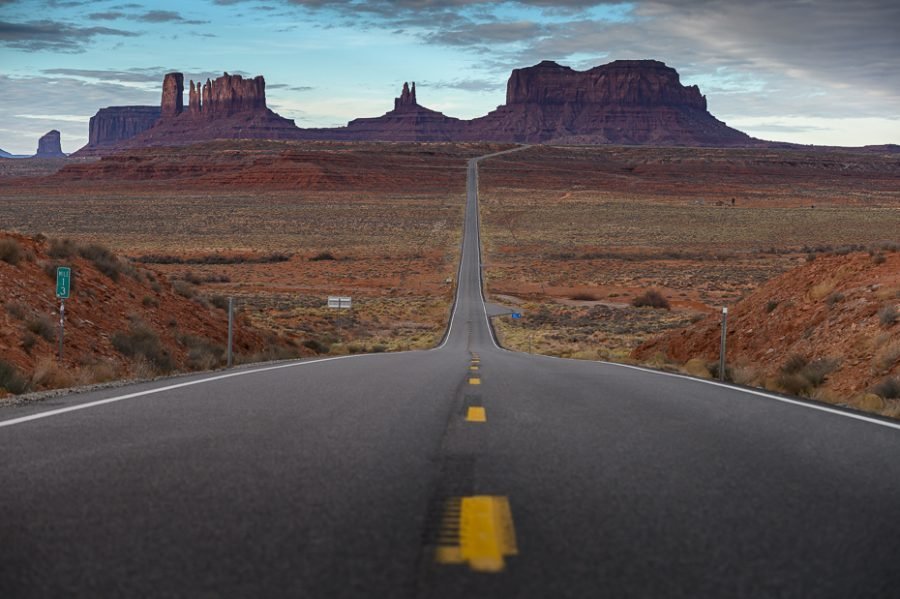
Two to three days, and the most recognizable landscape in American film: the Mittens and Merrick Butte rising from the valley floor inside the Navajo Nation. Monument Valley is a Navajo tribal park, and the seventeen-mile valley drive is only the beginning — the valley floor beyond the public loop is seen properly on a tour led by a Navajo guide, which adds the arches, the petroglyphs, and the living context of a place that is not a backdrop but a homeland. Combine with the Four Corners monument (the only point where four states meet, run by the Navajo Nation) and, time allowing, Antelope Canyon and Horseshoe Bend near Page. It is the shortest route here and the one people describe in the most superlatives per mile.
Planning any of them: season, beds, and budget
Three facts govern all seven routes. Season: the desert Southwest in summer means temperatures past 100°F and monsoon storms building in the afternoons; winter means snow at the higher parks — Bryce sits above 8,000 feet and the Grand Canyon’s North Rim closes for the season entirely. Spring and autumn are the prime windows nearly everywhere on this list. Beds: in-park lodges sell out six to twelve months ahead for peak dates and are worth the planning for the dawn-and-dusk access alone; failing that, the gateway towns named above exist precisely to serve each park. Money: these routes are naturally thrifty trips — the scenery is the entertainment — and the money discipline in how to plan a national park road trip on a budget, built around the annual pass, camping options, and cooler-based food, applies to every mile of them.
The seven routes at a glance
Grand Circle: about 1,400 miles, 7–10 days — five national parks plus the Grand Canyon, the complete tour. Route 66 (Southwest stretch): 4–7 days — neon, diners, and Americana from Kingman to Santa Fe. Big Bend + Marfa: 3–4 days — remote Texas desert and an art town, maximum solitude. Sedona + Verde Valley: 3–4 days — red rocks, a swimming hole, a ghost town. Grand Canyon + Sedona: 5–7 days — the Arizona greatest hits, taken slowly. US-50 + Great Basin: 3–4 days — the loneliest road, caves, and ancient pines. Monument Valley + Four Corners: 2–3 days — the iconic buttes with Navajo guides. Notice how the lengths ladder: a long weekend buys routes three, four, six, or seven; a week buys one, two, or five; and two weeks buys the Circle plus whichever spoke your heart picks.
The 3-day blitz, for the time-poor
If three days is what exists, take this concentrated dose: fly into Las Vegas, spend day one on Valley of Fire in the morning — Nevada’s oldest state park, all red sandstone and petroglyphs — and Hoover Dam in the afternoon, both under ninety minutes from the Strip. Day two belongs to Zion, two and a half hours away: the canyon shuttle, one real hike, the drive up the Mount Carmel highway at golden hour. Day three is the choice between Bryce’s amphitheater at sunrise or a return through the Virgin River Gorge at a pace that allows stopping. It is a trailer for the full feature, and it works exactly as intended: nearly everyone who drives it starts planning the Grand Circle in the rental-car return line.