
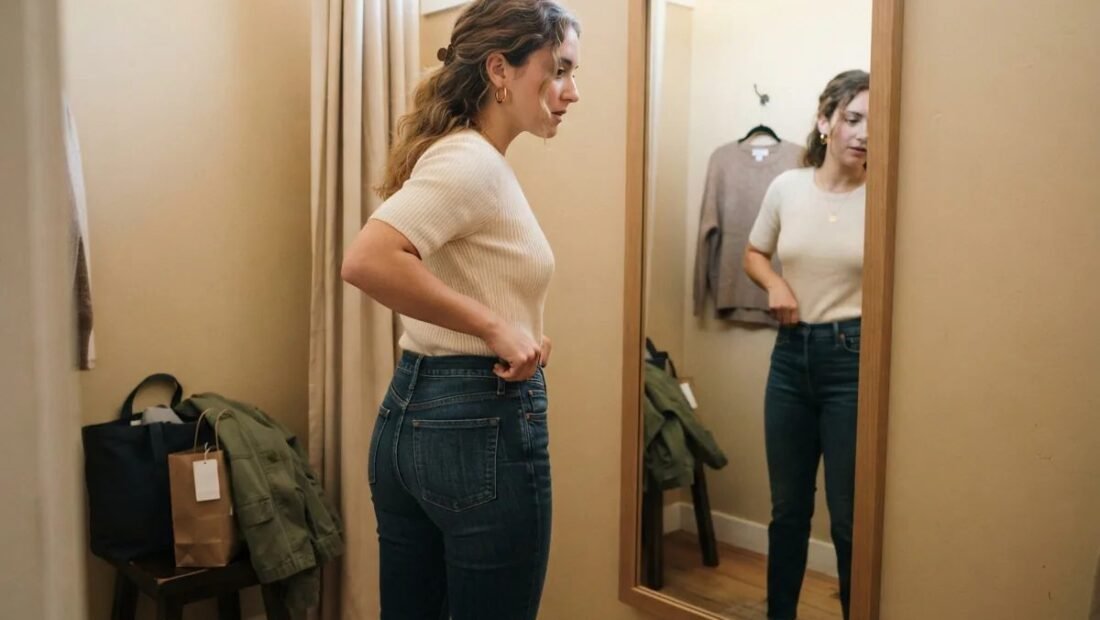
If your waist and hips differ by ten inches or more, standard jeans are not failing you by accident — they are drafted for a straighter ratio, and the fitting room math will defeat you every time: the pair that fits your hips gaps at the back waistband, and the pair that closes at your waist will not make it past your thighs. So how do you actually find jeans that fit a curvy body?
The short answer: shop curvy-fit cuts (they exist, and they are drafted with more room in the hip and thigh relative to the waist), choose a mid-to-high rise of about 9 to 11 inches, keep stretch in the 1 to 3% elastane window, buy the pair that fits your hips and thighs, and have the waist taken in — a $15 to $25 alteration that turns a good pair into a custom pair. Everything below is the detail behind those five moves: why rise matters more than brand, how to read a fabric label like a professional, the tests to run in the fitting room, and the questions curvy shoppers ask most.
Start with the cut: “curvy fit” is a real pattern, not a marketing word
Standard jeans are graded from a fit model whose waist-to-hip difference is modest. Curvy-fit lines — most major denim brands now offer one, often labeled “curvy,” “curve,” or “hourglass” — are patterned from a different block: smaller at the waist relative to the hip, more room through the seat and thigh, and often a contoured (yoke-shaped, higher-at-the-back) waistband that closes the infamous back gap by design. This is the single largest upgrade available to you, larger than any brand loyalty or price jump, because it changes the geometry instead of asking your body to negotiate with the wrong geometry. If a brand’s standard line has never once fit, its curvy line is not a gimmick aimed at you — it is the same company admitting the block was the problem.
Rise matters more than brand
Rise — the distance from crotch seam to waistband — decides where the jeans hold you. Mid-to-high rises, roughly 9 to 11 inches, contain and smooth: the waistband lands at a narrower part of the torso, the seat stays covered when you bend and sit, and the whole silhouette reads as intentional. Low rises create the gap-and-muffin-top combination simultaneously and will fight a curvy body all day. Within the high-rise family, front rise shapes the tummy (a slightly higher front with a contoured band is the comfortable version), while back rise determines whether the waistband stays put when you sit. Check both in the fitting room with the sit-down test below. Petite frames should watch total rise carefully — 11 inches on a short torso can reach the ribs — and look for petite curvy ranges, which scale the rise and the inseam together.
The stretch window: 1 to 3 percent
The fabric label is a fit document. Jeans with 1 to 3% elastane (or a modern equivalent fiber) have exactly the give a curvy body needs through the hips and thighs while the denim still holds its shape through the day. At 0% — rigid denim — fit must be perfect at purchase, because nothing will forgive; rigid can be superb once broken in, but it is the expert level. Over 3%, the clock starts: high-stretch jeans feel miraculous in the fitting room and bag out at the knees and seat by noon, because elastane at that proportion relaxes faster than cotton recovers it. The sweet spot also washes and wears longer. One more label note: cotton-rich blends with a touch of polyester hold shape better than pure cotton-stretch, at a small cost in that classic denim feel — a trade most daily wearers should take.
The waistband is the whole battle — win it with a tailor
Here is the strategy that ends the fitting-room war: fit the largest circumference first. Buy the pair that fits your hips and thighs comfortably, accepting the waist gap, then have a tailor take in the waistband — typically $15 to $25, a few days, and the transformation is total. This is standard practice among people who look consistently great in jeans, and it inverts the usual advice (never size for the waist and squeeze the hips). A contoured or “no-gap” waistband off the rack reduces the alteration needed; an elastic-insert waistband hides the adjustment entirely. Either way, budget the alteration into the purchase price when comparing pairs: $40 jeans plus $20 of tailoring beat $90 jeans worn with a belt cinching fabric into folds, on fit, on comfort, and usually on cost per wear. Refinery29’s plus-size jeans picks and fit notes are a good current survey of which brands’ curvy cuts shoppers rate highest.
In the fitting room: four tests that predict real life
Run these before the tags come off. The sit-down test: sit fully, cross your legs, and bend as if tying a shoe — the waistband should neither dig nor gap open, and you should be able to breathe and forget the jeans. The two-finger check: at the back waistband, room for two fingers is comfortable ease; a whole hand means the gap will grow. The thigh pull: pinch the fabric at mid-thigh — you want a little to pinch; fabric under total tension will wear through faster at the inner thigh, the most common death of curvy jeans. The mirror-from-behind: check that the yoke and pockets sit proportionately — pockets placed too wide or too small exaggerate; centered, slightly angled pockets flatter. Walk the length of the store too; hems, rise, and waistband behavior all reveal themselves in motion.
Washes, lines, and making them look expensive
Dark, uniform washes and clean lines (no heavy whiskering, no contrast fading across the thigh) are the reliable flatterers — they create one long line and work from casual to dressed-up. That versatility matters: the same dark curvy-fit pair that runs errands all week can carry a dinner with the right top and shoes, as how to dress up jeans for a nice dinner demonstrates. Mid-tone washes are fine in straighter-leg and relaxed cuts. Treat extreme distressing and ultra-light washes as styling choices rather than fit tools — they draw the eye and add visual width exactly where the fading sits. And care for the fit you bought: wash cold, inside out, and skip the tumble dryer when you can, since heat is what ages elastane — the difference between jeans that fit for two years and jeans that quit in six months is mostly laundry.
Front details that quietly decide comfort
Two design choices at the front of the jean deserve the same attention as rise and stretch. The first is the closure: a standard zip fly in a curvy cut is fine for most people, but button flies distribute tension across several points and bother some wearers less at the waist — try both if a brand offers the choice. The second is the so-called tummy panel or smoothing front: some curvy lines build a firmer front pocket construction that lies flatter under tops. Opinions divide honestly here — they do smooth, and they do add a layer of fabric that can feel warm — so treat them as a try-on question rather than a rule. What is not a matter of taste is rise consistency between sizes: when you take two sizes into the fitting room (always take two), measure the rise of each against your hand, because grading between sizes sometimes changes rise more than waist, and the size that looks right can be the one whose rise quietly dropped an inch.
Questions curvy shoppers ask most
Are skinny jeans over for curvy figures? No — silhouette is about balance, not bans. A curvy-fit skinny with the right rise remains an excellent base for longer tops, blazers, and boots. Straight-leg and relaxed cuts are having their fashion moment and are genuinely easier fits for many curvy bodies, but “flattering” is decided by rise, waistband, and proportion on your frame, not by the trend cycle.
What inseam works for petites with curves? Aim for the brand’s petite or short inseam (often 26 to 28 inches) in the curvy cut, so the knee break and taper land where the designer intended; hemming a regular length is the fallback, and a tailor can preserve the original hem for a few dollars more.
Why do my jeans always wear out between the thighs? Friction plus tension. A slightly roomier thigh fit, rotation between two pairs rather than daily wear of one, and cotton-poly blends all extend life; the pinch test in the fitting room is your early-warning system.
The through-line of every answer above: the problem was never your body negotiating badly — it was a pattern drafted for a different ratio. Buy the curvy block, respect the stretch window, fit the hips and tailor the waist, and jeans become the easiest thing in your closet instead of the hardest.

5 Comments