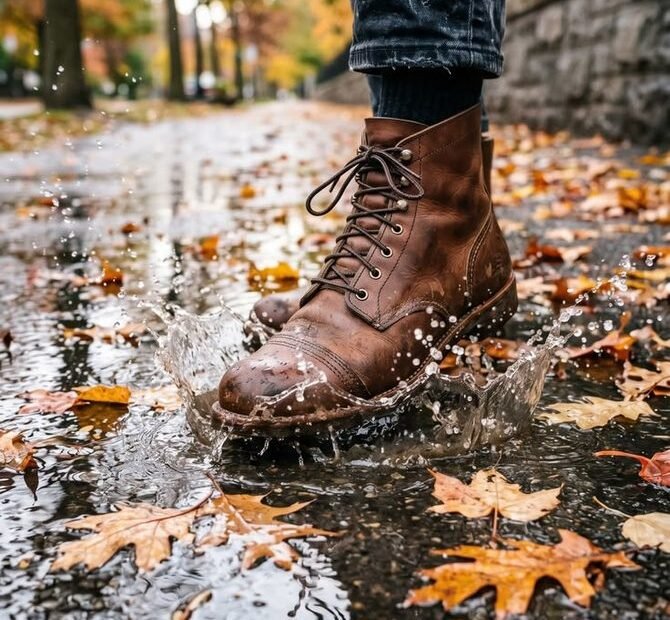
One surprise downpour can take a good pair of leather boots from rich brown to water-stained and dull — and the real damage is rarely the day they get wet. It is the weeks after: leather dried too fast by a radiator, cracking at the flex points; water marks blooming because nobody conditioned the hide; soles quietly separating because the boots were put away wet. Rain itself does not kill boots. Neglect after rain does. Protecting leather boots is a routine of five parts — condition, waterproof, dry properly, rotate, and maintain the soles — and none of it takes more than a few minutes at a time.
What you need
The kit is short and lasts for years: a quality leather conditioner (cream conditioner for dress boots, a heavier oil-based one such as mink oil for work boots), a waterproofing spray or a tin of wax-based waterproofer, a soft brush and a clean cloth, newspaper or cedar shoe trees for stuffing, and a spare pair of laces. One caution before anything goes on the leather: test every product on a hidden spot, like the inside of the heel, first. Oils and waxes darken most leathers — sometimes permanently — and the time to discover that is on a patch nobody sees.
Step 1: Clean the boots before you treat them
Waterproofing over dirt seals the dirt in, so start clean. Brush off dried mud with a stiff brush — never wash mud off under a tap while it is wet, which just spreads it into the grain. Wipe the boots down with a slightly damp cloth, clean the welt (the stitched seam where upper meets sole, where grit gathers and does real damage), and let them dry at room temperature until they no longer feel cool and damp to the touch. Salt stains from winter roads deserve their own pass: a cloth dampened with a half-and-half mix of water and white vinegar lifts the white tide-marks, and it matters, because dried salt keeps pulling moisture out of leather long after the puddles are gone.
Step 2: Condition the leather — every two to three months
Leather is skin; it stays supple because of oils in it, and rain, heat, and time strip those oils out. Conditioning replaces them. Apply a pea-sized amount of conditioner per boot with a soft cloth, work it in with small circles, let it sit for fifteen minutes, then buff off the excess. Boots worn weekly want this every two to three months; boots that live in a cupboard, twice a year. Two mistakes undo the good: over-conditioning, which leaves leather limp and greasy and can soften it too much around the seams, and conditioning dirty boots, which is just polishing mud. If the leather drinks the first coat instantly and still looks thirsty, a second thin coat is fine — thin coats, always.
Step 3: Waterproof while the leather is fed
Conditioning keeps leather healthy; waterproofing keeps the next downpour out. The two main families work differently. Sprays lay an invisible coating on the surface: hold the can about six inches away, spray evenly, let the boots dry fully, then apply a second coat — two light coats beat one heavy one, which can dry patchy. Wax-based proofers are worked into the leather with a cloth or your fingers and give deeper, longer protection, at the price of darkening the color and flattening the shine; they suit work boots and country boots better than polished dress boots. Specialist guides walk through the full process with timings — WikiHow’s walkthrough for waterproofing leather boots is a clear one to follow along with. Whichever you use, waterproof before the wet season rather than after the first soaking, and renew it when water stops beading on the surface.
Renew the proofing on evidence, not on the calendar. Run a tap over the toe of the boot: if the water beads and rolls off, the coating is alive; if it darkens the leather in a spreading patch, the leather is drinking again and it is time for another round. In a wet season of regular wear that usually means every few weeks for sprays, and a couple of times a season for worked-in wax.
Step 4: After a soaking, dry them the slow way
Sooner or later the boots will get properly wet, and the next twenty-four hours decide whether it matters. Take out the insoles if they come out. Stuff the boots loosely with newspaper — it draws water from inside while holding the shape — and replace the paper after a few hours if it is soaked through. Stand the boots in moving air at room temperature, away from radiators, fires, and direct sun: heat dries the outside faster than the inside, and that mismatch is what cracks leather. Leather needs a full day, often longer, to dry through. Putting boots away in a cupboard while they are still damp inside invites mould and a smell that no amount of airing quite removes.
Step 5: Rotate pairs through the wet season
Because proper drying takes at least twenty-four hours, wearing the same boots daily in a wet spell means they never fully dry — and leather that never dries weakens, stretches out of shape, and starts to smell. Two pairs worn in rotation fix this completely: each pair gets its rest day to dry and recover, and both pairs last far longer than either would alone. On rest days, keep cedar shoe trees in them if you have them; cedar absorbs moisture and odor while holding the shape, which is also the simplest way to keep the toe box from collapsing into creases.
Step 6: Resole before it is too late
Soles are the part of the boot designed to be sacrificed, and resoling at the right moment is the cheapest life-extension in all of footwear — typically in the region of forty to seventy dollars to have a worn sole replaced, against the price of new boots. The moment to act is when the tread is worn thin or the heel is worn down at an angle, but before the wear eats into the midsole or the upper. Past that point, water starts wicking up through the worn sole into the boot, and the repair stops being economical. While you are looking at soles, check the welt stitching and treat any loose threads as an early warning, not a detail. The same habit of small, regular care protects every shoe you own — the routine in how to keep white sneakers clean every day runs on exactly the same principle: little and often beats the occasional rescue.
Suede and nubuck: similar boots, different rules
Everything above applies to smooth leather. Suede and nubuck — the matte, velvety leathers — break most of the rules if you treat them the same way. Do not condition suede with creams or oils, and do not wax it: liquids mat the nap and darken it in patches that never quite even out. Suede gets its own spray — a protector made for suede and nubuck — applied before first wear and renewed through the season, and its cleaning tool is a stiff suede brush and a suede eraser, used dry, to lift marks and revive the nap. If suede boots do get soaked, the drying rules are the same (stuff, air, patience, no heat), but brush them once dry to raise the nap again. Knowing which leather you own is the whole game here: when in doubt, the maker’s care label or website will say, and guessing wrong is the expensive option.
Storage: where boots spend the other 360 days matters too
Rain protection does not end with the weather. Boots stored crushed in a pile lose their shape at the ankle and crease where they fold; boots stored in a steamed-up plastic box can mildew. Stand them upright, ideally with boot trees or a pair of rolled magazines inside to hold the leg, in a dry place with some air moving. Before a summer put-away, give them the full sequence — clean, condition, and only then store — because dirt and salt left sitting in leather for months keep working the whole time. Five minutes in spring saves the boots in autumn. Storage is also where rotation quietly pays off again: two pairs, each rested and stored properly between wears, will outlast three pairs worn hard and thrown in a heap.
For the worst weather, choose waxed leather
If your boots live a genuinely wet life — muddy walks, wet commutes, standing water — consider a pair in waxed or oiled leather for those days. The wax is in the hide from the start, so the boots shrug off water rather than relying on a coating you must renew, and small scuffs buff out with a thumb’s warmth. Keep the polished pair for ordinary rain and the waxed pair for the worst of it, and rain stops being a threat to your footwear at all. That, in the end, is the whole system: feed the leather, seal it, dry it slowly, rest it, and repair the soles on time — five small habits standing between a downpour and a pair of boots that last a decade.