The invitation says “garden celebration, 4 p.m.” — outdoors, on grass, in ninety-degree heat, followed by dinner and dancing until late. Summer weddings are the most joyful events in the calendar and the easiest to dress badly for, because they stack four problems at once: heat, grass, a dress code written in code, and photographs that will outlive you. Most guest outfits fail on one of six predictable mistakes. They are listed first, so you can stop making them, and the correct formulas follow — for women and for men, since the men’s version of every mistake exists too.
Mistake 1: Wearing white, cream, or anything that photographs as bridal
The oldest rule is still the first rule: the bride’s color family is off-limits — white, ivory, cream, and the pale blushes and champagnes that read as white in photographs and in person at twenty feet. “But it has a pattern” rescues a dress only if the pattern clearly dominates; a white dress with small flowers is, to every camera at the wedding, a white dress. The same family of courtesy covers the wedding party: if you happen to know the bridesmaids’ color, do not match it exactly, and never aim to outshine the couple — sequins that compete with the bride’s dress in flash photography are a story told about you later. These rules are not about fussiness. They are the guest’s one job: to be pleasantly dressed in the background of somebody else’s big day.
Mistake 2: Stilettos on grass
The garden wedding’s signature sound is a stiletto heel aerating the lawn, one sinking step at a time — followed by the guest walking on tiptoe, then barefoot, then with ruined heels. Outdoor ceremonies and receptions mean ground that is soft, uneven, or both. The fixes are well established: block heels, wedges, or elegant flats distribute weight and stay above the turf; heel stoppers (the small plastic caps that widen a stiletto’s base) genuinely work if you love a pair you already own. Cobblestones, gravel paths, and decking with heel-swallowing gaps all vote the same way. Choose the shoe for the terrain you are given, not the terrain in the showroom.
Mistake 3: Ignoring the fabric — the summer-specific killer
In July, fabric matters more than cut, color, or brand. A fully-lined polyester dress is a wearable sauna: it traps heat, shows sweat early, and keeps both all evening. Natural and breathable fabrics are the entire game — linen and linen blends, cotton and cotton voile, silk, chiffon, and light crepe — in constructions with some air in them: A-lines, wraps, and relaxed bodices rather than body-conscious synthetics. Color plays a supporting role: dark shades absorb heat in direct sun but hide sweat better; light shades are cooler and less forgiving. The professional compromise is a mid-tone or a print, which conceals the evidence while staying seasonally right. Men are not exempt: the dark wool suit in August sun is the male version of this mistake, addressed below.
Mistake 4: Guessing the dress code instead of decoding it
Invitations speak in code words, and misreading them produces the two visible failures — the guest in a gown among sundresses, the guest in shorts-adjacent chinos among suits. The working decoder: “cocktail attire” means a knee-length or midi dress (or a sharp jumpsuit) and a suit or blazer with trousers for men — festive, not formal. “Garden” or “semi-formal” drops half a step: sundresses in good fabric, sport coats, open collars possible. “Beach formal” means long or midi dresses in light fabric, linen suits, and shoes that survive sand — formal silhouettes, summer materials. “Black tie” is the only code that demands a gown or full evening dress and a tuxedo. When the invitation is genuinely ambiguous, the couple’s wedding website usually expands on it, and the venue itself is a hint: a ballroom and a barn are telling you something. MasterClass’s wedding guest attire guide decodes the standard codes in one place if you want the reference version.
Mistake 5: No layer for the second half of the day
Summer weddings are two climates: the ceremony’s heat and the evening’s air-conditioning or after-dark cool. The guest who planned only for 4 p.m. spends 9 p.m. shivering in a sleeveless dress while the speeches run long. Bring one layer — a wrap, a fine cardigan, a tailored jacket — chosen as part of the outfit rather than grabbed from the car, and check the venue’s indoor temperature reputation if you can. Men have the same issue in reverse and solve it by choosing a breathable blazer they can shed and recover. One layer, deliberately chosen, is the cheapest insurance in the whole ensemble.
Mistake 6 (for men): Defaulting to the interview suit
The male summer-wedding uniform error is arriving in the dark navy or charcoal wool suit, white shirt, and conservative tie that he wears to work — technically correct, seasonally punishing, and visually off-duty at a garden party. Summer asks for lighter everything: suits in light grey, tan, stone, or pale blue; linen or linen-blend jackets (the rumple is part of the charm and everyone at a summer wedding knows it); loafers or suede shoes instead of black Oxfords; and at cocktail-level and below, the tie is optional — an open collar with a good jacket reads deliberate, not unfinished. Add a pocket square or a watch rather than more formality. The test is the same as the women’s: does this look like it belongs at a celebration in July, or at a deposition in July?
Heat survival: the tactics experienced guests use
Beyond the outfit itself, a handful of small behaviors separate the guests who glow from the guests who melt. Eat something before you arrive and hydrate early — outdoor ceremonies plus champagne on an empty stomach in 95-degree heat end evenings early. Choose hairstyles that accept humidity rather than fighting it: updos, braids, and natural texture survive; a precision blowout in August humidity has a half-life measured in minutes. Blotting papers beat powder for shine control, and powder beat liquid foundation for longevity; set makeup in the morning expecting a ten-hour day. Sunglasses are fine for a sunny outdoor ceremony but come off for group photographs and, politely, during the vows if you are near the front. Keep a small rescue kit in the car or bag — blister plasters, a travel stain pen, safety pins, pain relief — because summer weddings are long, grass is real, and one saved wardrobe malfunction will make you the quiet hero of somebody’s wedding story. None of this is glamorous. All of it is the difference between an outfit that wins at 4 p.m. and an outfit still winning at 10.
The formulas that work
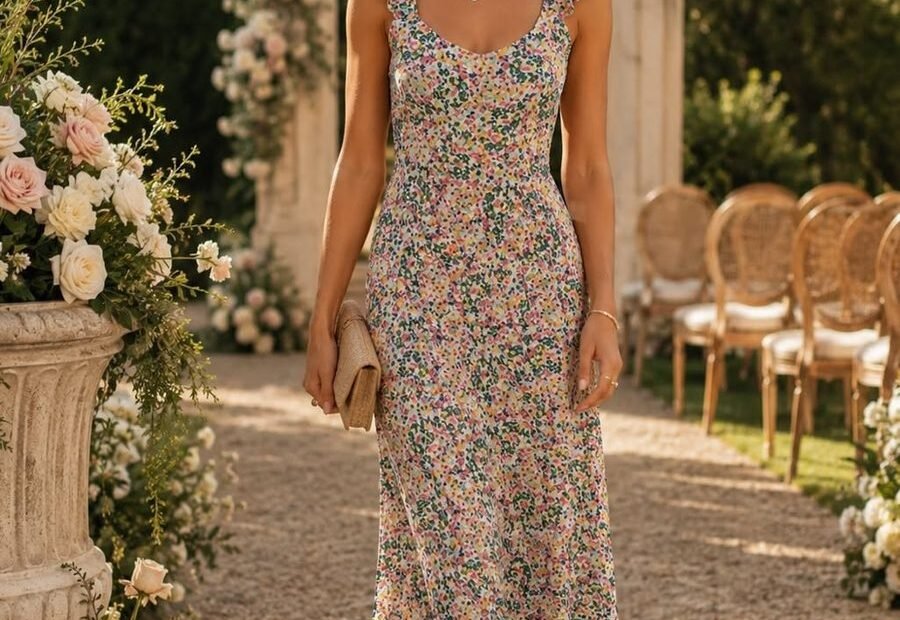
For women: a midi or knee-length dress in linen-blend, chiffon, or light crepe, in a color or print that is not in the bridal family; block heels, wedges, or dressy flats matched to the terrain; one layer for the evening; small bag, sunscreen applied before dressing (and minded around light fabrics), and the outfit road-tested for sitting, eating, and dancing — because all three are guaranteed. For men: a light-colored or breathable suit or blazer-and-trousers combination, a shirt that can lose the tie gracefully, suede or leather loafers, and the same layer logic. Both formulas share one final step: check a full-length view in daylight before the day, because summer light is merciless about thin fabrics and pale colors in ways bathroom mirrors conceal. One more professional trick covers the whole event: bring the second pair of shoes. Elegant flats in the car transform hour five — dancing, lawn games, the walk back at midnight — and nobody in the history of weddings has regretted being the guest whose feet survived. The outfit gets you photographed; the planning gets you to the end of the night still enjoying the photograph’s occasion.
Can you wear black to a summer wedding?
Yes — the old prohibition has genuinely faded, and black is a normal guest color at most modern weddings, provided you summer-ify it: light fabric, some skin or movement in the silhouette, and warm or colorful accessories so the effect is “evening” rather than “funeral in July.” If the couple is traditional or the wedding is a daytime garden affair in a conservative community, a black dress may still raise an eyebrow or two — context, as always, outranks internet rules. When in doubt, deep jewel tones and rich florals are the perennially safe middle path.
Get the six mistakes out of the way and summer wedding dressing becomes what it should be: a formula, chosen once, worn with confidence, and forgotten about by the time the dancing starts. If the budget is the sticking point rather than the rules, affordable wedding guest dresses under $100 proves the formula does not need a designer label to work — only the right fabric, the right shoes for the ground, and the confidence that comes from having decoded the invitation instead of guessing at it.