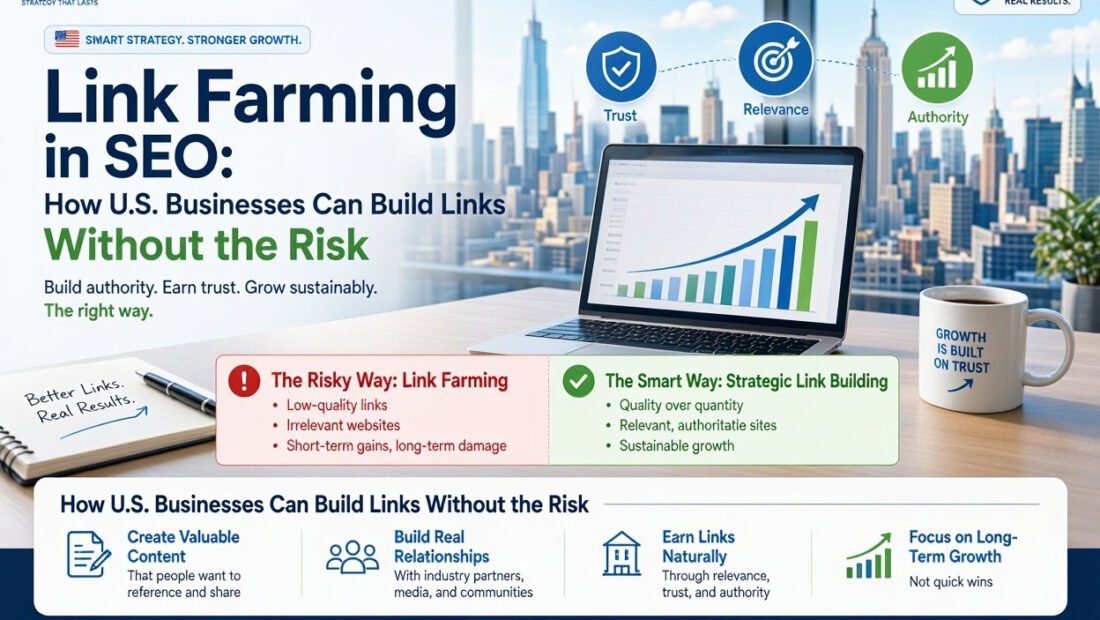
A business can spend months improving its website, then put that work at risk by chasing quick backlinks. Link farming in SEO is one shortcut that can look convincing on a report: a sudden rise in links, a network of polished-looking sites, and promises of fast ranking gains. But links from websites built mainly to manipulate search results may bring little lasting value and can expose a site to search-engine penalties. For a small business deciding where its marketing budget belongs, the useful question is not simply how to get more links. It is how to earn links that make sense to real readers.
The distinction matters for companies at every stage, from a local service business to a startup preparing an app launch. Search visibility can support sales, but a backlink count alone says little about whether a campaign is working. Before paying for placements or accepting a bundle of links, look at how the sites operate, who reads them, and whether the proposed article would have a reason to exist without the SEO benefit.
What link farming means in practice
A link farm is a site, group of sites, or coordinated publishing arrangement created primarily to exchange or sell links that influence search rankings. Some are obvious: pages packed with unrelated links, thin articles published in bulk, or a network of sites that link to one another without a clear editorial purpose. Others look more professional, with distinct branding and readable content, but still publish mainly to place paid backlinks.
Not every paid placement or guest article is automatically a link farm. A relevant article can serve an audience and disclose a commercial relationship while still being useful. The warning sign is manipulation as the main purpose: sites accept almost any topic, publish little original reporting or expertise, and treat links as inventory. A practical guide to spotting link farms in 2026 can help marketers recognize patterns before committing a budget.
Why businesses still get tempted
Link-building offers often appeal because the output is easy to count. A vendor may promise dozens of placements for a fixed fee, while legitimate outreach can take weeks and produce no guaranteed result. For a business under pressure to show progress, a spreadsheet of new backlinks can seem more persuasive than slower work on useful content, customer reviews, or public relations.
That shortcut can be costly in less visible ways. Search engines may ignore low-quality links, reducing the value of the spend. In more serious cases, manipulative practices can lead to ranking losses or a manual action that takes time and expertise to address. Even without a formal penalty, links from irrelevant or untrusted sites can do little for reputation. The business has paid for a metric, not necessarily for customers, referral traffic, or credibility.
A quick review before you buy a placement
Inspect the publisher as a reader, not just as an SEO buyer. Open several recent articles and ask whether they are written for a consistent audience. Check if the site has identifiable editors or authors, a coherent subject focus, and original material with useful detail. Then follow a few outbound links. If articles routinely link to unrelated businesses in different industries, or every page appears designed around commercial anchors, step back.
Look at the proposed article itself. Does it answer a real question or provide experience a reader could use? Is the link relevant to the surrounding discussion? Would the publisher still have a reason to run the piece if the backlink were removed? If the answer to that last question is no, the placement may be serving the campaign more than the audience.
- Check topical fit: A finance publication linking to a finance tool is more plausible than a general site linking indiscriminately to unrelated products.
- Review publishing patterns: A flood of thin, repetitive posts is a stronger concern than a modest archive of substantial articles.
- Ask how links are handled: Paid or sponsored links should be disclosed and appropriately qualified under search-engine guidance.
- Request evidence beyond volume: Ask about readership, referral visits, editorial standards, and the actual pages where links will appear.
What to fund instead
There is no single replacement for link farming, because sound link acquisition grows from something worth citing. A company can publish original research, explain a complicated process, create a useful calculator, or offer a specialist’s perspective to a publication with a genuine audience. Local businesses may earn mentions through community partnerships and useful local resources. These approaches take more planning, but they can bring visitors and recognition even when a search ranking changes.
Guest articles can also be part of a sensible strategy when the outlet is relevant and the contribution is written for its readers. Before using a guest-posting service or arranging placements directly, establish clear standards: no irrelevant sites, no guaranteed ranking claims, and no content published solely to carry an exact-match link. Treat the article as a piece of publishing, with an audience and an editorial reason, rather than a container for a backlink.
Budget decisions should reflect the whole business. A startup may need product development, analytics, or customer acquisition before it needs a large link campaign. For example, a company planning a mobile product should first understand its development costs; this U.S. mobile app development pricing breakdown is one reference point for sizing that commitment. Osdire is a freelance marketplace with programming and marketing categories, among others, so the example also illustrates why businesses should compare the purpose and cost of different kinds of work rather than treating SEO as an isolated line item.
The bottom line
Link farming in SEO sells certainty in a field where durable results usually come from relevance, useful work, and trust built over time. A suspiciously cheap package of links may look efficient, but its value depends on who publishes them and why. Review the site, the article, the link treatment, and the intended reader before paying. If a placement would not make sense without its backlink, spend the budget on something people would genuinely want to read, cite, or share.