
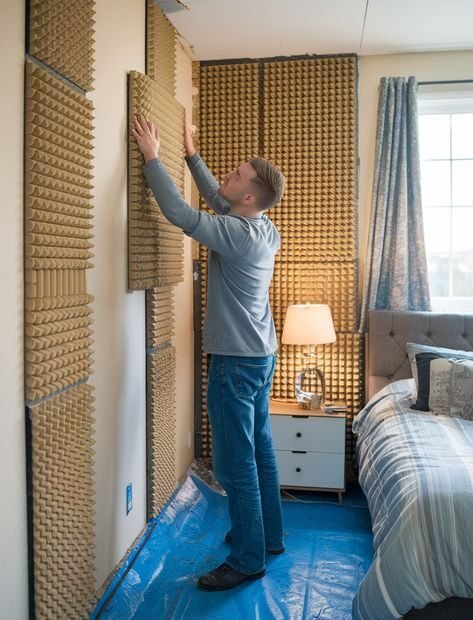
Picture the room: a bedroom on the day side of a thin apartment wall, occupied by someone who sleeps while the world is awake — a night-shift nurse, a new parent trading shifts, a student under a neighbor who has taken up the drums. The problem feels structural and the quotes for real soundproofing sound like it, too: thousands per room. But sound, like water, mostly escapes through gaps — and gaps are cheap. Follow one sleeper’s weekend of fixes, in the order they were done, and note the pattern: each roughly $25-to-$150 step bought a share of the quiet, until drums that were a concert became a rumor. A realistic expectation for the whole budget program is a 30 to 50 percent cut in perceived noise — not silence, but sleep.
Hour one: find the leaks
The sleeper’s first job was detective work, not shopping. Sound passes wherever air passes, so the inspection follows the air: the gap under the bedroom door (a hand’s breadth of light visible in most apartments), the unsealed door frame, hollow-core door itself, electrical outlets on the shared wall — back-to-back outlets are literal holes between homes — heating vents that duct the neighbor’s television straight in, and window frames with perished seals. A lit incense stick or a fingertip on a windy day finds the moving air. This audit costs nothing and decides the shopping list, because sealing flanking paths routinely outperforms the expensive headline acts like adding wall mass. It also reveals the one limit to keep in mind: structure-borne noise — footsteps and bass that travel through the building’s frame — is the hardest kind to block cheaply, and the fixes below address airborne noise, the voices, music and television that make up most complaints.
The door: $25 that behaves like $500
The first purchase was a door sweep and weatherstripping — about $15 for the sweep, $10 for foam tape around the frame, $25 in total. The reasoning deserves the emphasis: a gap of just 1 percent of a door’s area can transmit a startling share of the sound trying to pass, which is why so many nearly-solid doors perform so poorly. Sealed, the bedroom door stopped behaving like an open window. Where the door itself is a hollow-core featherweight, two upgrades exist: replace it with a solid-core door if the budget and the landlord allow, or add a layer of mass-loaded vinyl or a fitted panel to its inner face. But seal first — households regularly discover the $25 version was the fix, and the record of small, verified home improvements at Bob Vila’s home improvement guides is full of the same moral: the cheap seal outperforms the expensive panel installed over a leak.
Soft armor: curtains, rug, and the wall of books
Next came absorption, because hard bare rooms amplify whatever sound gets in. Heavy curtains over the windows — $40 to $100, dense fabric, hung floor-to-ceiling and wider than the frame — damped street noise and echo together. A thick rug with a dense pad, $80 to $150, killed the impact noise from the room below the floor’s other side and softened the room’s own acoustics. Then the shared wall got furniture as fortification: the bookcase moved against it, filled with books — irregular, dense, and free — with the bed relocated to the room’s far corner, since every meter from the source wall is free attenuation. Acoustic caulk, about $10 a tube and permanently flexible, sealed the baseboard lines and outlet boxes on the shared wall; foam outlet gaskets behind the cover plates cost pennies each. None of these steps is glamorous. Stacked, they changed the room’s character from echoing box to padded cell, in the best sense.
Masking: the honest cheat
At this point the drums next door were audible but no longer commanding — except in the silence between tracks, when the ear strains and finds them. The final budget step was not blocking but masking: a white-noise machine (or a fan with a full, steady tone) at low volume raises the room’s background floor so that intruding sounds have less contrast to stand out against. Masking is how open-plan offices and hotels survive; it does not reduce the noise, it reduces the noticeability, which for sleep is the metric that matters. Earplugs rated for sleep and a pair of comfortable sleep headphones extend the same idea for shift workers sleeping against daytime’s worst hours. Combined spending so far: roughly $200 and a weekend, for a room transformed from unusable-at-noon to genuinely restful.
The other two surfaces: ceiling and floor
The sleeper’s room shared one wall with the drums, but noise also arrives by the ceiling and floor, and both have budget answers. From above, footsteps and dropped objects are impact noise, fought best at their source — which is the neighbor’s floor, not your ceiling — but a thick rug in your own room protects the household below you, and it is worth being the neighbor you wish for. From below, voices and television rise through floor structures, and your defenses are mass and seal on your side: a dense rug with a heavy pad is again the workhorse, bookcases and upholstered furniture break up the room’s hard surfaces, and sealing the baseboard gaps where floor meets wall closes a surprising flanking path. Windows deserve a sentence of their own: a fitted interior window insert — an acrylic panel in a frame, removable for cleaning — can quiet a street-facing window noticeably for the cost of a nice dinner out, and it is the renter-friendliest item in this entire guide after the door sweep.
The renter’s toolkit: quiet without permission
Everything the sleeper did survives a landlord’s inspection because none of it is construction: sweeps and foam tape remove cleanly, caulk in baseboard gaps is invisible, curtains and rugs are furniture, the bookcase is a bookcase, and the white-noise machine plugs into the wall. Renters who need one step more can ask — in writing, politely, citing the actual noise — for permission to hang a second layer of drywall or fit a solid-core door, and landlords say yes more often than tenants expect when the request includes restoring the room at departure. What renters should not do is build unauthorized structure: the deposit is worth more than the decibels. The final renter’s tool is documentation itself — dated notes and phone recordings of the noise — because in the specific case of a neighbor’s drums at unreasonable hours, most leases and local ordinances already contain the remedy, and a paper trail is what activates it.
Measuring progress honestly: decibels and the ear
Expectations need one calibration before the verdict. Loudness perception is logarithmic: a reduction of about 10 decibels is what the ear reports as “half as loud,” and the budget program described here — seals, softening, masking — realistically delivers the equivalent of that halving for mid-frequency sounds like voices and television, which is why the 30-to-50-percent figure is stated as perceived noise rather than a laboratory promise. Phone sound-meter apps measure roughly enough to compare before and after in the same spot, though they flatter bass and should not be quoted to a landlord as evidence. Bass and impact noise — the drum’s low thump, the upstairs heel-strike — sit at the stubborn end of the spectrum, and the sleeper’s experience was typical: the melody of the problem vanished, the rhythm faded to a rumor. Judge the project by sleep, not by silence: a room in which daytime noise no longer wakes you is a success at $200, whatever a meter says, and a household chasing true zero through a shared wall should take the construction tier’s price seriously rather than buying a fourth rug.
When budget fixes are not enough
Some walls lose honestly. If the shared wall is a single layer of drywall on shared studs, if the noise is a home theater’s bass or a band’s practice schedule, sealing and softening will not finish the job, and the remaining answers are construction: a second layer of drywall with damping compound over the existing wall, resilient channel, sealed and staggered outlets — professionally, $2,000 to $5,000 per room, and genuinely effective. Renters should negotiate before building: a landlord presented with a documented noise problem sometimes funds the door or shares the drywall work, and the patching skills involved are the household kind — how to patch a hole in drywall yourself is the same family of work, one scale up. Our sleeper never needed the construction tier: $25 of seals, a wall of books, curtains, a rug and a masking machine delivered the 30-to-50-percent quieter room the budget promised — drums reduced, as promised, to a rumor, and sleep restored to the day side of the wall. That is the honest promise of budget soundproofing: not a silent world, but a room whose acoustics you have voted on — gap by gap, layer by layer, at prices that leave the construction tier looking like what it is, a last resort rather than a first step.




2 Comments