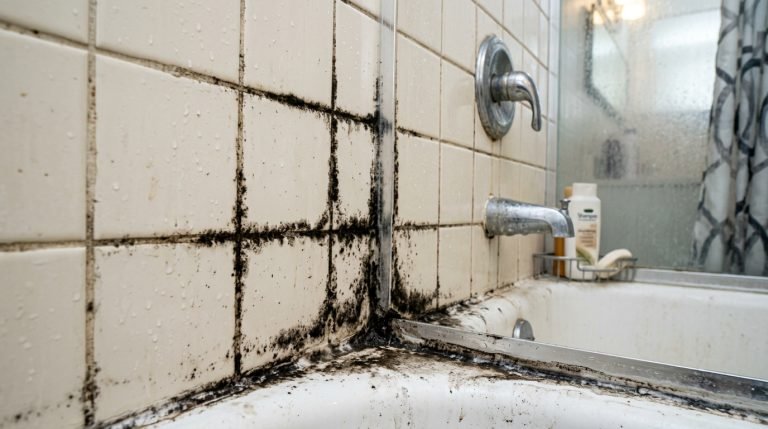
Scrub the black spots off the grout and they return within the month — not because the cleaning failed, but because the mold was never really the problem. Mold is a moisture report. It grows where water lingers: on grout fed by daily showers, on caulk lines that never dry, on the wall behind a slow leak nobody can see. Killing the visible growth without fixing the water is mowing a lawn and calling it landscaping. The questions below are the ones every homeowner with a spotted bathroom actually asks, answered in the order they matter — what it is, what kills it, when it is dangerous, when it is a professional’s job, and how to keep it from ever filing another report.
Is it mold or just mildew and grime?
Mildew is mold’s shallow cousin — a surface film, usually grey or white, that sits on top of tile, grout and caulk and wipes away with a bathroom cleaner and a brush. Mold proper roots into porous material: it returns in the same spots, looks black, green or pink-tinged depending on type and food source, and may smell musty — the smell is often the first honest signal, arriving before the spots. Soap scum and hard-water staining imitate both but do not grow, spread or smell. The practical distinction matters less than the shared conclusion: all three flourish under the same condition, a bathroom that stays wet, and all three are handled by the same sequence — clean, dry, ventilate. One place cleaning and mold truly intersect is the grout itself, and the best way to clean grout between tiles covers the scrubbing half of this job in detail.
What actually kills it — and what should never be mixed
For nonporous surfaces — glazed tile, glass, metal, sealed stone — a standard approach works: apply a mold-killing cleaner or a solution of detergent and water, let it dwell 10 to 15 minutes, scrub with a stiff brush or an old toothbrush, rinse and dry completely. For porous grout and caulk, household staples perform differently than folklore suggests: hydrogen peroxide at drugstore strength (3 percent) and undiluted white vinegar both penetrate better than bleach on porous material, because bleach’s active ingredient largely stays on the surface while its water feeds the roots beneath. Bleach has one more absolute rule, worth printing on the memory: never mix it with vinegar, ammonia or any acidic cleaner — the gas produced is genuinely dangerous. Moldy caulk, it must be said, cannot be cleaned back to life; once growth runs through the bead, the fix is to cut the caulk out, treat the joint, and re-caulk. That is an afternoon, not a renovation, and it ends the recurring spot in that corner permanently.
How big a patch is too big to handle myself?
The working line used by regulators is area: a patch smaller than about 10 square feet — a shower’s grout field, a window wall’s corner — is a homeowner-scale job with cleaning, protection and ventilation. Beyond that, or wherever mold covers wallboard, insulation or framing, the job changes character: disturbing a large colony releases heavy spore loads, and the source is usually a real water problem inside the wall. The the EPA’s mold guide sets out the same threshold and the safe-work basics — fix the water source first, contain the mess, and dry everything within 24 to 48 hours to stop regrowth. Wear gloves and a mask for anything beyond a wipe-down, run the exhaust fan, and keep children and anyone with asthma out of the room until it is clean and dry.
When should a professional take over?
Call a remediation professional when any of these are true: the affected area exceeds roughly 10 square feet; mold returns within weeks despite correct cleaning and ventilation (the signature of a hidden leak); the growth followed a flood, a burst pipe or a roof leak into wall cavities; the musty smell exists with no visible source; or anyone in the house has respiratory conditions that make exposure unwise. Legitimate professionals contain the work area, find and fix the moisture source, and remove affected material rather than spraying and painting over it — any contractor whose plan is only to spray should be shown the door. Professional remediation for a bathroom-scale job typically costs $500 to $3,000, priced by area and by how much material must come out. Ask for the moisture source in writing: a pro who cannot name it has not finished the diagnosis.
Is black mold the emergency it is sold as?
Calm, informed honesty helps here. Color alone does not identify a mold species — many common molds are dark, and the feared ones cannot be confirmed by looking. What is true for all indoor mold: it is an allergen and irritant, it can aggravate asthma and breathing problems, and it should be removed and its moisture source fixed — promptly, but without panic, evacuation or paying emergency prices to the first company that uses the scary name. Testing is usually unnecessary expense: if you can see it or smell it, the prescription is identical regardless of species — remove, dry, ventilate, fix the water.
Where mold hides: behind, under and inside
The visible spots are the colony’s flag, not its territory, and three hiding places explain most “it came back” stories. Behind the toilet and under the sink, slow supply-line drips and condensation on the tank feed growth on the wall and floor where nobody looks — check with a flashlight and a dry hand on every pipe run twice a year, and after any plumbing work. Inside the wall around the shower, a failing grout line or cracked tile lets each shower inject water into the cavity; soft or swollen drywall beside the tub, paint bubbling at the baseboard, or a musty smell localized to one wall are the signatures, and they outrank any surface patch in seriousness — that wall needs opening, drying and a fixed water path, not another spray. Under vinyl flooring and inside hollow vanity bases, trapped moisture from old leaks grows in the dark indefinitely. The discipline is simple to state: whenever mold is cleaned, spend five minutes hunting its water source with a flashlight, because mold that is only cleaned is mold that is merely between appearances.
Measuring what you cannot see: the humidity habit
Prevention becomes much easier with a number. A small digital hygrometer — under $15 — placed in the bathroom reports the room’s humidity honestly, and the target band is clear: below about 50 percent, surfaces dry too fast for growth to establish; sustained readings above 60 percent mean the fan is undersized, underused, or the showers are longer than the drying system. Watch the number fall after a shower to learn your fan’s true clearing time, then set the timer switch to that duration rather than guessing. In homes without exhaust fans — older bathrooms rely on windows — a small dehumidifier or a fan in the doorway after showers substitutes imperfectly but genuinely. Data turns “the bathroom feels damp” into a maintenance fact with a fix attached, which is the entire mold story in miniature: moisture is measurable, sources are findable, and growth is optional.
Which cleaner should I actually use?
The shelf of mold products resolves into four honest categories. Detergent and water — the unglamorous default — physically removes growth from hard surfaces and is the right start for most small patches, because removal, not sterilization theater, is the goal. Hydrogen peroxide at 3 percent penetrates porous grout and caulk better than bleach and leaves no dangerous residues, at the cost of lightening some colored materials — test a corner. Vinegar, used undiluted, handles mineral-flecked bathroom growth acceptably but smells like the process and must never meet bleach. Commercial mold removers, mostly bleach- or peroxide-based with surfactants, earn their price on large or awkward areas for their spray-and-dwell convenience. The label phrase “kills 99.9 percent” deserves translation: on a hard, pre-cleaned test surface, under lab conditions — your shower is none of those, which is why scrubbing and drying outrank brand selection. Whatever the bottle, the sequence from the earlier answers holds: apply, dwell 10 to 15 minutes, scrub, rinse, and dry the surface like you mean it.
How do I stop it coming back?
Prevention is three habits and one device. Habit one: run the exhaust fan during every shower and for 20 to 30 minutes after — the drying window when mold is decided. Habit two: squeegee the shower walls and glass; removing the water removes the hours of damp the growth needs, and it takes ninety seconds. Habit three: hunt drips — a weeping valve, a toilet that sweats and drips, a grout crack that wicks water into the wall — and fix them while they are small. The device is a timer switch on the fan, around $40, which runs the fan for 30 minutes after every shower automatically and removes human forgetfulness from the system; paired with a squeegee living in the shower, it is the cheapest anti-mold installation a bathroom can receive. Keep indoor humidity under about 50 percent, leave the shower door or curtain open between uses so the enclosure dries, and the black spots stop returning — because the report they were filing, the one about water, finally gets answered.