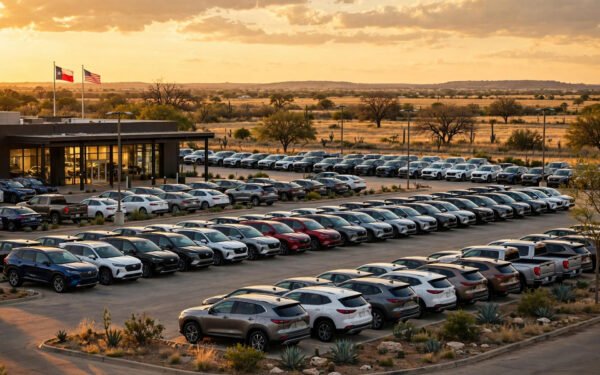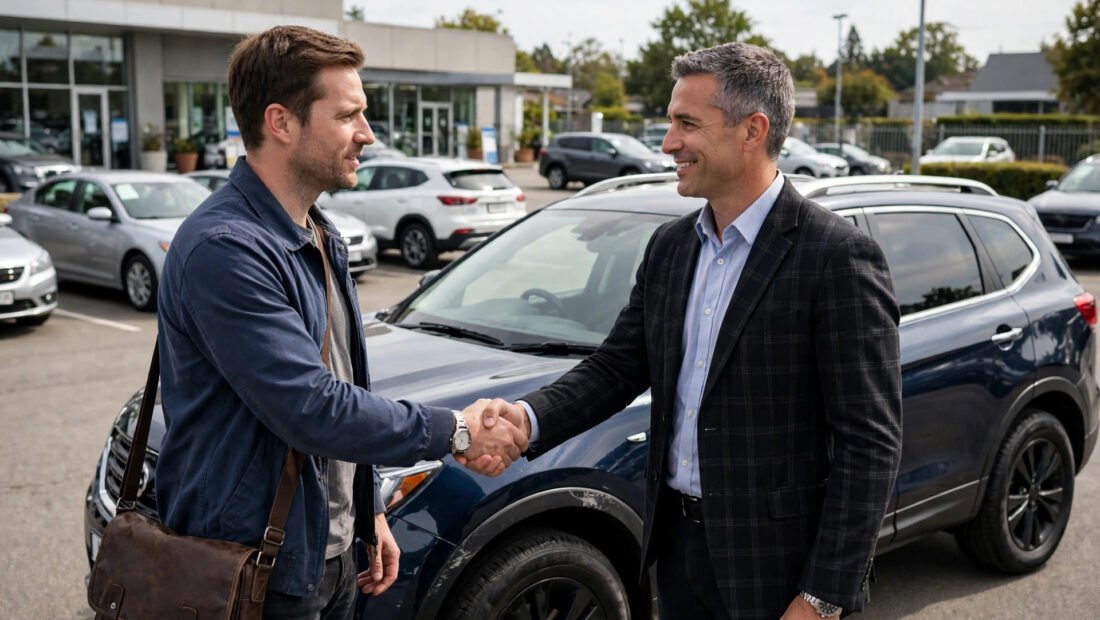
Maria did her arguing before she ever saw the car. On Friday night she printed three to five listings for the same model, same trim, within 100 miles of home, with prices and mileage she could point to. She read the $40 to $100 history report for the one she liked best — no title brand, no odometer flag, one minor accident disclosed and repaired years ago. And she booked an independent mechanic for the next afternoon, $150 to $250 for a full pre-purchase inspection, with a lift and no stake in the sale. When she walked onto the lot on Saturday, she was not hoping to be treated fairly. She had the numbers that make fairness hard to avoid.
Saturday morning: the test drive as evidence gathering
Maria arrived mid-morning and asked for the keys without talking price at all. Price talk before a drive helps the seller, not the buyer, because it locks the conversation to a car no one has tested. She started the car cold and listened for the first 30 seconds — a cold start tells you more than a warm idle. She drove a loop she had picked in advance: rough side streets for suspension noise, a highway merge for power and shifting, a hard stop from speed for brake feel, tight parking-lot turns for steering and tire scrub. She ran every switch she could reach — windows, locks, air conditioning on full, heat, infotainment, lights — because a dead feature found on Saturday is leverage, and the same feature found on Monday is a repair bill.
Back at the lot, she walked the car slowly with the salesperson a step behind. Tires mattered most in her notes: uneven wear, mismatched brands, and how much tread was left. She checked panel gaps, paint that did not quite match on one door, and the smell inside for smoke or mildew. She opened the trunk, lifted the mat, and looked for rust or water marks. None of this needed expert skill. It needed patience. A buyer who rushes the walk-around is telling the lot that condition does not matter, and every later claim about condition gets weaker because of that rush.
She also named her limit out loud to herself, not to the seller: walk away if the inspection found frame damage, a branded title the listing had not disclosed, or a transmission problem. Writing the walk-away lines before emotion enters is what makes them hold later. It is the same discipline that helps buyers shopping at the lower end too — the shoppers who do well with the best used cars under $15,000 in Texas are the ones who set their conditions before they fall for a clean detail job.
Early afternoon: turning the inspection into arithmetic
At the mechanic’s shop, Maria waited while the car went up on the lift. The report that came back was good and useful, which in car buying means specific. No frame damage. No flood signs — a check that matters in Texas, where Gulf storm cars can circulate for years after the water is gone. Engine and transmission sound. Two findings carried dollar signs: the tires were near the end of their life, and the front brakes would need pads and rotors soon. The mechanic priced the pair at about $1,200 in parts and labor at his shop.
Maria did not treat that number as bad luck. She treated it as arithmetic. A car needing $1,200 of tires and brakes is worth $1,200 less than the identical car that does not need them. She asked the mechanic to write the findings on his letterhead, with the estimate attached, and she kept the history report with it. Paper beats memory in a negotiation. A salesperson can argue with an opinion. Arguing with a signed inspection estimate from a licensed shop down the road is a different, shorter conversation.
She also checked the paperwork basics while she waited. She confirmed the VIN on the car matched the listing in more than one place, and she planned to match it again on the final buyer’s order. She asked whether the title was a clean Texas title — not salvage, not rebuilt, not flood-branded — and said she would need to see the Buyers Guide that Texas dealers must provide, stating whether the car was sold as-is or with any warranty. If a car is as-is, that means exactly what it says under Texas law: problems after the sale are the buyer’s, unless a separate written warranty says otherwise. Verbal promises do not change that. Anything the dealer promised to fix would have to be written into the order.
The negotiation: one number, not a monthly payment
Back at the desk, the first question was the monthly payment Maria wanted. She declined it politely and named the only number she would negotiate: the out-the-door total, including tax, title, and every fee. A monthly payment can be stretched, padded, and rebuilt with term length and add-ons until it hides the true price. An out-the-door number cannot hide. Everything after that moment derived from that single figure.
Her first offer was 8 to 12 percent below asking, which is the typical opening range on normal used inventory, and she showed her work. She laid out the printed comps — comparable cars within about 80 to 100 miles listed lower than this lot’s ask — and the inspection estimate. Her sentence was plain: the market and the condition together put her at her number, out the door. She did not insult the car or the lot. She did not claim a better offer she did not have. Data, presented calmly, invites a counteroffer. Bluster invites a standoff.
The counter came back higher than she wanted, with the documentary fee doing quiet work in the total. In Texas that fee is unregulated — commonly $150, often higher, sometimes over $500 — and dealers will often say the fee itself cannot change. Maria accepted that framing and moved the pressure where it works: if the fee stays, the vehicle price comes down by the same amount, so the out-the-door total still lands where the comps say it should. Title and registration, roughly $100 to $200, she left alone as a real pass-through cost. Before signing anything in a finance office, she planned to compare the deal against the CFPB’s guidance on auto loans, dealer costs and out-the-door pricing, which lays out which charges are standard and which are optional add-ons dressed as requirements.
The finance office: a second negotiation in a smaller room
The car price was close, so Maria was walked to the finance office, where the tone changed from bargaining to paperwork. That change is the trap. On the screen came the familiar extras: VIN etching, paint protection, nitrogen in the tires, and an extended service contract presented as if it belonged with the loan. She refused each one during price negotiation, without heat. Any warranty she might want, she said, she would judge later, on its own price and terms, with time to read it — not bundled into a payment under time pressure.
She had also brought a pre-approval from her credit union, which did two jobs. It capped her budget with a number she had chosen at her kitchen table, not at a sales desk. And it took dealer financing profit out of the haggle: if the dealer could beat her rate in writing, fine; if not, she would use her own loan. Texas credit unions often beat dealer rates by a point or more, and even when the gap is smaller, walking in pre-approved changes who needs whom in the room.
The trade-in, kept as its own deal
Only after the purchase price was agreed in writing did Maria mention her trade-in. That order matters. When price and trade are negotiated together, a dealer can inflate the trade allowance while holding the car price high, or discount the car while quietly underpaying for the trade, and both numbers look generous while the total stays the same. Separate deals keep both numbers honest.
She already knew her floor. Before Saturday she had pulled value ranges and gotten instant cash offers from large buyers, so she knew what she could get by selling the car herself in an afternoon if the trade offer insulted her. She also factored in a real Texas benefit without letting it excuse a low offer: trading in reduces the taxable amount, because you pay sales tax on the price difference. On a $30,000 car with a $12,000 trade, that tax saving alone is over $1,100. The saving is genuine. It is still not a reason to accept $1,500 less for the trade than the car is worth. Get the trade value right first, then enjoy the tax benefit on top of a fair number.
The walk-away that finishes the job
The final gap was a few hundred dollars, and the lot would not close it. Maria thanked them, left her phone number, and drove home with her folder — comps, history report, inspection estimate, and the written out-the-door figure they had reached. Leaving felt like losing. It was the strongest move she made all day. A buyer who cannot leave has no negotiation left, only payment.
The follow-up call came within 48 hours, as it often does when a serious buyer with paperwork walks out over a small gap. The lot met her number. She returned, matched the VIN on the order to the car, confirmed every promised item was written in, read the Buyers Guide before signing, and closed at the out-the-door price she had set that morning. Her total saving against the original ask, counting the inspection-driven discount, landed inside the $1,500 to $4,000 range that disciplined Texas buyers commonly achieve — not because she was loud or clever, but because every step gave the next step evidence to stand on.
Maria is one example buyer, but nothing she did needs talent or insider access. Print the comps. Read the history. Pay for the inspection. Negotiate one number. Keep the trade separate. Leave when the number is wrong. A lot that sells cars every day respects that process, because it is the same language they use themselves — evidence, arithmetic, and a deadline that is real.