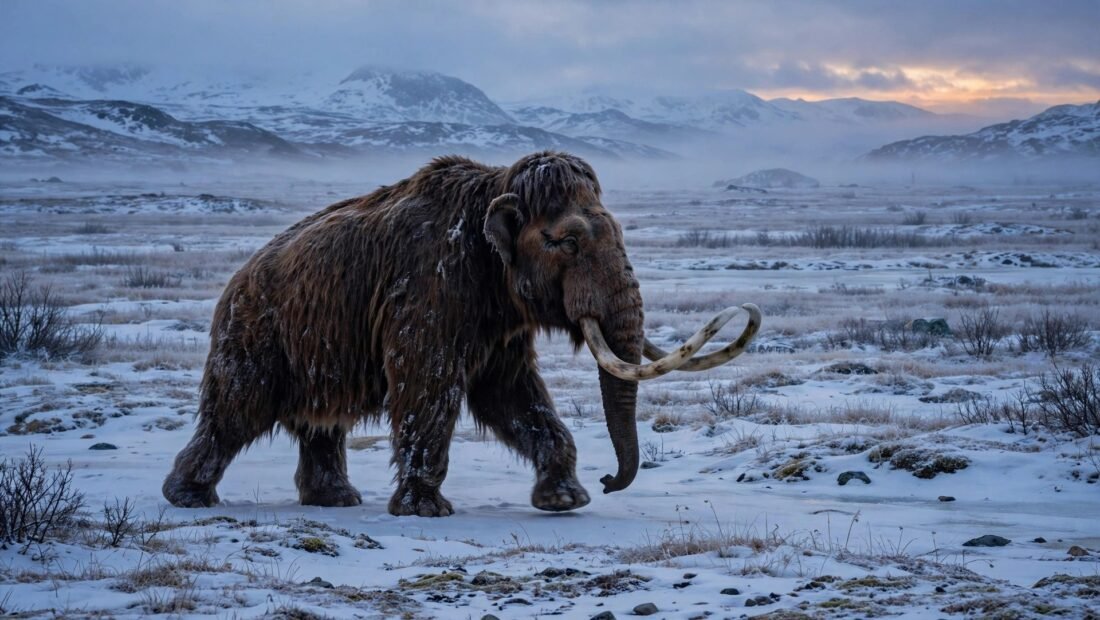
Nobody is rebuilding a true woolly mammoth. The live, funded project is different: take an Asian elephant, the mammoth’s closest living relative, and edit in a set of mammoth traits — thick hair, a heavy layer of fat, blood that handles cold well, smaller ears that lose less heat. If it works, the animal that walks out will look mammoth-like and tolerate cold in a way no modern elephant can. It will still be, underneath, an elephant. A mammoth in an elephant’s body, not a mammoth returned from the dead.
That distinction is not a trick or a disappointment. It is the whole question. The mammoth has been gone for about 4,000 years. The last small population held on for a while on a remote island after the mainland herds vanished, then it too disappeared. No living mammoth cells survive. That single fact shuts one door and opens another, and it shapes everything that follows.
What de-extinction actually means
De-extinction sounds like resurrection. In practice the word covers three very different ideas, and only one of them is being seriously pursued for the mammoth.
Back-breeding is the oldest and simplest. You take living descendants or close relatives and breed them, generation after generation, for traits that resemble an extinct ancestor. People have tried this with cattle bred to look like the wild aurochs. It can produce an animal that looks the part, but the genetics are still modern cattle genetics, selected and narrowed. It is slow, it is imprecise, and for the mammoth it does not apply at all, because there is no domestic herd of mammoth relatives waiting to be bred backward.
Cloning is the second path. This is the method that produced Dolly the sheep: take the nucleus from a body cell, place it in an egg with its own nucleus removed, and grow an animal that is a genetic copy. It needs an intact nucleus with usable DNA. For a mammoth, that material does not exist. Freezing preserves a great deal — scientists have recovered remarkably complete mammoth genomes from permafrost specimens — but thousands of years still break and scatter DNA. There is no whole, living-quality nucleus to clone from. A brief clone of an extinct Spanish ibex in 2003 lived only minutes, and that animal had fresh tissue to work from. The mammoth offers nothing close to that starting point.
Gene editing is the third path, and the funded one. You do not need a mammoth. You need a good map of the mammoth genome, which researchers largely have, and a living relative you can edit. Scientists identify the genes behind the traits that matter — hair growth, fat storage, hemoglobin that releases oxygen well in the cold, ear size — and use editing tools to change the elephant version toward the mammoth version, trait by trait. To understand the tool at the center of that work, it helps to read what CRISPR is and how it could change medicine, because the same basic editing approach is used in both fields. The result, if the long chain of steps succeeds, is a new kind of animal: an Asian elephant engineered to live where mammoths lived.
How close the science honestly is
Parts of the work are real and advancing. Mammoth genomes have been read to high quality. Laboratory progress with elephant cells and stem cells matters, but cells are not calves.
The hardest problems are not the edits themselves. They are elephant problems. Elephants reproduce slowly, with pregnancies that last about 22 months. They are endangered, which makes using elephant mothers as surrogates for experimental pregnancies ethically fraught and practically difficult. That is why so much attention falls on artificial wombs, and an artificial womb at elephant scale is an unsolved engineering problem, not a product waiting on a shelf. Social animals learn migration, feeding, and social behavior from older animals. A first generation would have elephant teachers at best, or human keepers.
Put together, an engineered, cold-tolerant elephant calf within about a decade is plausible to many scientists, though timelines in biotechnology slip often and should be read with care. A self-sustaining wild population, breeding on its own in Arctic grassland, is a different scale of claim. That sits decades away, if it arrives at all. Public announcements tend to run years ahead of animals on the ground, and that gap between press release and living herd is where most of the confusion lives.
The case for bringing something back
The strongest argument is ecological. Mammoths were not just residents of the northern grasslands. They helped make them. Large herds trampled snow and shrubs, knocked down small trees, spread seeds and fertilizer in dung, and kept open a cold grassland often called the mammoth steppe. Some researchers argue that restoring large grazers to parts of the Arctic could slow the thaw of permafrost — the frozen ground that stores huge amounts of carbon — by keeping the land as grassland and by packing snow so winter cold penetrates deeper. It is an elegant idea. It also needs honesty about scale: changing a landscape takes very large numbers of animals over very large areas, far beyond any herd a single program could produce in a generation.
The second argument is about spillover. The tools built for this work — better gene editing, better understanding of elephant reproduction, better ways to work with endangered species’ genetics — do not stay locked inside one project. They can help living Asian elephants, which face habitat loss and disease now. Supporters argue, with some reason, that an ambitious target pulls in funding and talent that narrower conservation work struggles to attract.
The third argument is moral, and it is simpler. People played a role in the loss of many extinct species, through hunting, habitat change, or both, alongside a warming climate at the end of the last ice age. The dodo and the thylacine, the Tasmanian tiger, are clearer cases of human-driven loss in recent centuries. Bringing back even a proxy can feel like repair, and it holds public attention on extinction itself.
The case against
The first objection is about honesty in naming. A mammoth-trait elephant has no mammoth microbiome in its gut, no mammoth behavior learned across generations, and no mammoth social world. Calling it a returned mammoth stretches the truth. If the public is sold a resurrection and delivered a cold-hardy elephant, trust in the science suffers, and trust is hard to rebuild.
The second objection is cost. De-extinction programs run on very large budgets. Living species, by contrast, are being lost right now for lack of much smaller sums — land protection, anti-poaching work, habitat corridors. Conservation biologists who raise this point are not against genetics. They are asking a hard budgeting question: should charisma decide where the money goes? A single high-profile program can cost what it would take to protect entire ecosystems that support hundreds of living species.
The third objection is welfare and risk. An engineered animal has to live a real life, for decades, in a body assembled by human choices. Will a cold-adapted elephant be healthy? Will its hair, fat, and blood work together as well in life as they look on a gene list? Who cares for these animals across lifespans that can stretch to about 60 years, and what happens if funding or fashion moves on? There is ecological risk too. Modern northern ecosystems have had about 4,000 years to adjust to a world without mammoths. Adding a large engineered grazer is an intervention, and history is full of confident introductions that went wrong once the animal met the real landscape.
Texas, where the work is happening
Texas is not a bystander in this story. A leading de-extinction company is headquartered in Dallas, which makes the state an unlikely center for work aimed at Arctic grasslands. The reasons are practical: investment money, research infrastructure, strong veterinary and genetics work at Texas universities, and vast private ranches that already host exotic species from around the world. Whether a mammoth-like elephant ever sets foot on Texas land is an open question, and in some ways the less important one. The jobs, laboratories, and research dollars are already here.
The dodo, the thylacine, and the same pattern
The mammoth is the flagship, but the pattern repeats across the other targets. The dodo, a flightless bird from Mauritius gone for centuries, left behind far less complete genetic material and no close relative nearly as workable as the elephant is for the mammoth. The thylacine is the opposite case in one respect: it died out only in 1936, so its DNA is younger and better preserved, and its relatives are marsupials whose reproduction, while still hard, follows a different path — young born tiny and developing in a pouch — that some teams see as more tractable than an elephant pregnancy.
For readers who want the underlying science in plain language, the National Human Genome Research Institute’s explainers on genomics and gene editing lay out how genomes are read and changed, without the marketing layer that company announcements carry.
The verdict
Possible, in altered form. Not soon, in any form the word mammoth fully deserves. And not a mammoth.
That verdict is not a dismissal. A cold-resistant elephant engineered toward mammoth traits would be a genuine scientific achievement, and the tools built along the way could help endangered elephants that exist today. Those are real goods. Set against them are real costs: enormous expense while living species go underfunded, open welfare questions for animals built to an ancient blueprint, habitat that has changed in 4,000 years, and publicity that consistently outruns the biology.
The fair way to judge any announcement is to ask three plain questions. Is this a living, healthy animal, or a step in a dish? Is it being called what it actually is? And did the work help species that are still alive and still saveable? Extinction, for now, remains what it has always been: close to final. Treating it that way is still the strongest reason to protect what remains.