Picture a pair of scissors that can find one exact address in a library of three billion letters and cut only there. That is the working picture of CRISPR. One part is the address label, a short piece of guide RNA that names the stretch of DNA to visit. The other part is the cutting enzyme, most famously Cas9, which travels with the guide and cuts the DNA where the guide matches. Bacteria invented this system long before any laboratory used it. Scientists learned to program it. From that simple pairing, an address plus a cut, has come the first approved gene-editing cures for inherited blood disease, a new way to think about cancer treatment, a fierce argument about where editing should stop, and a price tag that forces hard questions about who gets helped first.
Where the system came from: a bacterial defense
CRISPR stands for Clustered Regularly Interspaced Short Palindromic Repeats, a name that describes a pattern scientists noticed in bacterial DNA: repeated sequences with stored snippets between them. Those stored snippets turned out to be pieces of DNA from viruses that had attacked the bacteria before. The bacteria kept them as a memory bank. When the same virus returned, the bacteria made RNA copies of the stored snippet, loaded them onto a Cas enzyme, and used them as a guide to find and chop the invader’s DNA.
The leap to medicine came when researchers showed that the guide could be designed in the lab. Instead of a virus snippet saved by a bacterium, a scientist writes a guide RNA to match a chosen human gene. Paired with Cas9, that guide leads the cut to a precise place in the genome. The cell then repairs the break. If the repair is left to the cell’s quick, messy method, the gene at that spot is usually disabled. If scientists also supply a template, the cell can use it to rewrite the spot with a corrected sequence.
How an edit becomes a treatment
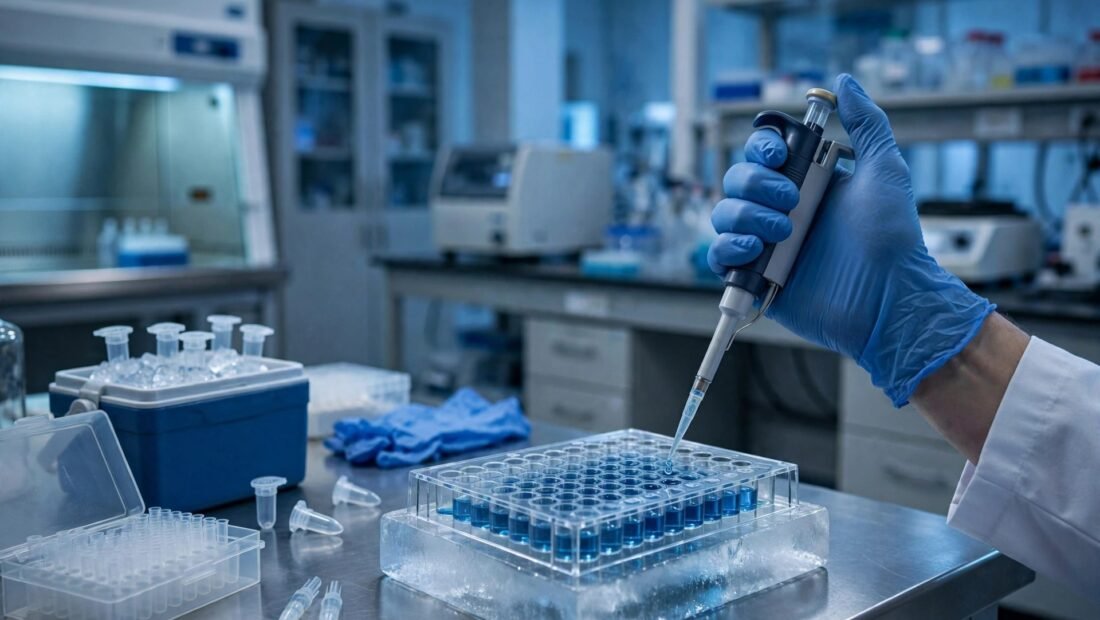
Most current therapies edit cells outside the body. Doctors collect a patient’s own blood stem cells, edit them in a laboratory, check them, and return them through a transplant process. Working outside the body gives the team control: the edited cells can be tested before they go back, and the rest of the body is not exposed to the cutting tool. That approach suits blood diseases, because blood stem cells can be removed, edited, and returned, and those cells then produce healthy blood for years.
A second approach edits inside the body. A delivery vehicle, often a harmless virus shell or a tiny fat particle, carries the editing parts to an organ such as the liver or the eye. This route can reach tissues that cannot be taken out and put back, but it is harder to control. The dose must reach enough of the right cells, miss the wrong ones, and avoid stirring a strong immune reaction. The choice between editing outside and inside the body is not a detail. It shapes safety, cost, and which diseases can be attempted at all.
What it has already done: the first approved cures
The clearest success so far is in sickle cell disease and beta thalassemia, two inherited blood disorders that trace back to faulty hemoglobin genes. In the approved treatment, a patient’s stem cells are edited outside the body so they switch on a fetal form of hemoglobin that most people stop making after birth. That fetal form does the work the faulty adult form cannot do. Patients who lived with repeated pain crises, transfusions, and organ strain have lived without those symptoms after treatment in trials and early clinical use. Regulators in the United States approved the first CRISPR therapy for these conditions in late 2023, making it the first approved gene-editing cure of its kind.
Other work is earlier and should be described with care. Trials have used editing for a form of inherited blindness, with some patients gaining partial vision. A single-infusion approach for transthyretin amyloidosis, a disease in which a misfolded protein damages nerves and the heart, showed strong early results by disabling the faulty gene in the liver. Cancer programs, including work at major centers such as MD Anderson in Houston, edit a patient’s own immune cells so they can recognize tumors better, then return those cells as a living treatment. For readers who want the scientific background in plain language, the National Human Genome Research Institute’s explainers on CRISPR and genomics track how these tools are defined and tested.
Why a one-time cure can cost $2 to $4 million
Current approved therapies cost $2 to $4 million per patient. That figure shocks people, and it should be explained rather than defended. Each treatment is made for one person from that person’s own cells. Specialists collect the cells, ship them under tight conditions, edit and test them, prepare the patient with chemotherapy to make room for the edited cells, perform the transplant, and follow the patient for years. The factory run serves a single customer. There is no warehouse of finished doses to spread the cost across.
The honest comparison cuts two ways. A lifetime of transfusions, hospital stays, and lost work for a severe blood disorder also costs a great deal, in money and in life not lived. A one-time cure can still be worth its price on those terms and still be out of reach for families and health systems that cannot pay it. Both things are true at once.
Hard problem one: delivery
Getting the editor to the right cells is the largest practical barrier. Blood stem cells can be handled outside the body. Brain cells, muscle fibers spread through the whole body, and lung tissue cannot. A delivery vehicle must survive the bloodstream, find the target organ, enter the right cells, release its cargo, and then disappear. Too little delivery and the treatment changes too few cells to help. Too much, or delivery to the wrong tissue, raises safety risks.
Hard problem two: off-target cuts and unwanted changes
A guide RNA is meant to match one address, but DNA is long and similar sequences exist. Cas9 can sometimes cut at a near-match, an off-target site. A cut in the wrong gene could disable something needed or, in the worst case, help set a cell on a path toward cancer. Editing teams screen guides to avoid close matches, test edited cells for stray cuts, and use newer enzymes and editors that cut less freely. Editing outside the body helps here, because cells can be checked before transplant. Editing inside the body leaves less room to inspect the result.
Even an on-target cut carries choices. Disabling a gene is simpler than rewriting it exactly. A messy repair that knocks a gene out may be perfect for a disease caused by a harmful protein and useless for a disease where the missing protein is the problem. Large deletions and rearrangements around the cut site have also been observed and must be watched for. None of this makes the approved blood treatments reckless; they went through years of testing for these exact risks. It does mean safety work grows harder as editing moves to new organs and to edits made directly inside a patient.
Hard problem three: ethics and the embryo line
Almost every current therapy edits body cells in one patient. Those edits are not passed to children. Embryo editing is different. Changing DNA in an embryo, or in sperm or eggs, would pass the change to future generations who cannot consent, and any mistake would pass with it. That is the line almost nobody in mainstream science will cross. The international reaction to a 2018 claim of gene-edited babies showed how firm that line is: wide condemnation, calls for moratoriums, and legal consequences for the scientist involved.
Other ethical questions sit closer to current practice. If a cure costs millions, who receives it first, and who decides? Should editing ever be used for enhancement, such as height or muscle traits, rather than disease? Where does treatment of a serious disorder end and selection of preferred traits begin? A useful comparison is the history covered in how antibiotics work and why resistance is dangerous: a powerful medical tool changes society only as fast as the systems around it learn to use it wisely.
Where it goes next: shared cells, farm fields, and wider reach
The next major goal is to end the one-patient factory. Scientists are working on multiplex editing, changing several genes at once, to create off-the-shelf immune cells that could work for many patients rather than being built from each patient’s own cells. Such donor cells must be edited to avoid attacking the patient and to avoid being rejected in return. If that work succeeds at scale, cell therapies could become faster to deliver and far cheaper than today’s bespoke treatments, which the original programs have priced in the hundreds of thousands even before CRISPR blood cures set the higher range.
Beyond medicine, the same tools are already at work in agriculture and research. In Texas fields and laboratories, editing is used to study drought tolerance, disease resistance, and crop traits that matter in heat and scarce water. Livestock research explores resistance to costly diseases. These uses raise their own questions about food labeling, ecological spread, and ownership of seed lines, but they face lower technical barriers than human therapy because a plant trial can be grown, measured, and discarded in ways a patient cannot. Expect farm and laboratory uses to keep expanding while human uses advance disease by disease.
The likely future is neither miracle nor menace. It is a growing list of specific diseases for which a targeted edit, delivered safely, beats a lifetime of management. Sickle cell disease and beta thalassemia opened that list. Blindness, protein disorders, immune-cell cancer care, and inherited cholesterol problems are pressing to join it. Each addition must clear the same three gates: delivery, accuracy, and fair access. CRISPR gave medicine an addressable way to rewrite instructions inside living cells. What changes medicine is the slower work of proving, for each disease, that the right letters were changed, in the right cells, for a price a real family and a real health system can bear.