Why is the sky blue, and if it is blue, why does it turn red at sunset? They sound like two puzzles, but they are one puzzle seen from two angles. Follow a single sunbeam at noon and then at dusk, and the same physics answers both. Sky color is not paint and not a reflection from the sea. It is what happens when white sunlight meets air that throws one part of that light in every direction.
Sunlight Is a Spectrum Traveling Together
Sunlight looks white, but white is a blend. Pass a beam of it through a glass prism and it fans out into red, orange, yellow, green, blue, and violet. Each color is light with a different wavelength. Red light travels in long waves. Blue and violet light travel in short, tight waves. Under normal daylight the colors arrive mixed so evenly that your eye reads the mix as white, in the same way that many instruments playing at once can sound like a single full note.
That mix matters because air does not treat each wavelength the same. If air scattered all colors equally, the sky would look pale and washed out at every hour. Instead, the size of air molecules compared with the size of light waves creates a strong bias toward the short end of the spectrum. The whole story of blue days and red evenings grows out of that bias, plus one change in geometry when the sun drops low.
Air Molecules and the Scattering That Favors Blue
The air around you is mostly nitrogen and oxygen. A single molecule of either gas is far smaller than the wavelength of visible light. When sunlight hits such a tiny particle, the light is scattered, sent off in new directions rather than passing straight through. This kind of scattering, where the particle is much smaller than the wave, is called Rayleigh scattering, named for Lord Rayleigh, the British physicist who worked out the math in the 1800s.
The key point is how steeply the effect rises as wavelengths shrink. Short waves are scattered far more strongly than long waves. Blue light is scattered many times more than red light by the same air. Picture the sun high at noon. Its light takes a short path down through the air. Along that path, blue light is thrown sideways, downward, and in every other direction by countless molecules. When you look away from the sun at any patch of sky, you are seeing blue light that was scattered toward you from all across that patch. The sky looks blue because the air itself is lit with scattered blue sunlight. You are not looking at a blue surface. You are looking into blue light in motion.
Clean air deepens the color. After a cold front sweeps through Texas and clears out dust and haze, the midday blue can look dark and rich. Dirty or damp air softens it, for reasons covered below. The scattering itself never stops. It is a basic result of sunlight meeting gas, and it happens on any clear day, over desert, city, or ocean alike. The sea does not cause it. If anything, the sea often looks blue in part because it reflects this already blue sky.
The Violet Problem: Why the Sky Is Not Purple
An honest account has to face the awkward fact. Violet light has even shorter waves than blue light, so it scatters even more strongly. Why, then, is the sky blue and not violet? Three effects stack up to shift the answer. First, the sun does not send out all colors in equal strength. It emits less violet light than blue light, so there is less violet to scatter in the first place.
Second, part of the violet and near-violet light is absorbed high in the atmosphere before it can be scattered down to you. Third, and most important for what you actually see, your eyes are poor violet detectors. Human vision is far more sensitive to blue than to violet. The light reaching your eye is a mix with plenty of blue and some violet, green, and other colors mixed in by repeated scattering. Your visual system reads that mix as the familiar blue of a clear day. Physics supplies a spectrum. Your eyes and brain settle on a color name for it. Both steps are needed to explain the result, which is why a camera and a person can argue, mildly, about the exact shade of the same evening sky.
For a fuller reference on light and color in the air, Encyclopaedia Britannica’s explainers on light and atmospheric scattering lay out the same ideas with diagrams of wavelengths and angles.
Sunset Geometry: The Long Path Through the Air
At sunset the sun sits near the horizon, and geometry changes everything. Light from a low sun does not drop steeply down to you. It slants through a far longer stretch of air, many times the thickness it crosses at noon. Every extra mile of that trip gives scattering more chances to pull blue light out of the direct beam and send it off in other directions, toward other viewers and other patches of sky.
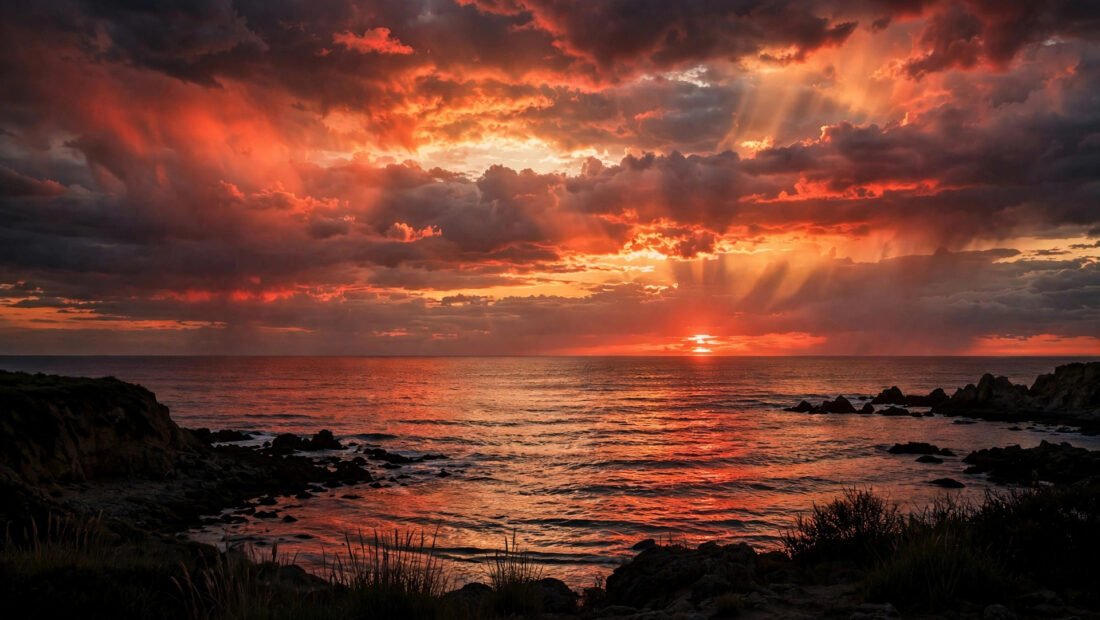
By the time low sunlight reaches your eye, most of its blue and much of its green have been scattered away along the route. What survives the long trip is the part of the spectrum that scatters least: red, orange, and warm yellow. That is why the sun itself looks deep orange or red as it sets, and why clouds near it catch fire with the same colors. A sunset is not the sky gaining red light. It is the direct light losing its blue on the way in. The blue has not vanished from the world. Viewers elsewhere, looking at sky lit by that same scattered light, still see it as blue.
The same logic explains the soft color that lingers after the sun drops. High air is still lit when the ground is in shadow, and it passes along the warmest tones that remain. Different paths through the air give different mixes, all from one rule.
Dust, Haze, and Why Texas Evenings Can Out-Color Clean Ones
Pure gas scattering sets the base colors, but real air holds more than gas. Dust, salt, smoke, pollen, and tiny water drops all scatter light too, and larger particles scatter in a different, less color-selective way. A small amount of dust in the evening air can deepen a sunset. The particles catch the surviving red and orange light and spread a glow across a wider area, and they add extra path length effects that strip out still more blue. That is why a slightly hazy Texas evening can produce a richer sunset than a crystal-clear one.
Push the haze too far and the effect reverses. Thick smoke or heavy pollution scatters and absorbs so much light that the sunset turns dull, brown, or pale. The sun may fade out well above the horizon, swallowed by murk. After large volcanic eruptions, fine particles high in the atmosphere have spread unusually vivid red sunsets across whole regions for months. The dose makes the difference. A little extra particle load enriches the warm end. Too much chokes the light altogether.
The Pale Band Near the Horizon
Look at a clear midday sky and you will notice the blue is deepest overhead and palest near the horizon, where it fades toward white or light gray. That, too, follows from path length. Looking toward the horizon, your eye takes in light that has traveled through much more air at low angles. Along those long paths, light gets scattered many times over, and light of other colors, scattered by larger haze particles near the ground, mixes in. The pure, single-scatter blue from overhead gives way to a blend of many colors from many scatterings. A blend of all colors reads as whitish, so the horizon band washes out.
Height reverses the effect. From a tall mountain or an airplane, the sky overhead looks darker and deeper blue, because there is less air above you to scatter light back down. Climb high enough, toward the edge of space, and the sky fades to black even in full sun, since there is almost no air left to do the scattering. Astronaut photos show that thin blue line of atmosphere glowing against blackness, the same scattered light you see from below, now seen from the side.
Clouds: Large Drops That Scatter Every Color Alike
Clouds break the blue pattern for a clear physical reason. A cloud is made of water droplets far larger than air molecules, and large enough compared with light waves that size bias fades. Big droplets scatter red, green, and blue light in much more equal measure. Equal scattering of the whole spectrum gives white, so a sunlit cloud looks white. The tops of thick clouds, lit in full, are the brightest white in the sky for the same reason.
When a cloud looks gray, you are mostly seeing shade, not a new color. A thick cloud blocks and absorbs enough light that its base receives little direct sun, and the scattered light that does reach you from that base is dim. Thin clouds at sunset can take on pink and gold because the light reaching them has already had its blue stripped away on the long slant path, and the droplets pass those warm colors along evenly. One rule for tiny molecules, another for large droplets, and the full range of sky colors follows.
The Same Physics in Plants, Hills, and Distant Views
Scattering does not stop at the sky. The blue haze that softens distant hills and mountain ranges on a clear day is this same scattered light sitting in the air between you and the land. Miles of air scatter blue light toward your eye along the whole line of sight, laying a blue veil over the dark slopes behind it. Artists have used that veil for centuries to show depth, painting far hills paler and bluer than near ones, long before the physics had a name.
Sunlight shaped by the air is also the light that living things use. Anyone curious about how plants convert sunlight into energy through photosynthesis is following the same spectrum onward, from scattering in the sky to capture in a leaf. The colors that paint a sunset are the leftovers of a beam that the air, the clouds, and the land have each taken a share of. Blue at noon and red at dusk are not two facts to memorize. They are one beam, two paths, and the view each path leaves for your eye.