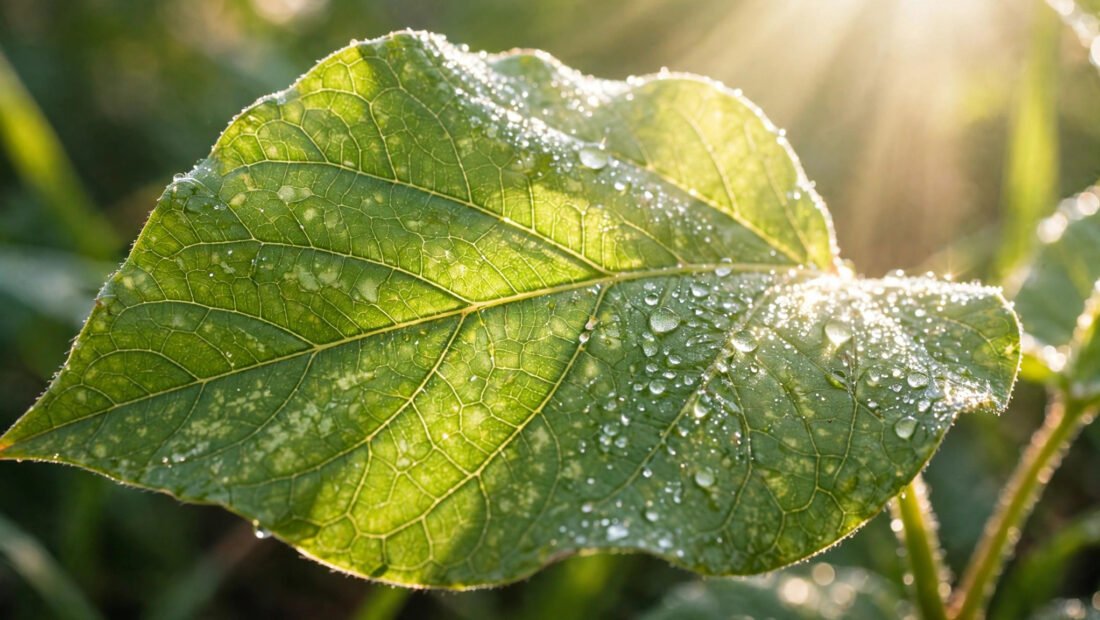
A leaf is a solar panel that also cooks. Sunlight, water, and air go in one end, and sugar and oxygen come out the other, through a chain of steps that runs whenever the light is on. Nothing about it needs fire, fuel delivery, or moving parts you can see. The whole factory sits inside tiny green compartments in the leaf’s cells, and it follows a strict order: first capture light and store its energy, then spend that stored energy building sugar. Follow the phases in order and the famous equation stops being a formula to memorise and becomes a story you can retell.
Phase One: Sunlight, Water, and Air Arrive at the Leaf
Every phase needs its supplies in place. Water rises from the soil through the roots and stem into the leaf. Carbon dioxide drifts in from the air through tiny pores on the leaf surface, mostly on the underside. Sunlight falls on the leaf from above. The leaf is built to gather all three at once: broad and flat to catch light, thin so gases and light reach inner cells quickly, and laced with veins that deliver water and carry sugar away.
Inside most leaf cells sit chloroplasts, the small green structures where the whole process happens. Each chloroplast has stacked membranes inside, a bit like piles of coins, surrounded by a fluid space. The stacks handle the light work. The fluid handles the sugar building. Gardeners manage these same three inputs without thinking about chemistry — anyone learning how to grow garlic at home in Texas is really arranging light, water, and air flow so this phase never runs short.
Phase Two: Chlorophyll Catches the Light
The light work begins with chlorophyll, the pigment packed into those stacked membranes, which are called thylakoids. When a particle of sunlight, a photon, strikes a chlorophyll molecule, its energy lifts an electron in that molecule to a higher energy level. Think of it as winding a spring. The energised electron does not stay put. It gets passed hand to hand along a chain of proteins set in the membrane, giving up a little energy at each step.
Chlorophyll catches red and blue light most strongly and reflects green light away. That reflected green is the colour your eyes receive, which is why plants look green. Some plants carry extra pigments that tint leaves yellow, orange, or red, especially in autumn when chlorophyll fades first and the backup colours show through. The capture step only runs while light arrives. Dim light slows it. Darkness stops it completely.
Phase Three: Water Splits and Oxygen Escapes
Passing electrons along leaves chlorophyll short of an electron, and the leaf replaces it from an abundant source: water. In the thylakoid, water molecules are split apart. The split frees electrons to refill chlorophyll, releases hydrogen ions that help drive the next phase, and produces oxygen as a leftover.
That leftover oxygen is the oxygen in the air you breathe. It exits the leaf through the same pores that let carbon dioxide in. This corrects a common mix-up: the oxygen released by plants comes from the water, not from the carbon dioxide. The carbon from carbon dioxide ends up in sugar. On a bright day, a healthy leaf releases oxygen steadily for as long as the light reactions run.
Phase Four: Energy Gets Packed Into Carrier Molecules
As electrons move along the membrane chain, the energy they release is used to pump hydrogen ions across the membrane, building up pressure on one side, like water behind a dam. Those ions then flow back through a protein channel, and that flow drives the making of ATP, the cell’s standard energy packet. At the end of the chain, a second carrier, NADPH, picks up the spent electrons along with hydrogen and holds energy in a form suited to building work.
ATP and NADPH are best pictured as charged batteries, or as loaded delivery trucks. They carry energy from the sunny membrane stacks to the building site in the surrounding fluid. They do not store energy for long. They are made, spent, and recharged over and over all day. Together, phases two through four are called the light-dependent reactions: they need light directly, they split water, they release oxygen, and their whole output is these two carriers, ready for the building phase.
Phase Five: The Calvin Cycle Builds Sugar From Air
Sugar building happens in the stroma, the fluid around the thylakoid stacks, in a looping set of reactions called the Calvin cycle. This phase does not need light directly, which is why older books called it the dark reactions — a misleading name, since it normally runs in daylight, powered by the ATP and NADPH arriving from the light phase.
The loop starts when an enzyme called RuBisCO attaches a carbon dioxide molecule to a five-carbon starter molecule already in the cycle. The result splits and is then reshaped, using energy from ATP and help from NADPH, into a small three-carbon sugar piece called G3P. Most G3P stays in the loop to rebuild the starter molecule so the cycle can turn again. A portion leaves as the plant’s actual harvest. Two of those three-carbon pieces combine to form glucose, a six-carbon sugar. Carbon that entered as an invisible gas leaves as food. RuBisCO does this job slowly and sometimes grabs oxygen by mistake, wasting effort — one reason plants carry so much of it and one reason yields are hard to push higher.
Phase Six: Sugar Gets Spent, Stored, and Built Into the Plant
Glucose is a starting material, not a finished product. Some is burned straight away in respiration to power the plant’s own cells — roots growing, minerals being absorbed, new leaves unfolding. That burning runs day and night, in every living cell. Some sugar is linked into long chains to make cellulose, the tough material of cell walls, so wood, stems, cotton fibre, and paper all began as sugar from this phase. Surplus sugar is stored as starch in roots, tubers, and seeds. Potatoes, rice, wheat, and corn are all stored sunlight in this sense, which is why they feed people so well. Sugar also feeds the making of proteins, oils, and the chemicals that give herbs their scent and peppers their heat.
Phase Seven: Night Falls and the Balance Shifts
When light fades, the light-dependent reactions stop for lack of photons. No new ATP and NADPH are made, water stops splitting, and oxygen release ends. The Calvin cycle can turn briefly on stored carriers, then winds down as well. There is no photosynthesis at night.
Respiration, though, continues around the clock. The plant burns some of its stored sugar to stay alive, taking in a little oxygen and releasing a little carbon dioxide as it does — the reverse direction of the daytime flow. Over a full sunny day, a healthy plant makes far more sugar than it burns overnight, so the net result is growth plus oxygen released to the air. Plants stretched by low light grow weak because income falls while night-time spending continues.
How Efficient the Whole Chain Runs
For all its importance, the chain is not very efficient at turning sunlight into plant matter. Most plants convert only about 1–2% of the sunlight falling on them into biomass. Losses occur at every phase: some wavelengths go unused, some light reflects or passes through, the Calvin cycle wastes effort when RuBisCO grabs oxygen, and the plant spends much of its sugar just staying alive.
A few plants do markedly better. Sugarcane, a highly tuned warm-climate crop, reaches roughly 7–8% under good conditions. The theoretical maximum sits near 11%, which shows the headroom researchers are chasing. Even a one-point gain, spread across world farmland, would mean a great deal more food from the same fields. Artificial light can drive the whole chain indoors, provided the spectrum and intensity suffice — red and blue light do most of the work, which is why grow lights often glow purple-pink rather than white.
Three Variations Plants Use in Hard Climates
Not all plants run the standard sequence, called C3, in quite the same way. C3 plants fix carbon directly with RuBisCO in ordinary leaf cells, and they make up most species, including rice, wheat, and beans. In hot, dry places, that direct route wastes water and suffers more of the oxygen-grabbing error.
C4 plants such as corn and sugarcane first catch carbon in a different cell, then deliver it concentrated to RuBisCO, cutting the waste and thriving in heat and strong sun. CAM plants such as cacti, agaves, and pineapple take the opposite approach to timing: they open their pores at night to gather carbon dioxide while the air is cool, store it, then build sugar by day with pores shut against water loss. A Texas garden can hold all three strategies within a few feet of each other. Readers who want diagrams and practice questions for the standard pathway will find them in Khan Academy’s biology lessons on photosynthesis, which walk through both phases step by step.
Watching the Oxygen Phase on a Kitchen Counter
You can watch the light phase work with a spinach leaf, baking soda water, and a bright lamp. Punch small disks from the leaf, draw the air out of them with a syringe so they sink in the baking-soda solution, then set the cup in strong light. The baking soda supplies carbon dioxide. As the disks photosynthesise, oxygen builds inside their tissue and buoys them up. Sunken disks typically rise within about 15–30 minutes.
Move the cup into darkness and the disks slowly sink again as oxygen production stops and respiration uses what remains. Few home experiments make an invisible gas exchange this visible. It also confirms the phase order from real evidence: light first, oxygen as the sign that capture and splitting are running, and sugar building quietly behind it.
Why the Chain Matters Far Beyond the Leaf
Nearly every food chain on Earth starts here. Animals eat plants, or eat animals that ate plants, so the energy in almost every meal entered the living world through a leaf or a photosynthetic microbe in the sea. The oxygen atmosphere itself is the accumulated leftover of this process running for billions of years. Forests, grasslands, and crops also lock carbon into wood, roots, and soil, pulling it out of the air for as long as that growth stands.
That is the full sequence: light caught by chlorophyll, water split for electrons, energy packed into ATP and NADPH, carbon fixed into sugar in the stroma, and sugar spent, stored, and built into the plant itself. Sunlight, water, and air in. Sugar and oxygen out. A leaf runs it quietly, in order, every bright day.