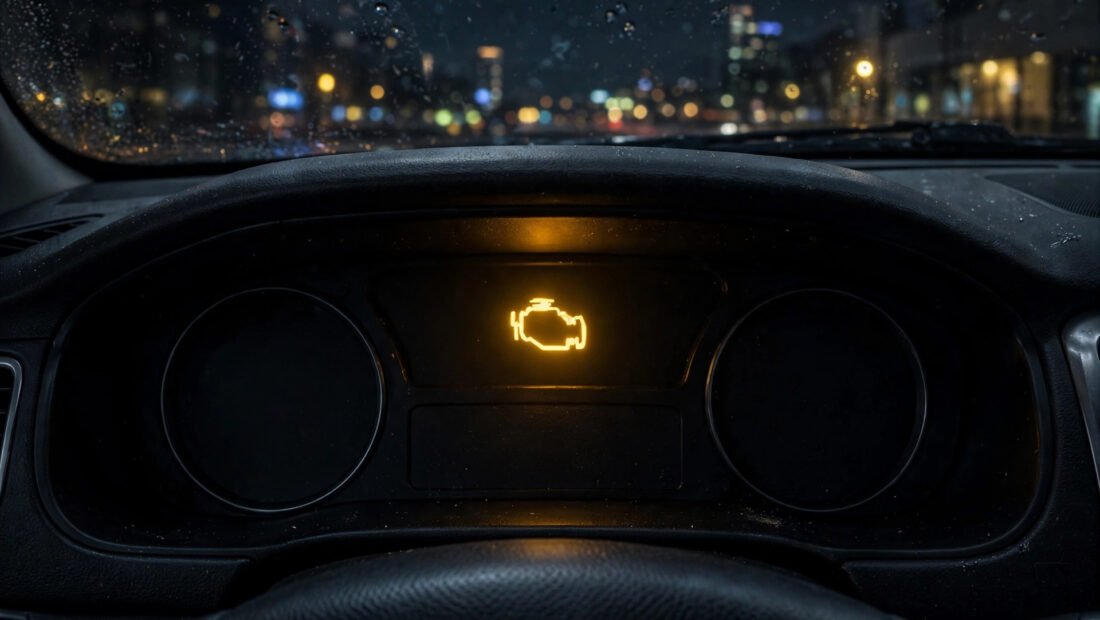
One small amber light on a Texas dashboard can mean a gas cap that needs one more click — about a $30 fix if the cap itself is bad — or a catalytic converter at $1,000 to $2,500 or more. It can also mean almost anything in between. The light does not name the fault. It announces that the car’s computer found something outside its expected range, stored a code for it, and wants you to look. The difference between the cheap outcome and the expensive one is a process, followed in order, and the order matters because each step is cheaper than the one after it.
Since the mid-1990s, cars sold in the United States have carried a standardized diagnostic system, OBD-II. Sensors watch fuel mixture, ignition, emissions, engine temperature, and transmission behavior, and the engine computer compares what it sees against what it expects. Step outside the lines and a diagnostic trouble code is stored. Hundreds of different faults share that one lamp: a loose gas cap upsetting the evaporative emissions system, a tired oxygen sensor skewing fuel control, worn spark plugs causing misfires, a failing mass airflow sensor, a stuck thermostat, and the converter problems that so often arrive last, after a cheaper fault was ignored. Follow the steps below and you will usually know which end of the price range you are on before you pay anyone.
Step 1: Read the light itself — steady or flashing
A steady light means a fault is present but nothing is being destroyed right now. You can generally keep driving — to work, home, or a shop — with a light touch: ease off hard acceleration, skip heavy loads and towing, and book diagnosis within days, not weeks. Steady does not mean harmless. Faults cascade. An oxygen sensor at roughly $200 to $400, left alone, can overwork and ruin a converter that costs several times more. The steady light buys you time. It does not buy you months.
A flashing light is a different message entirely. Flashing means an active, severe engine misfire — raw fuel passing into the exhaust, where it can overheat and wreck the catalytic converter in a short drive, and possibly harm the engine itself. Slow down, avoid hills and hard throttle, and get to a safe place or a shop now. If the car is shaking hard, losing power, or the temperature gauge is climbing alongside the flash, pull over safely and call for a tow. Driving on to see whether it clears is exactly how a repair in the $300 range turns into one in the $4,000 range. In Texas heat this step carries extra weight: an engine already running hot in air around 105 degrees has almost no margin left, and a warning can become a warped head gasket with frightening speed.
Step 2: Do the free two-minute checks
With urgency settled, do the checks that cost nothing and take almost no time. Start with the gas cap, because it is the most common trigger of all. If the light appeared not long after fueling, the odds rise further. Unscrew the cap and retighten it until it clicks. Look at it while it is in your hand: cracks in the plastic or a flattened, damaged seal mean the cap itself is the fault, and a replacement is cheap. Then drive normally for a few days. The evaporative system tests itself over repeated trips, called drive cycles, and a cap fault will often clear its own light once the system passes its checks again.
While you are there, use your senses. Note anything that arrived with the light: rough idle, hesitation, a new sound, worse fuel mileage, a smell, a temperature gauge sitting higher than usual. Check the basic fluid levels you can reach safely on a cool engine.
Step 3: Read the code
Texas drivers have a free option: large auto parts stores across the state, AutoZone and O’Reilly among them, will plug in a reader and pull your codes at no charge. The permanent option is inexpensive: a Bluetooth OBD-II reader in the $20 to $50 range pairs with a phone app and gives you the same ability any time the light appears, in your own driveway. Either way, write the exact code down. Codes look like P0420 or P0301, and the pattern carries meaning — the first characters point to the system involved, with misfire codes, emissions codes, and transmission codes grouped in their own ranges.
One caution belongs here. A code names the system that reported a problem, not always the part that caused it. A code pointing at the converter can be caused by a sensor feeding the computer bad information upstream. Replacing the part named by a code, without the next step, is the most common way drivers overspend.
Step 4: Research the code in context
Take the exact code and search it together with your car’s make, model, year, and mileage. The same code means different things on different cars, and patterns show up quickly once you look. A P0420 code on a car with about 150,000 miles usually points to a converter that is genuinely worn out. The same code on a young, low-mileage car more often points to an upstream sensor misleading the computer, with the converter itself still fine. Forum posts and repair databases for your exact model will show which fix other owners actually needed, how often, and roughly what it cost.
Texas context belongs in this research too. Heat ages rubber hoses, plastic fittings, and sensors faster here, so evaporative emissions faults on an eight- or nine-year-old Texas car often have a plain age-and-heat explanation. Dust is its own factor in West Texas and the Panhandle, where grit fouls mass airflow sensors early — a fix that can be as small as a can of sensor cleaner at about $15, for a fault many drivers have paid around $300 to have misdiagnosed and replaced. And weigh distance honestly: a minor code may tolerate a week of short trips, while a misfire or cooling code should not be carried on a long run across the state.
Technology is adding new options at this stage as well, and it is worth knowing where they help and where they stop — for example, whether AI can diagnose car problems from engine sounds is a useful check on what sound-based tools can and cannot prove compared with a stored code.
Step 5: Decide whether you need a professional diagnosis
Sometimes the path is clear after step 4: tighten or replace the cap, clean a sensor, replace an inexpensive part you can reach and verify. When the code is ambiguous, when several codes arrive together, or when the likely repair is expensive, the right purchase is not a part. It is an hour of diagnosis at a reputable independent shop, typically about $100 to $150.
That fee buys confirmation: a technician with live data, pressure tests, and experience with your model working out which repair is actually needed before the expensive one is authorized. It prevents the classic waste in car repair — fitting a converter at $800 or more, in round terms, when a sensor at a fraction of the price was the true fault. Get the diagnosis in writing, with the code and the reasoning, and keep it. For typical Texas independent-shop pricing, the common repairs behind the light run roughly as follows: a gas cap at $25 to $50, an oxygen sensor at $200 to $400, spark plugs at $150 to $400 and sometimes more on trucks where the plugs are buried, an ignition coil at $200 to $350, a mass airflow sensor at $250 to $450, a thermostat at $250 to $450, evaporative system repairs at $200 to $600, and the catalytic converter at $1,000 to $2,500 or more. Knowing the range before you approve work is the difference between a customer and a target.
Step 6: Clear the repair, then verify it held
The process does not end when a part goes on. After a repair, the code should be cleared and the car driven through its normal cycles so the computer can run its self-tests again — the readiness monitors, in shop language. If the light stays off and the monitors complete, the fix held. If the light returns with the same code, the diagnosis was incomplete, and your written record from step 5 is what makes that conversation straightforward.
This verification step has a hard deadline in much of Texas. Many metro counties — the Houston, Dallas–Fort Worth, Austin, and El Paso areas among them — require an annual emissions inspection, and a lit check-engine light fails that inspection outright. You cannot renew registration until the fault is fixed and the monitors have completed, which takes real driving over several days, not a single trip around the block. For the official requirements, check the Texas Department of Transportation’s vehicle safety inspection information well before your inspection month. A light that appears the week registration is due turns a calm repair into a scramble, so the time to run these steps is the week the light appears.
Habits that keep the light off
Most check-engine lights are not bad luck. They are maintenance, deferred. Spark plugs replaced on schedule prevent the misfires that kill converters. Fresh oil and a clean air filter keep fuel control honest. A gas cap clicked shut at every fill-up removes the most common trigger entirely. Cooling system service matters doubly in Texas, where summer heat punishes every weak hose and tired thermostat, and a battery and charging system in good health keep sensor readings stable — weak voltage can produce strange, misleading faults.
Above all, keep the habit the steps themselves teach: respond early, while the fault is still the cheap version of itself. The light is best understood not as a verdict but as an early, fairly polite request for attention. Answer it in order — judge the urgency, do the free checks, read the code, research it in context, buy diagnosis when the stakes justify it, and verify the repair — and that amber lamp goes back to being what it should be: a $30 warning you heeded, instead of a $2,500 lesson you postponed.