
Day one, the new rescue dog is behind the washing machine, and she has no plan to come out. Food does not tempt her. A soft voice does not tempt her. She has found the smallest, darkest gap in the house and decided it is the only safe place in it. That scene sets the tone for everything that follows. Helping a shy dog settle is not a weekend project. It runs in phases, each one with its own job, and rushing an early phase makes the later ones harder.
Shyness in a rescue dog usually has layers. Many missed the critical social window from 3 to 14 weeks, when puppies learn most easily that people, sounds, and new places are normal. Others carry bad experiences: neglect, chaos, or rough handling. Some are simply wired to be cautious. In Texas, the rescue population also includes many former strays and dogs from hoarding cases, animals that may never have lived inside a house or heard a vacuum cleaner at close range. None of that makes a dog stubborn. Freezing, fleeing, cowering, and even snapping are fear responses. Punishing fear teaches the dog that the world, including you, really is dangerous. Let the dog set the pace, and arrange for new experiences to predict good things. That principle runs through every phase below.
Phase One: The First 3 Days — Decompression Only
Rescue workers use a timeline called the 3-3-3 rule: 3 days to decompress, 3 weeks to start settling in, and 3 months to feel at home. For a shy dog, read that as a minimum. Some need closer to six months for the last stage.
In the first 3 days, a dog may barely eat, drink little, sleep a lot, or show almost no personality. That is normal. The job in this phase is not training and not bonding on your terms. It is rest and predictability. Keep the house quiet. Keep visitors away. Keep the routine plain: same feeding times, same short trips outside, same calm voice. Skip the welcome party, skip showing the dog off to neighbors, and skip any group class. Flooding a shy dog with new people and places in week one pushes her past what she can cope with and can set trust back by weeks.
Set up a sanctuary space right away and protect it. A crate with the door left open, or a quiet corner with bedding, works well as long as it belongs to the dog. Nothing scary should happen there. Never drag the dog out of that spot, and never let visitors corner her in it. A retreat she can count on sounds like a small thing. In practice, a dog who knows she can leave a situation is braver about staying in it a little longer next time.
Phase Two: The First 3 Weeks — Safety, Routine, and the Trust Account
Across the first 3 weeks, the goal is a boring, steady home life the dog can learn by heart. Same schedule. Same quiet walking routes. Same calm energy from the people in the house. Boring is the point. Each uneventful day is evidence that nothing bad happens here.
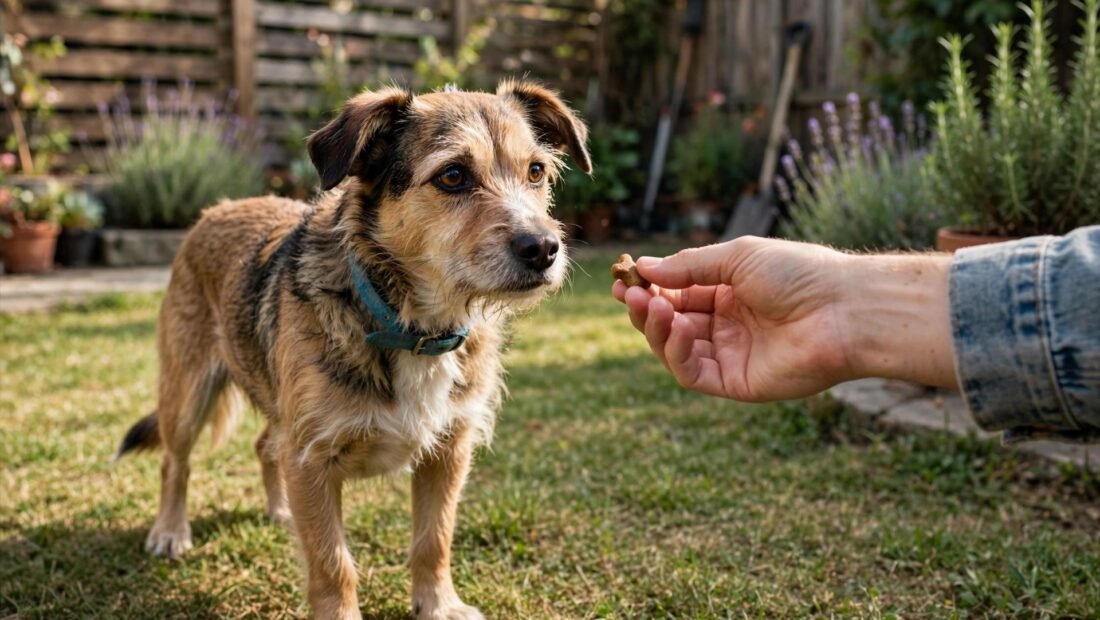
Hand-feeding part of each meal helps during this phase. Every piece of food that comes from a human hand makes a small deposit: hands predict food, not grabbing. Sit on the floor near the dog rather than looming over her. Early on, toss treats near her instead of holding them out, and let her close the distance herself. Reaching toward a shy dog, especially toward the head, can feel like a threat even when it is meant kindly.
Learn to read the early warnings so you can act before fear grows. Lip licking, yawning, turning the head away, showing the whites of the eyes, tucking the tail, and freezing all say the dog is uncomfortable. When you see those signals, add distance or lower the pressure. A dog who learns that her quiet warnings work has less reason to escalate to growling or snapping later.
Training in this phase should stay tiny and rewarding. Short sessions built on rewards, ideally with a clicker or a clear marker word, give the dog a predictable way to earn good things through her own choices. Simple wins count: a hand target, a sit, a “find it” game with treats scattered in the grass. Each success builds confidence. Keep sessions short and end them while the dog is still coping well.
Phase Three: Weeks 3 to 12 — Gradual Exposure, One Layer at a Time
Once home feels safe, widen the world slowly. The method is straightforward: show the dog the scary thing at a level low enough that she notices it but does not panic, and pair it with something she loves, usually high-value food. Over repeated sessions, raise the level in small steps. It is slow and unglamorous, and it is the approach that changes how the dog feels, not just how she behaves.
Start with people. One calm person at a time, at a distance, ignoring the dog completely is the right opening. Have visitors toss treats behind the dog, so she gets to retreat to collect the reward. That teaches two lessons at once: strangers predict good things, and moving away is allowed. Do not let strangers stroke the top of a shy dog’s head. If the dog chooses to approach and asks for contact, a chest or side scratch is safer. Children come last in the sequence, because they move fast, sound unpredictable, and bend down over dogs.
Other dogs need the same restraint. Not every shy dog needs dog friends, and forcing company is a common mistake. Begin with parallel walks: a calm, known helper dog walking in the same direction at a distance, with that distance shrinking gradually over several sessions. Skip face-to-face greetings on tight leashes. Skip dog parks entirely — they are uncontrolled and unpredictable, the worst mix for a fearful dog. One stable dog friend is worth more than a hundred random meetings, and a dog who ends up neutral around other dogs has reached a perfectly good outcome. Later, if a second dog joins the household itself, the separate question of how to introduce a second dog into your home deserves its own slow plan.
Sounds, surfaces, and the wider Texas environment come next, still in layers. Play recordings of vacuums, doorbells, and thunder at low volume and pair them with treats. Let the dog walk on new surfaces at her own speed. For car rides, which matter in a state where almost every trip needs a car, build the steps over days: sit in the parked car and eat treats, then sit with the engine on, then ride around the block. Walks deserve special care. Many shy rescues freeze or refuse to move once outside. Do not drag the dog forward. Let her watch the world from the driveway for ten minutes; watching is training. Pick quiet routes and off-peak hours, and use a long line of 15 to 30 feet in safe open areas so she can explore without feeling trapped at the end of a short leash.
Phase Four: Months 3 to 6 — Texas Conditions and Real Life
By around 3 months, many dogs start to feel at home, and meaningful progress usually shows across 3 to 6 months, with more improvement through the first year. This phase is where Texas conditions shape the work.
Heat narrows the training day. In summer, go out early in the morning or late in the evening. A stressed dog who is also overheated cannot learn well, and pushing a session at midday helps no one. Storms are the other Texas factor. Thunder here is loud and frequent, so start storm practice well before storm season, using recordings at low volume paired with treats and raising the volume gradually. Severe storm panic may call for situational anxiety medication prescribed by a veterinarian.
Safety planning matters more with a fearful dog, because a panicked dog is a flight risk. A startled rescue can clear a weak fence or dig under one in seconds. Check fencing, double-leash on walks during the early months, and consider a GPS tracker collar as backup. Health can shape the timeline too. Many Texas rescues arrive heartworm-positive, and treatment requires strict exercise restriction for months. Follow the veterinarian’s protocol exactly in that case, and shift the work to low-arousal indoor games and gentle training while treatment runs its course.
What to Avoid at Every Phase
Reward-based training is the only approach that fits a fearful dog. Punishment-based tools — prong collars, shock collars, leash corrections, and flooding a dog with the thing it fears — suppress behavior through fear without changing the feeling underneath. With shy dogs, they reliably make fear worse. If a trainer reaches for corrective tools for a rescue like this, find a different trainer. Look for credentials such as CPDT-KA, KPA CTP, or IAABC. The guidance collected in the ASPCA’s dog behavior guidance is a useful check on why aversive tools backfire with fearful dogs and what qualified help looks like.
Adult dogs are not a lost cause, even though they missed the easy early window. The 3 to 14 week period makes exposure easiest, but dogs keep learning throughout life. It takes more repetitions and more patience, not a different kind of hope. Cowering when you reach for the dog usually reflects past handling or simple lack of experience with people. Toss treats instead of handing them over, come in from the side at the dog’s level, and let the dog start the contact.
When a Phase Stalls: Getting Professional Help
Bring in a certified professional if the dog is not eating normally after the first week, shows aggression, has panic episodes, or stops improving after a couple of months. For severe fear, a veterinary behaviorist can judge whether anti-anxiety medication would help. Medication does not do the training. It lowers the dog’s baseline arousal enough that learning becomes possible at all.
Progress with a shy rescue is measured in months and in small, easy-to-miss wins: eating in the open instead of behind furniture, choosing to cross a room, leaning against a leg on the couch. The dog behind the washing machine on day one is not broken, and she does not need to be fixed on your schedule. She needs safety, routine, and time, given in that order, until she decides for herself that the world has changed.


1 Comment