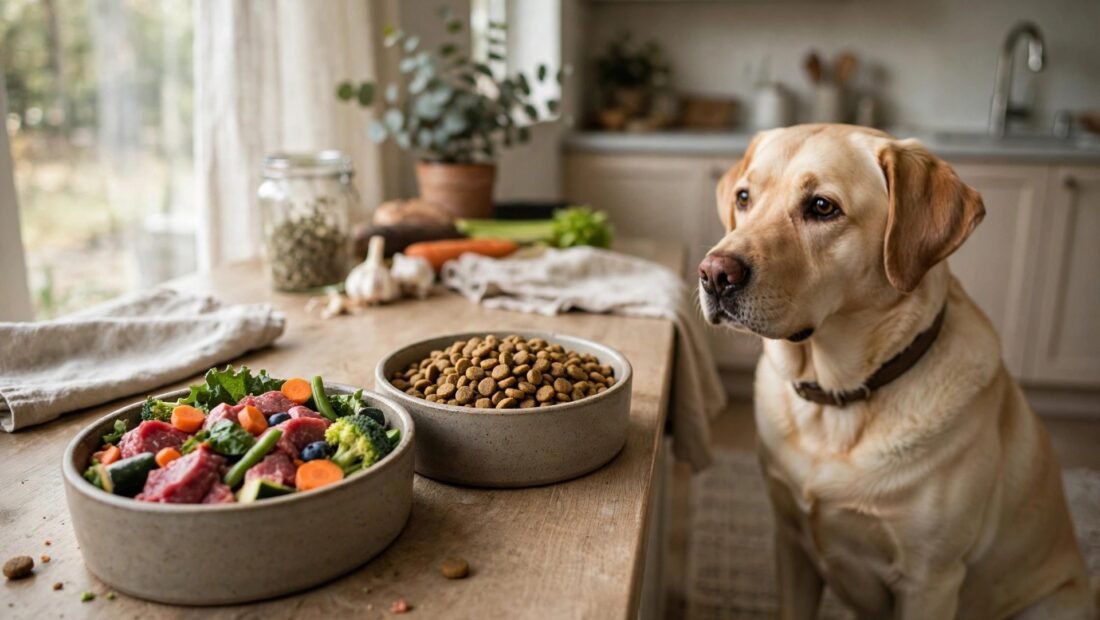
Scroll any dog forum and you’ll find the war: raw feeders calling kibble “dead brown balls of corn,” kibble defenders calling raw “an expensive way to give your dog salmonella.” Both sides are certain. The actual evidence is more nuanced — and more interesting — than either camp admits. Is raw food actually better for dogs than kibble? The honest answer: it depends on what “better” means, which dog, and whether the raw diet in question is actually complete. Here’s what the science, the vets, and the Texas practicalities say.
What “Raw” and “Kibble” Actually Mean
Raw diets (BARF — Biologically Appropriate Raw Food — or prey-model) typically combine raw muscle meat, raw meaty bones, organs, and sometimes vegetables, fruit, or supplements. They come as homemade (you source and balance) or commercial (freeze-dried, frozen, formulated to nutritional standards).
Kibble is extruded dry food — ingredients cooked under high heat and pressure into shelf-stable nuggets. Quality spans enormously: from corn-first grocery brands to carefully formulated veterinary and premium lines. “Kibble” as a single category is like “restaurant food” as a single category — the range makes generalizations suspect.
The comparison that matters isn’t “best raw vs. worst kibble” (raw wins) or “best kibble vs. worst raw” (kibble wins). It’s well-formulated raw vs. well-formulated kibble — and there, the differences shrink dramatically.
The Claims for Raw: What’s Real
Shinier coats and smaller stools — mostly real
The most consistent reported benefits: improved coat quality and smaller, firmer, less odorous stools. These make biological sense — raw diets are highly digestible (less filler in, less waste out) and rich in fatty acids that support skin and coat. These are real, observable differences, though premium kibbles with quality fats narrow the gap.
Better dental health — partially real
Raw meaty bones provide mechanical teeth-cleaning action that kibble’s crunching doesn’t fully replicate (the “kibble cleans teeth” claim is largely marketing — most kibble shatters on contact). But bones carry fracture and obstruction risks, and the dental advantage doesn’t extend to formulated raw without bones.
“Dogs evolved eating raw” — true but incomplete
Dogs did evolve from wolves eating raw prey. They also evolved 15,000+ years of adaptation to human food scraps, including extra amylase gene copies for digesting starch — dogs are not wolves, and “ancestral” isn’t automatically optimal. Evolution optimizes for reproduction, not for an 18-year lifespan.
More energy, fewer allergies — anecdotal
Owner reports of transformed energy and resolved allergies are common — and commonly confounded. Switching any diet (including to a different kibble) can resolve issues caused by the previous food. Without controlled comparison, the “raw fixed everything” story often credits raw for what was really “not the old food.”
The Case for Kibble: What’s Real
Nutritional completeness — kibble’s strongest argument
This is the decisive factor. AAFCO-formulated kibble is complete and balanced by design — every bag meets established nutrient profiles. Homemade raw diets, by contrast, are routinely nutritionally incomplete: studies of homemade raw recipes find the majority deficient in calcium, zinc, vitamin D, or with dangerous calcium-phosphorus imbalances. Balancing raw at home requires formulation software or veterinary nutritionist guidance — “meat and bones” is not a complete diet. Commercial raw formulated to AAFCO standards solves this, but then you’re paying premium prices for the same completeness kibble provides.
Safety — the uncomfortable data
Raw meat carries pathogens: Salmonella, Campylobacter, E. coli, Listeria. Studies consistently find raw pet foods contaminated at far higher rates than kibble. Dogs often carry these asymptomatically — and shed them, exposing children, elderly, and immunocompromised household members. The FDA’s Center for Veterinary Medicine has specifically cautioned against raw pet foods for this reason (see the FDA’s animal veterinary resources). In Texas heat, the cold-chain risk compounds: a thawed delivery sitting on a 100°F porch is a bacterial incubator. Kibble isn’t sterile either, but the risk profile isn’t close.
Cost and convenience — no contest
Feeding raw costs 2–4× quality kibble — $150–$300/month for a medium dog versus $50–$80. Plus freezer space, prep time, and sourcing. For multi-dog Texas households, the math gets stark fast.
What Veterinarians Actually Say
The organized veterinary position (AVMA, AAHA, and most veterinary nutritionists) is caution: they don’t recommend raw, primarily over pathogen risk and nutritional completeness concerns. This isn’t a conspiracy — it’s risk-benefit analysis from professionals who treat the salmonellosis and the nutritional deficiencies.
But there’s a more nuanced clinical reality: vets who do support raw typically support commercial, AAFCO-formulated raw from reputable manufacturers with high-pressure processing (HPP) — which addresses both completeness and pathogen concerns — while opposing casual homemade raw. And virtually all vets agree on the hierarchy that matters: a well-formulated diet the owner can sustain beats an ideal diet fed inconsistently. The best diet is the complete one you’ll actually feed correctly for 15 years.
PetMD’s nutrition resources reflect this middle ground: emphasis on AAFCO completeness, whatever the format, with honest discussion of raw’s risks.
The Texas Practicalities
- Cold chain: commercial raw ships frozen. Texas summer porches destroy cold chains — schedule deliveries for days you’re home, use a cooler box, or buy locally from retailers with proper freezers.
- Cost pressure: raw for a 70-pound lab in Texas runs $200+/month. That’s a budget line item, not a casual switch — grocery budgeting discipline is what makes premium pet food sustainable, and the same planning applies here.
- Vet alignment: if you feed raw, tell your vet. Nutritional bloodwork and honest discussion beat the alternative — vets can’t help formulate what they don’t know about.
- Multidog and kid households: pathogen shedding risk scales with the number of dogs and the vulnerability of household members. Homes with toddlers or immunocompromised people should weigh this heavily.
The Decision Framework
Choose commercial AAFCO-formulated raw (HPP-treated) if: budget allows 2–4× kibble cost, no immunocompromised household members, reliable cold chain, and your vet is looped in. Choose premium kibble if: you want proven completeness with minimal risk and fuss — this is the rational default for most owners. Choose homemade raw only if: you’re working with a veterinary nutritionist on formulation, understand the pathogen protocols, and accept the labor. What not to choose: casual homemade raw from internet recipes (the deficiency data is damning), or the cheapest kibble (the quality range is real).
And whichever you choose, fit it into a family budget built for the long haul — diet is a 15-year commitment, and the “best” food is the one you can afford consistently without resentment.
Conclusion
Raw isn’t magic and kibble isn’t poison. Well-formulated raw offers real advantages in digestibility, stool quality, and coat condition — and real disadvantages in pathogen risk, cost, and the ease of getting nutrition wrong. Well-formulated kibble offers proven completeness, safety, and value — with less romance. The evidence doesn’t crown a winner; it describes trade-offs. For most Texas dog owners, the rational choice is a quality AAFCO-formulated kibble, with commercial formulated raw as a legitimate premium alternative for those who accept the cost and handle the safety protocols. What matters most isn’t the format — it’s completeness, consistency, and a vet who knows what you’re feeding.
Frequently Asked Questions
Is raw food actually better for dogs than kibble?
Not categorically. Well-formulated raw offers better digestibility and coat condition, but carries higher pathogen risk and cost, and homemade raw is frequently nutritionally incomplete. Well-formulated kibble provides proven complete nutrition with better safety and value. The best choice depends on budget, household risk factors, and consistency.
Is raw dog food safe?
Commercial AAFCO-formulated raw with high-pressure processing (HPP) is reasonably safe. Homemade raw carries meaningful Salmonella, Campylobacter, and E. coli risks — for the dog and for humans handling the food or contacting the dog. Households with young children or immunocompromised people face higher stakes.
Do vets recommend raw dog food?
Most veterinary organizations advise caution, primarily over bacterial contamination and nutritional completeness. Vets most open to raw recommend commercial AAFCO-formulated products and emphasize telling your vet so nutrition can be monitored.
How much does raw feeding cost compared to kibble?
Raw typically costs 2–4× quality kibble — roughly $150–$300/month for a medium-to-large dog versus $50–$80 for premium kibble. Homemade raw can be cheaper than commercial raw but requires formulation guidance to be nutritionally complete.
Can I mix raw and kibble?
Yes — many owners feed kibble as the base with commercial raw as a topper or partial replacement. This captures some palatability and digestibility benefits while keeping costs manageable and nutrition anchored by the complete kibble. Keep the overall diet balanced and tell your vet.