
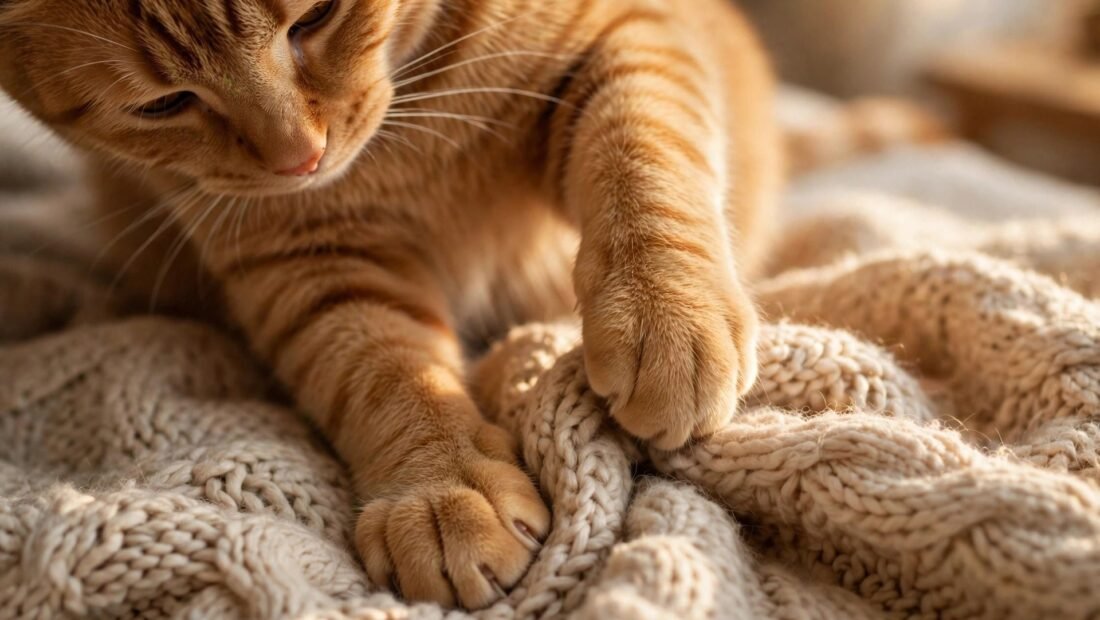
She is marching in place on the blanket, left paw, right paw, left paw again, purring loud enough to hear across the couch. Her eyes are half closed. A little drool may even show at the corner of her mouth. Is she happy? Is she stressed? Is she quietly claiming the blanket, and you under it, as her territory?
The short answer is reassuring. Kneading plus loud purring, in a loose and sleepy cat, almost always means comfort. The habit starts in the first days of kittenhood, and it stays tied to safety for the rest of a cat’s life. A few other instincts ride along with it, which is why the same motion can also mark a spot, arrange a bed, or calm the cat down. All of those explanations can be true at once.
Where does kneading come from?
Newborn kittens knead against their mother while they nurse. The steady pushing helps stimulate milk flow. At that age the kittens cannot see well yet, but they already know the pattern: press, get fed, stay warm, stay close. Warmth, a full belly, and safety all arrive together.
That early pairing leaves a lasting mark. Adult cats keep the motion long after they stop nursing because the feeling linked to it never really fades. When a grown cat kneads a soft blanket on a lap and starts to purr, the cat is settling into the same kind of contentment first felt as a kitten. That is also why kneading shows up most often when a cat is relaxed and getting sleepy, curled on a favorite spot in the evening, rather than when the cat is alert, hungry, or watching something at the window.
The detail on this early behavior is covered well in Cornell Feline Health Center’s behavior resources, which treat kneading as a normal behavior carried from kittenhood into adult life. It is not a habit cats need to be trained out of. It is a leftover comfort tool that most cats keep.
What else does kneading mean besides comfort?
Comfort is the main story, but it is not the whole story. Cats also get a few practical benefits from the same motion, and watching when and where a cat kneads helps sort out which one matters most in the moment.
Scent marking is one piece. Cats have scent glands in their paw pads. Pressing and spreading the paws leaves scent on the blanket, the couch cushion, or a person’s legs. A cat that kneads a spot for a minute and then circles and lies down on that exact spot has likely just claimed it. The lap gets the same treatment. It is not rude. It is how cats label a safe place as theirs.
Nesting is another piece. Wild ancestors of house cats padded down grass and leaves before lying down, testing the surface and flattening it into a bed. The same instinct shows up indoors. A cat may work harder on a lumpy throw than on a flat sheet, pushing the bunched fabric around until it feels right. The blanket does not need fixing by human standards. By cat standards, it does.
Stretching counts too. Kneading flexes the toes, extends the claws, and stretches the legs and shoulders. Cats often knead right after a nap, the same way people stretch after sitting too long. The motion feels good on its own, apart from any memory attached to it.
Self-soothing is the last piece, and it explains the confusing cases. A cat that is mildly anxious may knead to settle down, using the kittenhood link on purpose. A cat in a carrier on the way somewhere unfamiliar, or a cat recovering after a loud noise at home, may knead a blanket in a way that looks like happiness but is closer to a calming routine. Context decides the meaning. Body posture, ears, tail, appetite, and what just happened around the cat matter more than the kneading alone.
Why does the purr get so loud?
Purring and kneading often rise together because both belong to the same relaxed state. As the cat sinks deeper into rest, the purr can get stronger and more steady, almost like a small engine idling. Half-closed eyes, slow blinking, a loose body, and ears in a neutral position all point the same way. That full picture is a content cat.
Volume alone does not prove happiness, though. Cats also purr when they are stressed, hurt, or unwell. A purr by itself is a weak signal. A purr paired with kneading, a soft body, and normal habits is a strong one. A purr paired with hiding under the bed, skipping meals, or staying tense is a different signal entirely.
Some cats are simply louder than others. Size, personality, and habit all play a part. A cat that has always purred loudly on a favorite person’s lap is showing a personal style, not a new symptom. A sudden change in how a cat purrs, especially alongside other changes, is the part worth paying attention to.
Why do claws and drool join in?
Claws come out because claw extension is part of the full kneading motion. A deeply relaxed cat is not carefully managing each claw. The cat is not being aggressive, and the cat has no idea the points hurt through thin pants or a light sheet. Pulling the cat off mid-knead or pushing the cat away tends to confuse things, since the cat was in the middle of a bonding and settling routine.
A calmer fix works better. Keep nails trimmed so the tips stay blunt. Keep a thick blanket folded on the lap as a built-in barrier during couch time. If the kneading spot needs to move, slide the blanket, with the cat’s attention on it, to the cushion beside you rather than lifting the cat away. Punishment has no useful place here. It teaches the cat that a safe moment turned unsafe, and it does not teach claw control.
Drooling has a similar origin. When relaxation is complete, some cats drool a little while they knead, a leftover from nursing. A small amount of drool during kneading, with normal eating and drinking the rest of the day, is usually nothing to chase. Drooling at other times is a separate question. Heavy drooling away from kneading, pawing at the mouth, bad breath that is new, or dropping food all point toward the mouth and teeth and deserve a veterinary check.
Why does a cat pick only one person or one blanket?
Most kneading cats are selective. One or two favorite people get chosen, and one or two favorite surfaces get used again and again. Texture matters. A plush throw, a fleece blanket, or a soft sweater often wins over smooth bedding. Familiar scent matters too. The spot that already smells like the cat and like home is the spot the cat returns to.
Being the chosen person is a real compliment. Cats do not knead every lap on offer. They knead the lap that feels safest. In a busy Texas house, that may be the person who sits still the longest in the evening, or the one whose spot on the couch stays consistent. Other family members should not take the snub personally. Cats are narrow in their favorites for many habits, from sleeping spots to greeting routines.
Texas homes add a small twist. Blankets stay out all year, even with the heat, because air conditioning keeps living rooms cool and cats hunt for the warm pocket anyway. A cat may start the afternoon stretched on cool tile, then move to a blanket on a lap once the room cools down at night. The blanket is not about the season. It is about a soft, familiar, claimed surface.
What if a cat barely kneads at all?
That is normal too. Some cats knead often and for long stretches. Some do it rarely. Some never really do it. One theory for light kneaders is early weaning, where the nursing link was cut short and the habit never set as deeply. Other cats simply show contentment in different ways, with head bumps, slow blinks, rolling over, or sleeping pressed against a person.
A lack of kneading says nothing bad about a cat’s bond or happiness. The change matters more than the baseline. A lifelong non-kneader is fine. A cat that kneaded daily for years and then stopped may be telling a different story, especially if jumping, grooming, or climbing also got harder. Stiff joints and sore paws can make the motion less pleasant for older cats.
Should you ever worry about kneading and purring?
Usually, no. Worry belongs to the pattern around the behavior, not the behavior itself. A cat that kneads and purrs but also hides more than usual, stops eating, drinks much more, uses the litter box differently, or changes sleep and grooming habits needs a veterinary check. Those combined changes can point to pain, illness, or stress that the purring alone would hide.
The same caution applies to coat and skin changes that show up at the same time as behavior changes. Hair loss, over-grooming, and restlessness often travel together, so reading up on why your cat is losing belly hair in patches can help sort out whether licking and stress are part of the picture. A cat that suddenly kneads far more than usual also deserves a closer look. In an unspayed female, hormonal changes can drive extra restless and affectionate behavior. In any cat, a sharp rise in self-soothing can mean something in the home changed, from a new pet to a new schedule to construction noise next door.
For the ordinary case, the response stays simple. Trim the nails, keep a thick throw where the cat likes to settle, and let the ritual run. The cat is not broken, bored, or plotting anything. The cat is doing one of the oldest and most honest things cats do, on the blanket that smells right, with the person who feels safest.



1 Comment