
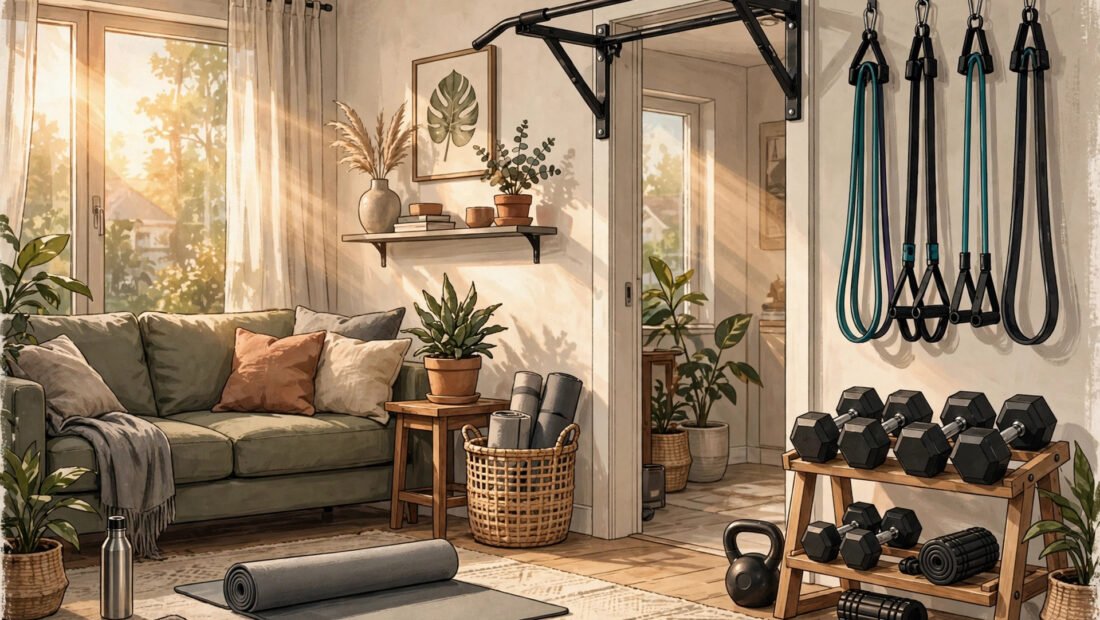
Three hundred to five hundred dollars of equipment, three sessions a week, and one rule account for nearly all the muscle a beginner will ever build at home. The rule is simple: do a little more than last time. Add a rep, add a little weight, or use a harder variation, and repeat that small advance for months. No secret exercise and no expensive machine can replace it.
Home training works because muscle responds to hard effort, enough total sets, enough protein, and steady progression. A living room or garage can supply all four. The sections below go deep on each part of the system, from the exact equipment list to the point, usually a year or two in, when a gym finally offers something the home setup cannot.
The Equipment: A Short List That Covers Every Movement
The full setup costs $300 to $500 in total, roughly equal to 6 to 10 months of gym membership, and then it is owned for good. Each piece earns its place by covering movements that body weight alone cannot load well.
Adjustable dumbbells, at $150 to $300, are the heart of the setup. A single pair replaces a whole rack for presses, rows, squats, and hinges. A pull-up bar at $30 to $50 fixes the pull gap for back and biceps. Resistance bands at about $30 add tension for face pulls and lateral raises. An adjustable bench at $100 to $150 unlocks incline presses, supported rows, and step-ups.
Buying order matters when the budget arrives in stages. Dumbbells come first, then the pull-up bar, then bands, then the bench. A beginner with only dumbbells and a bar already owns enough to run the full program for months.
The Movement Patterns: Five Slots That Build the Whole Body
The program is built from patterns rather than a long list of exercises. Five slots cover everything: squat, hinge, push, pull, and core. A full-body session visits each slot once, three times a week, in sessions of 45 to 60 minutes.
The squat pattern trains the front of the thighs and the glutes. Goblet squats with a single dumbbell are the starting point, with split squats as the harder single-leg step that follows. The hinge pattern trains the hamstrings, glutes, and lower back. Dumbbell Romanian deadlifts lead here, teaching the hips to fold while the back stays flat, with single-leg versions as the progression.
The push slot covers chest, shoulders, and triceps through floor presses or bench presses, plus overhead presses with dumbbells. The pull slot pairs pull-ups or band-assisted pull-ups with dumbbell rows, building the back and biceps that keep shoulders healthy under all that pressing. The core slot finishes the session with planks, dead bugs, or loaded carries using the dumbbells, training the midsection to brace rather than merely to crunch.
A practical session might run as follows: goblet squats, Romanian deadlifts, bench press, one-arm rows, pull-ups spread across the session in small sets, and a carry or plank at the end. Three sets per movement, with reps mostly in the 6 to 15 range, covers a beginner well. Rest one to three minutes on the big movements.
Progressive Overload: Adding More Without a Barbell
Muscle grows when the work gets slightly harder over time, and a home setup offers more ways to do that than most beginners expect. The first lever is reps. When a set of 10 becomes manageable at a given weight, push toward 12 or 15 before touching the dial on the dumbbell. The second lever is weight itself. Once the top of the rep range is reached with clean form on every set, raise the load by the smallest step available and rebuild the reps.
The third lever is tempo. Slowing the lowering phase to three or four seconds makes a familiar weight hard again without any new equipment. The fourth lever is a harder variation: goblet squats give way to split squats, standard push movements gain a pause at the bottom, and rows move from two feet on the floor to a single-leg stance. Range of motion is a fifth lever, since a deeper, controlled rep counts for more than a partial one.
Volume is the quiet lever behind the rest. Moving a movement from 3 sets to 4 sets adds about 33 percent more stimulating reps, a large jump disguised as a small one. That lever should be pulled sparingly, one movement at a time, and only when recovery, sleep, and appetite can support it. Every advance, however small, goes into a training log with the date, weight, sets, and reps. A log turns effort into evidence and stops hard sessions from being forgotten or repeated by accident.
The 12-Week Block: Structure That Prevents Random Training
Progression needs a container, and a 12-week block provides it. Weeks 1 through 4 build the habit and the base loads, with form as the main target. Weeks 5 through 8 push reps toward the top of each range and add weight where the log shows readiness. Weeks 9 through 12 add the planned volume increase on one or two movements and introduce the hardest variations the beginner has earned.
After 12 weeks, a deload week follows at half volume. Weights stay moderate, sets are cut in half, and the goal is to arrive at the next block fresh rather than worn down. Fatigue hides fitness, and many beginners mistake a tired week for a failed program when a light week was all that was missing.
The next block then starts with small variations swapped in, such as split squats replacing goblet squats as the primary squat pattern, or a different row angle taking the lead. The patterns never change, because the body is built by patterns. The variations simply keep progression moving and joints happy. Twelve weeks is also the minimum fair trial for any version of the program. Judging results at week 3 measures mostly soreness and enthusiasm, not muscle.
Nutrition: The Surplus and Protein That Make Training Count
Training provides the signal to grow. Food provides the material. Building muscle calls for a slight calorie surplus of about 200 to 300 calories above maintenance, enough to support new tissue without adding fat at a pace that forces an early diet. Larger surpluses do not build muscle faster in any meaningful way for a beginner. They mostly build a longer cutting phase later.
Protein is the priority within those calories, spread across the day in normal meals built around foods such as eggs, Greek yogurt, chicken, fish, beans, and milk. A trainee who trains hard while eating at or below maintenance often spins in place for months, because the material for new tissue never arrived. Meal timing around sessions is a smaller detail, and readers sorting it out can check what to eat before and after a workout for practical options.
Sleep belongs in this section too, even though it is not food. Muscle is repaired between sessions, and short sleep blunts that repair while raising hunger for calorie-dense food. Seven or more hours is a realistic target for most adults, and a trainee whose strength stalls for a month while sleep is solid should look first at total food intake. Under-eating, not a missing exercise, is the usual cause.
Timelines: Honest Markers From Week 3 to Month 12
Expectations decide whether a good program survives. Strength gains appear first, in about 3 to 4 weeks, and they are mostly neurological. The nervous system learns to recruit muscle that was already there, so weights climb before size changes. That early jump is real progress, but it should not be mistaken for new muscle.
Visible changes take 8 to 12 weeks. Sleeves fit differently, shoulders show shape, and monthly photos reveal shifts that daily mirror checks miss completely. Significant change takes 6 to 12 months of the steady work described above. Anyone promising a transformation in 30 days at home is selling something other than training.
The ceiling question deserves a straight answer. A fully equipped gym holds a slight edge, mainly through heavy barbell loading that dumbbells cannot match at the top end. Even so, about 90 percent of the results a beginner wants are achievable at home. For the first year or more, the limiting factor is almost never the equipment. It is consistency, progression, and food. General standards for safe, effective training are collected at the American Council on Exercise’s fitness resources for readers who want form guidance.
The Stalls: Habits That Quietly Stop Home Gains
Program-hopping is the most damaging habit. Muscle takes 8 to 12 weeks to respond to a stimulus, so switching routines every few weeks means never staying with any stimulus long enough for it to work. The cure is commitment to one block at a time, judged only at its end.
The missing log runs a close second. A feeling of getting stronger is not data. Without written weights and reps, sessions drift toward comfortable loads, and comfortable loads stop producing change. The log takes one minute per session and is the cheapest performance tool in the entire setup.
Other stalls are quieter. Skipping the pull slot because pull-ups are hard leaves the back undertrained and shoulders aching. Training through sharp joint pain rather than adjusting the variation turns a small problem into a layoff. Adding endless extra sets without the food to support them produces exhaustion instead of growth. Each stall has the same shape: an unmeasured habit drifting while the trainee blames the program.
The Gym Threshold: When Leaving Home Training Makes Sense
A gym becomes the right call at a specific, earned point. When the adjustable dumbbells are maxed out on key lifts with good form, and heavier loading is the only way forward, home equipment has done its job. For most beginners that point arrives 1 to 2 years in, not in the first months. Barbell-specific strength goals point to a gym for the same reason: the tool for the goal lives there.
Until that threshold, the home setup holds every advantage that matters early on. There is no commute eating the session, no crowd at the rack, and no monthly fee ticking during a busy month. A $300 to $500 setup, three 45 to 60 minute sessions a week, a log that proves a little more was done than last time, and food that supports the work: that plain system, run in 12-week blocks without hopping, builds the muscle.




2 Comments