
Seven exercises and one rule cover most of what a bad knee needs. The rule is simple to state and harder to obey: the knee should leave every session feeling worked, never punished. Worked means warm muscles, mild effort, and a joint that settles back to normal within hours. Punished means sharp pain during the session, swelling afterward, or a knee that feels worse the next day than it did before. The checklist below is the quick way to tell the difference before, during, and after any session, and the seven exercises after it are the ones that most often land on the right side of that line.
The Knee-Friendly Checklist
- Before: choose low impact, meaning the feet stay in contact with water, pedals, a machine, or soft ground rather than pounding hard surfaces.
- During: mild work discomfort is acceptable if it settles; stop for sharp pain, locking, catching, or the knee giving way.
- After: check again at 24 hours; pain that is worse a full day later means the last session was too much.
- Weekly mix: combine water or machine cardio with home strength work for the quads and glutes, plus balance work.
- Footwear: cushioned, supportive shoes are non-negotiable for any standing or walking exercise.
- Progression: add about 5 minutes to cardio sessions each week, not more, and add sets before adding resistance.
- Help: get checked for locking, swelling that lasts past 48 hours, inability to bear weight, or steadily worsening pain.
Why bother at all with a sore joint? Because exercise helps arthritic knees in three practical ways. Stronger muscles around the joint absorb force the joint would otherwise take alone. Movement helps circulate the fluid that lubricates the knee. Activity also supports weight control, and every pound lost is a pound the knee no longer carries thousands of times a day. Exercise does not reverse arthritis or regrow lost cartilage. It manages symptoms, often very well, and that distinction keeps expectations honest.
1. Swimming and Water Aerobics
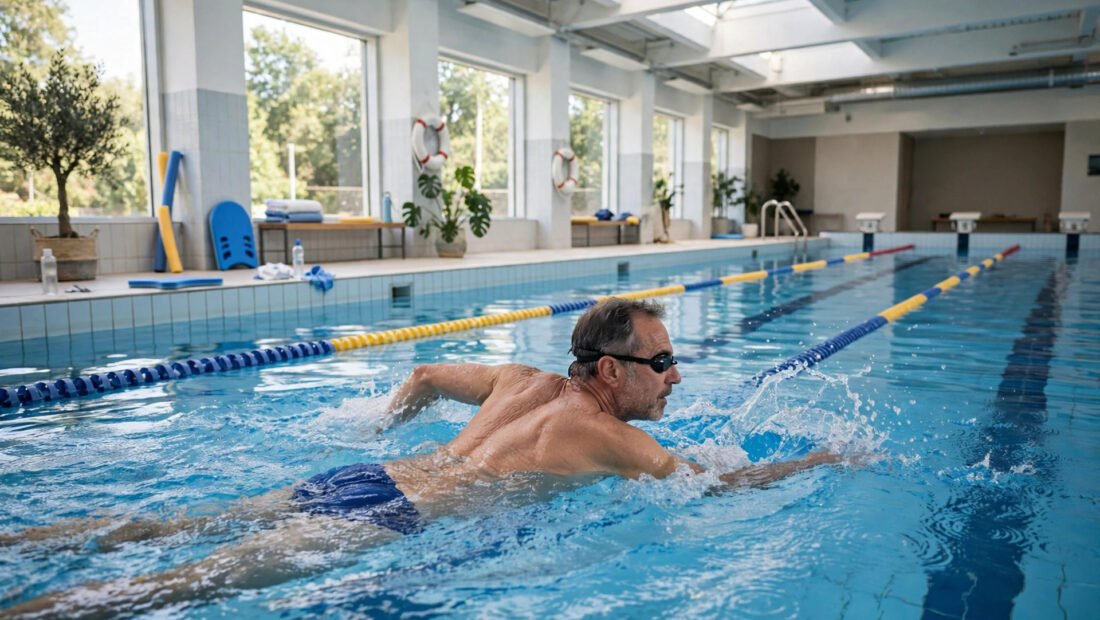
Water is the kindest setting for a bad knee. Buoyancy unloads up to 90 percent of body weight in chest-deep water, so a person can walk, jog in place, kick, and turn with only a fraction of the usual joint load. That makes the pool the best starting point for someone whose knee objects to almost everything on land.
Aim for 20 to 30 minutes of laps, water walking, or a water aerobics class twice a week. Water walking suits beginners who do not swim confidently: walk the shallow end at a pace that raises breathing while the knee stays quiet. Keep the breaststroke kick gentle or avoid it if it twists the knee, since that whipping motion bothers some joints. Warm water also loosens stiffness, so early movement in the session often feels easier than the same movement on land.
2. Stationary Cycling
A stationary bike strengthens the quads and hamstrings through a smooth circle, with no impact at all. The setup decides whether it helps or annoys the knee. Set the seat high enough that the knee keeps a slight bend at the bottom of the pedal stroke. A seat set too low forces a deep bend under load on every turn, and that is the classic error that makes cycling feel bad.
Start with 15 minutes at easy resistance. Easy means the legs can keep the pedals turning smoothly without pushing hard or rocking the body. Add a few minutes at a time before adding resistance. A recumbent bike, with its chair-like seat and back support, suits people whose back or balance also needs help. Stop and adjust if pain gathers at the front of the knee; a small seat change often fixes it.
3. Elliptical Trainer
An elliptical copies the rhythm of walking and running while the feet never leave the pedals, so the impact of each step disappears. It suits people who find a bike seat uncomfortable or who want a standing, weight-bearing session that is still gentle.
Start with 10 to 15 minutes and add 5 minutes a week. Keep resistance moderate and stand tall rather than leaning heavily on the moving handles, since leaning dumps the work into the arms and cheats the legs. Cushioned shoes are non-negotiable here too, even indoors, because the foot still takes load through the whole stride. Keep the motion forward at first. Backward pedalling changes the muscle pattern and the knee load, so it belongs later, if at all.
4. Straight-Leg Raises and Quad Sets
These two small movements look too easy to matter, which is why people skip them. They are the most direct way to wake up the quadriceps, the thigh muscles that guide and protect the kneecap, and they load the knee joint itself very little.
For a quad set, sit or lie with the leg straight, tighten the thigh muscle as if pressing the back of the knee down into the floor or bed, hold for about 5 seconds, then release. For a straight-leg raise, tighten the thigh first, then lift the straight leg slowly to a modest height, lower it slowly, and rest. Three sets of 10 to 15 repetitions a day is a solid target. Slow lowering matters as much as the lift. If the back aches during raises, bend the other knee with that foot flat to support the lower back. Learning proper squat form that protects your knees matters later for standing strength work, but these floor movements come first because they build control with almost no joint stress.
5. Glute Bridges
Weak glutes let the knee drift inward when a person walks, climbs, or stands up from a chair, and that inward drift is a common driver of knee pain. Bridges train the glutes and the back of the thigh while the knee stays in a safe, shallow position.
Lie on the back with knees bent and feet flat. Push through the heels, lift the hips until the body forms a straight line from shoulders to knees, squeeze the glutes, hold for about 2 seconds, and lower slowly. Keep the knees in line with the hips rather than letting them fall together or splay apart. Start with two or three sets of 10. When that becomes easy, march the feet slightly farther away or progress toward single-leg bridges, one side at a time. A bridge should be felt in the glutes and hamstrings, not as a pinch in the front of the knee.
6. Tai Chi
Tai chi is slow, standing, weight-shifting movement, and that slowness is the point. Each step is placed with control, which builds leg strength, balance, and joint position sense at the same time. Better balance means fewer awkward, twisting steps in daily life, and those awkward steps are what trigger many flare-ups.
Classes at community centers are usually cheap and led at a pace beginners can follow, and many routines can be done in a small space at home from a video. Wear flat, stable shoes or work barefoot on a non-slip floor. Keep the knees soft and never force a deep stance. A shallow stance done well beats a deep stance done with wobbling knees. Two or three sessions a week fit well on days between harder cardio.
7. Walking on Soft Surfaces
Walking belongs on the list, but the surface decides how friendly it is. A rubberized track, a packed-dirt park trail, grass, or a cushioned treadmill treats the knee far better than a concrete sidewalk. Hard, uneven pavement is the combination to avoid: impact plus surprise twists.
Start with 10 to 15 minutes and add 5 minutes a week, the same steady rule as the elliptical. Short, even strides are kinder than long overstrides that slam the heel down. Supportive shoes with real cushioning matter more here than in any other exercise on the list, and worn-out shoes should be retired rather than stretched for another season. A route with a bench partway round is a sensible touch for the early weeks, since it turns a rest into part of the plan instead of a failure.
Form cues for every exercise on the list, and many more movements besides, are collected in the American Council on Exercise’s exercise library, which shows positions clearly enough to copy at home.
Reading Pain Signals and Knowing When to Get Help
Acceptable pain has a pattern. It feels like mild work discomfort, it stays in the muscle more than deep in the joint, and it settles soon after the session ends. A little stiffness that loosens as the joint warms up at the start is also common with arthritic knees.
Red flags have a different pattern. Sharp pain is a stop signal, not a challenge. So are swelling after exercise, a knee that locks in one position, a knee that catches mid-movement, or a knee that buckles and gives way. Pain that is worse 24 hours after a session means the dose was too high; cut the next session back rather than pushing through. Get a professional assessment for knees that lock, catch, or give way, for swelling that does not resolve within 48 hours, for any inability to bear weight, for visible deformity after an injury, and for pain that steadily worsens over weeks despite sensible training. Those signs point to problems exercise alone should not be asked to solve.
A Sample Week That Mixes All Seven
A balanced week spreads the load across settings. Monday can hold a 20 to 30 minute pool session of water walking or easy laps. Tuesday is home strength work: quad sets, straight-leg raises, and glute bridges in about 15 minutes. Wednesday suits a stationary bike ride, starting near 15 minutes at easy resistance. Thursday can be rest or a gentle tai chi session. Friday repeats the home strength work, adding a set if the week has gone well. Saturday is a 15 to 20 minute walk on a track or trail. Sunday is full rest.
That pattern covers cardio, quad strength, glute strength, and balance without asking the knee to do the same hard thing two days in a row. Progress it the slow way the checklist sets out: a few more minutes here, one more set there. The goal across a month is a knee that feels more supported and more predictable, not a dramatic fitness leap. Steady, repeatable weeks are what bad knees reward.



1 Comment