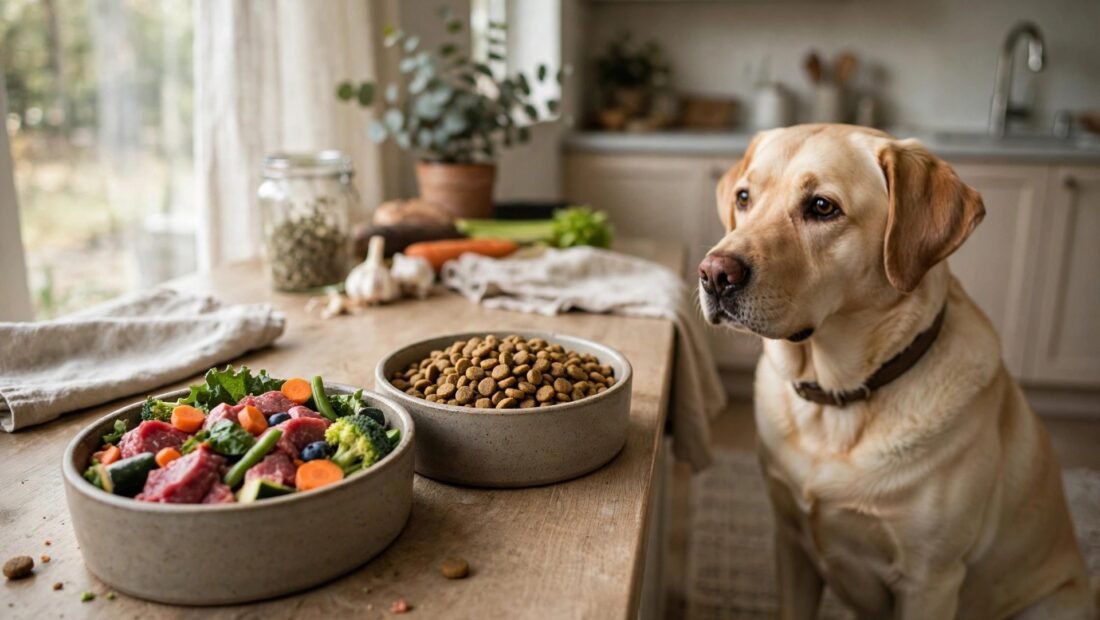
A bowl of raw meat, organs, and bone does look closer to what a wolf would eat. That photo is powerful, and it is exactly the trap. Whether raw food helps a dog has almost nothing to do with how natural the bowl looks. The answer sits in two less photogenic places: the nutrient panel, which shows whether the diet covers every need day after day, and the bacteria count, which shows what else comes with the meat. Judged on those measures, raw and kibble each have real strengths and real weaknesses.
That matters in Texas, where heat, delivery schedules, freezer space, kids on the floor, and a monthly pet budget all change the math. A diet that looks ideal online can fail on a porch in August. The useful question is which complete diet a household can feed safely, correctly, and consistently for the life of the dog.
What Counts as Raw and What Counts as Kibble
Raw feeding covers a wide range. Some owners follow a BARF pattern, short for Biologically Appropriate Raw Food, mixing raw muscle meat, raw meaty bones, organs, and small amounts of vegetables, fruit, or supplements. Others follow a prey-model pattern built mostly around meat, bone, and organs. Raw also comes in commercial forms: frozen patties, freeze-dried pieces, and refrigerated rolls formulated to meet set nutrient standards. Homemade raw and commercial raw are not the same product.
Kibble is dry food made by cooking ingredients under heat and pressure into shelf-stable pieces. Quality varies a lot, from corn-first grocery brands to premium and veterinary lines built to tight formulas with quality fats and proteins. The only fair test is well-made raw against well-made kibble. Once the comparison is narrowed to properly formulated versions of each, the gap shrinks. Raw keeps a few visible edges. Kibble keeps a few structural edges. The rest comes down to cost, safety handling, and fit for a specific dog and home.
The Case for Raw, Claim by Claim
Supporters make several claims. Some hold up well. Some hold up in part. Some rest only on stories from owners who changed a diet and saw a change at the same time.
Shinier Coats and Smaller Stools: Mostly Real
The most steady reports for raw are a glossier coat and smaller, firmer stools with less smell. Both make sense. Raw diets tend to be highly digestible, so less filler passes through. They also tend to be rich in fats that support skin and coat. Less waste in and more nutrients absorbed will change what comes out and how the coat looks. Owners can see and smell that difference within weeks, which is why this claim carries weight.
The limit is that premium kibble closes much of the gap. A kibble with quality fats and digestible protein can also produce a good coat and firm stools. For a dog with dull coat or loose stools on a low-grade food, the bigger gain often comes from moving to any better-formulated diet, not only to raw. Dogs with chronic loose stools also need a medical look first, and guidance on the best dog food for sensitive stomachs can help narrow options before price takes over the decision.
Dental Health: Partially Real
Raw meaty bones do scrub teeth as a dog chews. That mechanical action is real, and it goes beyond what dry kibble does. Most kibble shatters on contact, so the idea that plain kibble cleans teeth by crunching is mostly marketing. A dog working on a raw meaty bone spends more time chewing, with more contact across the tooth surface.
The partial part matters. Bones also carry risks: cracked teeth, choking, blockages, and sharp fragments. Formulated raw without bones offers no such action at all, so the benefit does not apply to every raw product. Brushing and regular vet checks still matter either way.
The Ancestor Argument: True but Incomplete
Dogs did descend from wolves that ate raw prey. That history is true but incomplete as a feeding rule. Dogs have lived alongside humans for more than 15,000 years, eating scraps and cooked foods, and they carry extra copies of genes that help digest starch. A modern Labrador is not a wolf in a smaller coat. Evolution also selects for reproduction, not for the longest, healthiest old age. Pet owners want sound joints and good energy at age 12 or 14. History can inform a choice. It cannot settle it alone.
Energy and Allergies: Anecdotal So Far
Stories about calm allergies and higher energy after switching to raw are common. Some are surely true for that dog. The problem is the cause. Changing any diet removes the old ingredients. If a protein in the old food bothered the dog, a new kibble could have produced the same relief. Energy reports carry the same flaw. A dog eating more fat or a food it likes better will often look livelier. Treat these claims as reasons to watch a dog closely after any diet change, not as promises.
The Case for Kibble, Claim by Claim
Completeness, safety, and steady cost do not make dramatic photos. They do decide whether a diet works over 10 to 15 years without gaps or scares. On those practical measures, kibble is hard to beat.
Nutritional Completeness: The Strongest Point
A kibble formulated to meet AAFCO profiles is designed to be complete and balanced in every serving. Calcium, phosphorus, zinc, vitamin D, essential fatty acids, and amino acids sit within set ranges. An owner scoops the measured amount and the nutrient work is already done. That reliability is the core strength of good kibble, especially for puppies, pregnant dogs, and dogs with medical needs where a shortfall does real harm fast.
Homemade raw struggles here. Reviews of homemade raw recipes repeatedly find most of them short on one or more key nutrients, or with a calcium-to-phosphorus balance that is off in a risky direction. Meat and bones alone do not cover the full list. Getting homemade raw right takes formulation software or direct help from a veterinary nutritionist, plus exact weighing and steady sourcing. Commercial raw that is formulated to the same standards as kibble solves the completeness problem, and that distinction should drive the choice. Format matters less than formulation.
Safety and Bacteria: The Hard Data
Raw meat can carry Salmonella, Campylobacter, E. coli, and Listeria. Testing consistently finds raw pet foods contaminated at far higher rates than kibble. Many dogs carry these bacteria without looking sick, then shed them in stool and saliva. The risk then spreads to people handling the food, cleaning bowls, or getting licked after a meal. Children, older adults, and anyone with a weak immune system face the highest stakes.
Kibble is not sterile, and recalls happen there too. The risk level is still not close. Safe handling lowers raw risk but does not erase it: separate cutting boards, fast cleanup, hand washing, and bowl washing after every meal. Households that cannot keep that routine daily should count that honestly. Guidance in the American Veterinary Medical Association’s pet nutrition resources reflects the same caution most clinics apply in person.
Cost and Daily Effort: No Contest
Raw typically costs 2 to 4 times quality kibble: about $150 to $300 per month for a medium-to-large dog, compared with about $50 to $80 for premium kibble. For a 70-lb Lab in Texas, raw commonly runs $200 or more per month.
Money is only part of the effort. Raw needs freezer space, thaw planning, portioning, and cleanup. Miss a thaw and dinner is late. Lose power in a summer storm and a freezer of raw food becomes a loss and a mess. Kibble needs a sealed bin and a scoop. That simplicity is the reason the diet stays consistent month after month.
Where Most Veterinarians Land
The mainstream veterinary position is caution about raw, driven by the two issues above: pathogen risk and the high rate of incomplete homemade recipes. Major veterinary groups do not recommend raw as a default. That stance comes from treating the infections and the deficiency cases, not from loyalty to kibble brands.
Vets who accept raw for a given client usually point to commercial, AAFCO-formulated raw from a reputable maker, often treated with high-pressure processing to lower pathogen load. Casual homemade raw from an internet recipe gets the strongest pushback. Nearly every vet agrees on one point: a complete diet fed correctly for years beats a supposedly ideal diet fed in fits and starts.
Texas Realities That Change the Verdict
Heat is the Texas factor national debates often miss. Commercial raw ships frozen and must stay frozen until thawing in the fridge. A thawed delivery sitting on a 100°F porch for hours is a bacterial incubator. Owners ordering raw in summer need delivery on a day someone is home, a cooler with ice packs by the door, or local pickup from a store with proper freezers.
Household makeup matters just as much. A home with toddlers on the floor, or a family member on immune-suppressing medicine, carries a different risk from a home with healthy adults only. None of this bans raw in Texas. It does mean the safety routine is not optional detail. It is part of the diet itself.
Verdict and How to Choose
Raw is not magic and kibble is not poison. Well-formulated raw offers real edges in digestibility, stool quality, and often coat condition. It also brings higher cost, higher handling demands, and a higher bacteria risk that no amount of enthusiasm removes. Well-formulated kibble offers proven completeness, lower risk, and value that most households can sustain without strain. Its edges are quieter but they last.
For most Texas dog owners, the sound default is a quality AAFCO-formulated kibble, chosen for the dog’s age, size, and health needs, fed in measured amounts with regular vet checks. Commercial AAFCO-formulated raw, ideally with high-pressure processing, is a legitimate premium alternative when three conditions are met: the budget can carry $150 to $300 per month without cutting other care, no household member is at high risk from bacteria exposure, and the cold chain and cleanup routine will hold in Texas heat. Homemade raw belongs only with a veterinary nutritionist guiding the formula and the owner accepting the daily labor and hygiene work. Casual homemade raw from online recipes and the cheapest corn-first kibble both fail the same test: neither can be trusted to cover the dog, day after day, for a full lifetime.