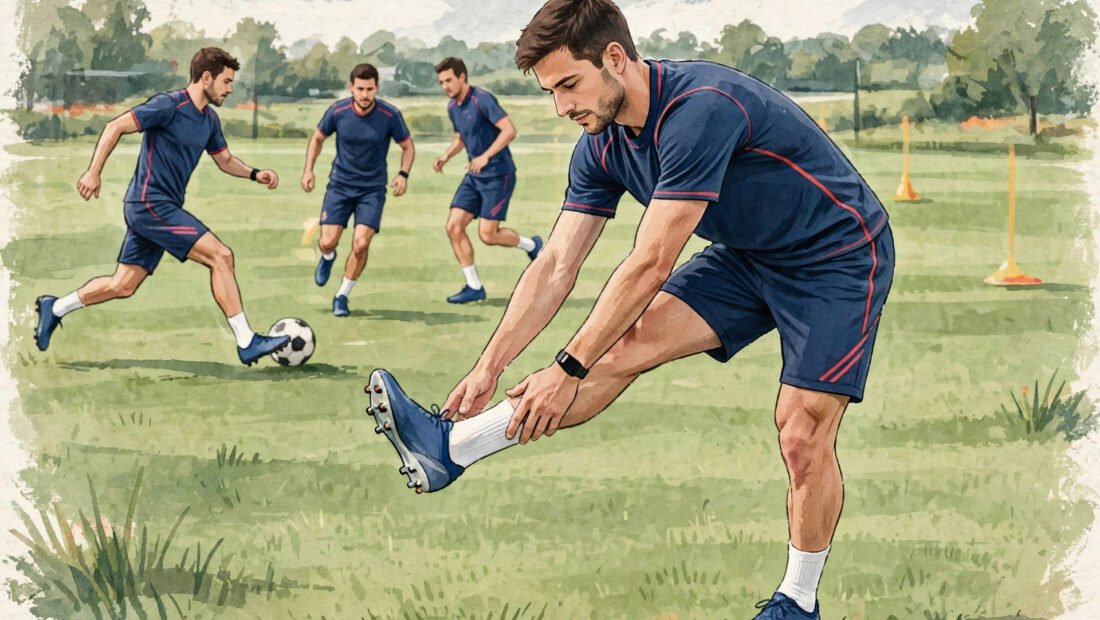
Saturday, 9 a.m. A 38-year-old who sat at a desk all week laces up, jogs two easy laps while chatting, and then, in the third minute, sprints full speed for a through ball played a yard too far ahead. He feels the back of his thigh grab before he reaches it. That sprint is where weekend soccer injuries are born: a cold, stiff body asked to do the hardest move in the game with no build-up at all.
Follow that same player through a better Saturday, and through the week around it. The difference is not talent or age. It is a short chain of choices: how he warms up, what he does twice during the week, how he handles Texas heat, what he wears, when he subs off, and how he recovers. Each choice is plain on its own. Together they keep him playing next Saturday too.
Before Kickoff: The Field, the Shoes, and the First Look Around
He arrives 30 minutes early, which already puts him ahead of most of the team. Before anyone kicks a ball, he walks one slow lap of the field. Weekend park fields in Texas can hide a lot: a sprinkler head sitting high, a dry cracked patch as hard as concrete, a hole near the penalty spot, a slick area where a hose leaked. A 60-second look tells him where to plant with care and where not to chase a loose ball at full tilt.
His shoes match the ground. On a maintained grass field he wears firm-ground cleats with studs that are still even and sharp enough to grip. On artificial turf he switches to turf shoes and leaves metal studs at home, because the wrong shoe on turf can stick when the body turns and load the knee and ankle. He checks for worn, uneven studs, a common cause of slips and rolls on hard summer ground. Shin guards go on without debate. In any game with slide tackles or real pace, bare shins are a needless risk.
He also thinks about how he got into the league and the level he signed up for, because playing at the right intensity is part of staying healthy. Players who are still choosing a team can start with how to find adult rec sports leagues in Houston and pick a division that fits their current fitness, not the fitness they had at 22.
The Warm-Up: Twenty Minutes That Change the Morning
Instead of standing in a circle taking turns to shoot, he works through the FIFA 11+ warm-up. The programme lives on FIFA’s official site, home of the FIFA 11+ warm-up programme, and it was built for soccer players rather than adapted from another sport. Published evaluations of the programme report roughly 30 to 50% fewer injuries among teams that use it as directed, which is why so many adult teams have adopted its structure even if they shorten the name to the pre-game routine.
Part one takes about 8 minutes of running work. He jogs easily, then adds hip rotations, sideways shuffles, and short runs forward and backward. The point is to raise body heat and wake up the basic patterns of the game before any hard effort. His breathing rises, his joints loosen, and his first touches come after his legs are warm, not before.
Part two takes about 10 minutes and does the heavy lifting. It mixes strength, balance, and controlled jumping and landing: squats, lunges, single-leg balance work, and Nordic hamstring curls done with a partner or with support. He starts the Nordic curls assisted and lowers slowly, because the move is hard and sloppy reps teach nothing. He lands from small jumps with soft knees lined up over his toes. Quiet landings are a good sign. Loud, stiff landings are a warning.
Part three takes about 2 minutes of faster running with changes of direction. He builds from three-quarter pace to near game pace, plants, cuts, and slows down under control. Only now does he sprint. By the time the whistle goes, a hard run for a through ball in minute three is no longer his first fast move of the day. It is about his twentieth, and his hamstrings have been prepared for it in steps.
During the Game: Heat, Fatigue, and the Smart Sub
By late morning the Texas part of the morning takes over. He started drinking water long before kickoff: about 16 to 24 ounces in the two hours before the game, then 6 to 8 ounces every 15 to 20 minutes during play, with more after. For a game that runs past an hour in strong heat, he adds electrolytes. His team captain had pushed for a 9 a.m. start for a reason. From May through September, morning games before 10 a.m. and evening games after 6 p.m. are far safer than a midday kickoff, and sensible players push back when a schedule ignores that.
He also knows the warning signs and treats them as orders, not as weakness. Heavy sweating, weakness, headache, nausea, and dizziness point to heat exhaustion. Hot, dry skin, confusion, or collapse point to heat stroke, which is a medical emergency: stop, call 911, and cool the person fast while help comes. Early in the season he takes the heat even more seriously, because the body needs about 10 to 14 days of gradual heat exposure to adapt. The first hot weeks are the danger zone.
Fatigue is the other mid-game risk. Late in each half, stabilizing muscles tire, steps get sloppy, and challenges get late. That is when ankle sprains, groin strains, calf pulls, and knee trouble cluster. Weekend players know the list well: the sprained ankle from an uneven patch, the hamstring pull from one chase too many, the groin strain from kicking without hip strength, the calf strain from pushing off on tight legs. Our player subs off when his legs are gone instead of proving a point. He would rather miss eight minutes today than six weeks after it. If he twists an ankle, he stops at once. He does not walk it off through the rest of the game, because playing on a real sprain can turn a short absence into a long one. In the first 48 hours the approach is rest, ice, compression, and elevation, then gradual rehab. If he cannot bear weight, he gets it checked.
After the Whistle: The First Two Hours and the Next Day
When the game ends, he does not go straight to the car. He walks and jogs easily for 5 to 10 minutes while his breathing settles, then keeps drinking and eats within two hours, with both protein and carbohydrates. That meal is not a reward ritual. It is the start of repair after an hour of sprints, cuts, and contact.
That evening he does gentle movement rather than hard stretching of sore or damaged tissue. Any knock gets compression and elevation. The next day he walks, rides a bike at an easy pace, or swims. Light movement helps stiffness clear. Total rest on the couch often leaves him tighter on Monday. He draws a clear line in his own mind: general soreness is normal after a hard game, sharp pain is not, and pain that changes how he walks or runs is a stop sign.
The Week Between Games: Twice-Weekly Insurance
The part most weekend players skip happens on Tuesday and Thursday, in two short sessions of about 15 minutes. This is the prehab work that makes ankles and knees harder to injure in the first place.
For his ankles, he does single-leg balance work, first with eyes open, then closed, then on a less steady surface. He adds resistance band work for the ankle in both directions and calf raises with a straight knee and a bent knee, so both main calf muscles get loaded. Strong ankles with fast reactions resist the roll that ends a season.
For his knees and hips, he repeats the Nordic hamstring curls at a level he can control, adds single-leg squats, lateral band walks to build the outer hip muscle that helps the knee track well, and more soft landing practice. For the groin, he adds Copenhagen planks for the inner thigh and hip mobility work. Weak hips do not stay a hip problem for long. They pass stress down to the knee and ankle, which is why the whole chain gets trained together.
By Thursday he takes an honest reading. If a thigh, ankle, or knee still hurts in a sharp or specific way, he tells the captain he will sit out Saturday or play only a short, controlled role. Playing hurt is how a small strain becomes a tear and a two-week problem becomes a season lost. He also guards his sleep during the week, because tired players react slowly and get hurt more often.
He applies the same honest test to format, not just to pain. There is no fixed age for stepping down a level. The signal is recovery. If one game leaves him unable to train, walk comfortably, or sleep well for four days or more, week after week, he treats that as useful data rather than a failure of toughness. Smaller-sided games, a lower division, or walking soccer can keep him in the sport he loves while cutting the sprint load and the collisions. Changing the format beats quitting, and it beats forcing a full-speed game his body no longer recovers from.
Come Saturday at 9 a.m., the through ball gets played again. This time he has walked the field, warmed up for 20 minutes, drunk water before he was thirsty, and built strength on two quiet weeknights. He still sprints, still competes, and still ends the morning tired. He just walks down the stairs on Sunday like a man who plans to do it all again next week.