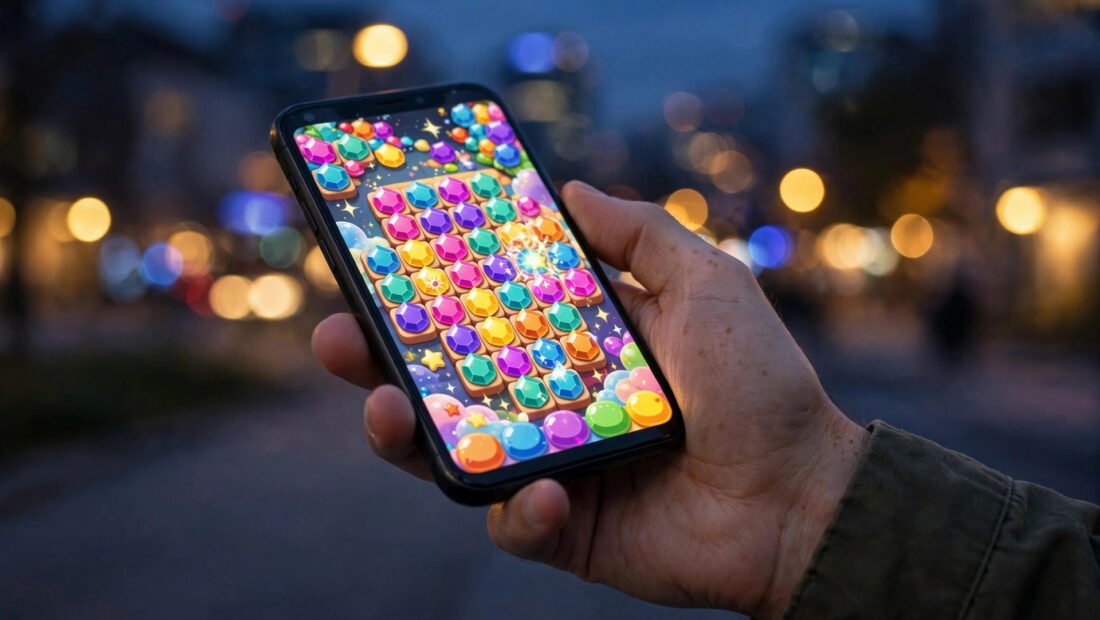
A purchase screen offers 500 gems for $4.99. Five hundred sounds generous. Four dollars and ninety-nine cents sounds small. Between those two feelings sits the whole business of mobile games. The gems are not counted in dollars once they land in your account. A sword costs 300 gems. An extra life costs 80 gems. A chest costs 120 gems. At no point does the screen remind you what a gem cost in real money, and that gap is deliberate.
What pay-to-win means, in plain terms
Pay-to-win means paying real money for power or progress in a contest with other players, in a way free play cannot match in reasonable time. A stronger hero, better gear, faster upgrades, extra moves in a ranked match — if money buys an edge that skill and patience alone struggle to reach, the game has crossed into pay-to-win ground.
Not every purchase does this. Paying for a new look for a character, a fresh map, extra story chapters, or a one-time full unlock sells content, not victory. Those purchases leave the contest itself untouched. Two players, one who paid for a costume and one who did not, still win or lose on play.
The grey zone sits in the middle: paying to move faster. Speed sounds harmless until speed is the contest. If free players need months to reach a level that paying players reach in a weekend, and ranked play mixes both groups together, then faster is stronger for most of the season. Labels matter less than effect. Ask what the money does inside the match, not what the store calls it.
The money underneath free games
Mobile gaming brings in over $100 billion, built mostly on games that cost nothing to download. Free entry is not charity. It is the funnel. A huge pool of free players fills matches, populates leaderboards, watches ads, and creates the world that paying players pay to stand out in.
Commonly reported industry figures put paying players at only about 2 to 5 percent of all players. Within that small group, a still smaller slice — high spenders often called whales — provides the majority of revenue. A design team that lives on a tiny minority will shape the whole game around that minority: deep upgrade ladders with no natural end, rare items priced for big wallets, and events that reward heavy spending during a short window.
That math explains choices that puzzle casual players. Why does progress slow to a crawl at a certain level? Why does a useful item cost more than a full console game? Why do offers appear at the exact moment a level is failed for the third time? The game is tuned to convert frustration into payment from the few who will pay a lot, even if the many find the tuning pushy. Free players are not the customer in that model. In large part, free players are the setting in which customers play.
Premium money that hides real prices
Premium currency is the first tool in the kit, and the 500 gems show how it works. Money goes in once and becomes points with an uneven exchange rate. Packs are sized so the math never comes out clean. You need 300 gems, so you buy 500. You spend 300 and hold 200 that feel free, which pulls you toward the next item priced just above what you hold. Leftover currency is not an accident. It is a nudge to top up again.
Odd prices complete the effect. An item at 280 gems has no clear dollar cost in your head, especially after two conversions — dollars to gems, gems to item — and a bonus offer layered on top. Stores also mix currencies in one game: coins for small goods, gems for premium goods, tickets for events. Each split makes total spending harder to track. A player who would balk at a $40 direct price may spend past $40 in small gem steps without ever seeing the total stated plainly.
The defense is boring and effective: translate back. Before buying, divide the pack price by the gems received, then price the item in dollars. If the number surprises you, the surprise itself is information about why the currency exists.
Energy, timers, and being sold your own time
Energy systems ration play. You get a set number of attempts, levels, or minutes. When the energy runs out, you wait hours for a refill — or pay to keep going now. Waiting is free in money and costly in momentum. Paying removes a pause the game itself created.
Timers do similar work on building and upgrades. A structure takes eight hours to finish, unless gems finish it at once. Early timers last seconds, so the habit forms gently. Later timers last days, and the instant-finish price climbs with them. By then the player has weeks invested in the town, team, or base that is stuck behind the clock.
Battle passes add a second twist: they sell you back your own playtime. You pay for a track of rewards, then must play heavily before the season ends to earn what you already bought. Miss days, and the paid rewards expire unclaimed — unless you pay again to skip levels. The pass can be fair value for someone who plays daily and enjoys the goals. It becomes pressure when the design leans on loss: pay first, then fear wasting the payment.
Walls placed where wallets open
Progression walls are difficulty spikes that arrive without warning. A game flows smoothly for days, teaching you that skill carries you. Then one stage, boss, or rival blocks every attempt. Nearby, as if by chance, sits an offer: a bundle with exactly the hero, gear, or boost that would clear the wall.
Near-miss design sharpens the feeling. You lose by a sliver, again and again. The game shows you how close you came. One more move, one stronger card, one extra attempt would have done it — and each of those is for sale. Losing by a lot invites quitting. Losing by a hair invites paying. That is why the wall and the offer so often arrive together.
None of this proves every hard stage is a sales trap. Good games need hard stages. The tell is placement and pattern. A fair challenge can be beaten with practice and free tools in reasonable time. A sales wall stays stubborn until a purchase softens it, then eases at once. Players learn to feel the difference, even when they cannot name it.
Loot boxes, odds, and the pull that knowledge does not cure
Loot boxes sell a chance, not a chosen item. You pay for a random pull from a pool where the best rewards are rare. Knowing that a desired pull sits at 0.5 percent helps you judge value, but it does not remove the pull. Random rewards on an uneven schedule are gripping precisely because the next try feels due, even when each try is independent and nothing is owed.
Rules have tightened in several countries. Some require odds to be posted. Some treat certain loot boxes as gambling. Some limit sales to minors. Coverage remains patchy from place to place, and enforcement varies, so two players in different countries may face the same game under very different protections.
Parents should treat posted odds as a warning label, not a safety seal. A child does not need to understand percentages to feel the rush of a near win or the sting of a poor pull. For families, Common Sense Media’s guidance on in-app purchases and kids’ games gives a clear starting point for checking a game’s buying systems before a child settles into it.
The fair side of free-to-play
A full account has to hold the counterweight. Game makers deserve to be paid. Making and running a polished game costs real money, and free-to-play lets millions of people play who could never buy a $70 release. For a player with no budget, a fair free game is not a trick. It is access.
Plenty of models respect that access. One-time premium unlocks remove ads and open the full game for a single price. Expansions sell new content in the open. Cosmetic shops sell looks that change nothing in a match. Season passes that reward normal play, without selling power, can suit regular players well. These shops tend to state their value plainly, because plain value is the offer.
Finding fair games takes a little hunting, and starting points help. Lists such as the best free mobile games with no ads point toward titles that leave your wallet alone, and player reviews often name pay-to-win pressure bluntly when it exists. A game that respects your time in the first week usually keeps respecting it. A game that squeezes in the first week rarely loosens its grip later.
Rules that hold when the design pushes
Protection works best when choices are made while calm, not mid-frustration after a failed level. Set a fixed monthly entertainment amount for mobile games, in dollars, before the month starts. When the amount is gone, spending stops until the next month, whatever offer is flashing. A budget set in advance speaks louder than willpower at midnight.
Keep payment friction in place. Turn off one-tap buying. Require a password or fingerprint for each purchase. For kids, remove saved payment methods from the device entirely, so every spend needs an adult in the loop. Friction feels annoying on purpose — it restores the pause that premium currency was built to remove.
Use the value test before any single buy. Five dollars a month for a game you love, that treats you fairly, is rational spending on a hobby, no different from renting a film. Two hundred dollars poured into frustrated gem purchases after a wall appears is the design working as intended, with you cast as the small minority who funds the whole game. Ask, in dollars, what the purchase buys and how long the benefit lasts. If the honest answer is ten minutes of relief, close the store and take a break. The wall will still be there tomorrow, and so will your money, if you let both wait.