Ask people who own a VR headset about their first month and you will hear real excitement. Ask about month three and a different picture shows up: the headset on a shelf, charged less and less often, while the phone and the TV do the daily work. That gap between a great first month and a dusty third month is the honest test for a casual player. Not whether VR is impressive. It plainly is. Whether it stays in your life once the newness wears off.
So both sides get weighed here in full: what VR gives a casual player that nothing else can, what it costs in money, comfort, and company, who it suits, and who should keep their money. A verdict sits at the end.
The Pros: What VR Does That a Screen Cannot
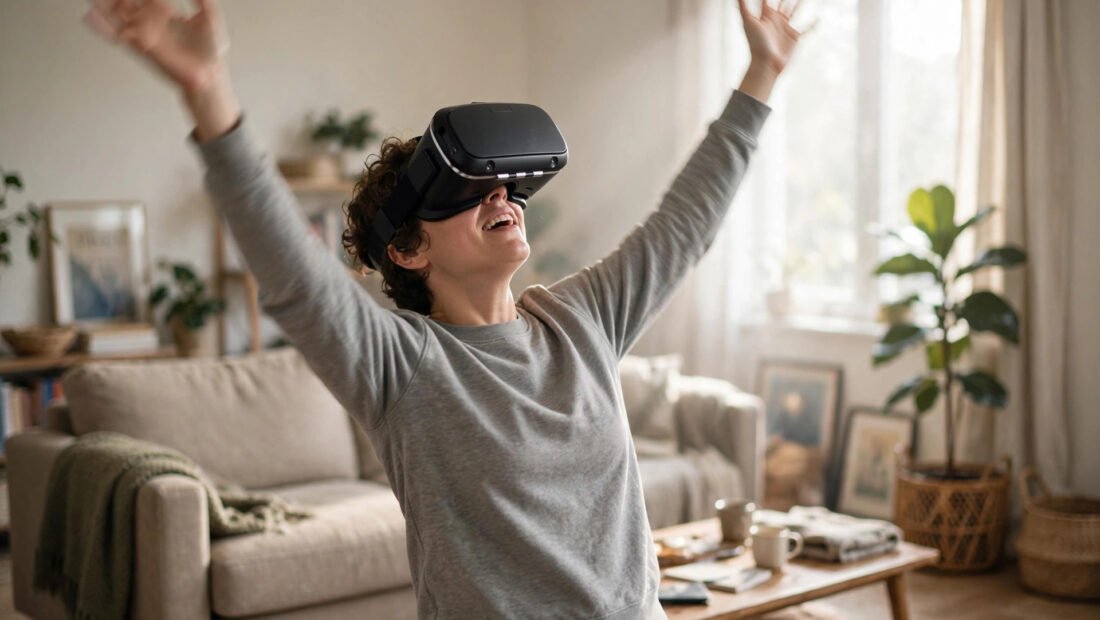
The first pro is presence. A flat screen shows you a place. A headset puts you inside it. You look around by turning your head. You duck, reach, and step aside with your own body. A gentle game about tending a small garden or exploring a quiet island feels different when the garden is around you at full size. No TV upgrade buys that feeling, at any price.
The second pro is genuinely new kinds of play. Fitness games are the surprise hit for casual players. Rhythm games where you slash blocks flying at you to music, and boxing games where you dodge and punch, make people move hard without noticing they are exercising. Sessions end sweaty. Players who would never finish a dull workout video come back to beat their own score the next day. These are short, clear, pick-up-and-play games, and casual players actually finish them, which cannot be said for many 60-hour epics.
The third pro is how simple the hardware has become. A standalone headset needs no TV, no console, and no PC. You charge it, put it on, and you are playing within minutes. There is no cable to trip over in the standard setup and no spare television to claim. For a household where the main TV is always in use, a headset is a second screen that folds away into a drawer.
There is also a quieter pro worth naming: focus. Casual play on a phone or TV competes with messages, news, and the room itself. Inside a headset, the game has all of you for 30 minutes. For people whose gaming time is a short break from a busy house, that full break can be the point. To place the tech itself in context, Britannica’s overview of virtual reality technology traces how long this idea has been developing before reaching the living room.
The Cons: Money First, Then Comfort
Start with the real money, because casual players feel it most. A good standalone headset costs $300 to $550. That is not the full bill. Add a better head strap because the stock one often disappoints, a case, and a handful of games, and an honest first-year total lands at $400 to $700. That is console money, spent on a device most people use a few times a week at most. A casual player has to be sure the use will come.
Motion sickness is the second con, and it splits people sharply. A minority feel sick quickly and hard, and for them VR is simply closed. Others feel mild unease in their first sessions, often tied to games that move the view while the body stays still, and it eases as they adjust and pick calmer games. The trouble is that you cannot know which group you are in from a store page. A demo or a borrowed headset settles it better than any review.
Weight and heat come next. A headset is a box strapped to your face. Over a long session it presses, warms up, and leaves marks. Most casual sessions are short enough to dodge the worst of this, which is one reason VR suits short play better than marathon play. Still, nobody forgets they are wearing it, and on a hot day the appeal drops fast.
The library problem is real for casual players. VR has true masterpieces, games people remember for years. But the shelf of gentle, short, easygoing games is thinner than on a console or a phone. A casual player who wants a new relaxing game every few weeks will run through the best of the catalogue and then wait. Console stores simply have deeper benches of light games.
Last is the social cost. VR is a solo box. One person plays while the rest of the room watches a person waving at air, seeing none of the game unless it is cast to a TV. Couch play, passing a controller, watching a friend’s run: that shared part of gaming mostly vanishes. Households that game together should count this loss honestly. Players weighing screen upgrades face a similar solo-versus-shared question, covered in whether a 144Hz monitor is worth it for casual gaming.
Space deserves a plain word as well. Standalone VR does not need a spare room, but it does need a clear patch of floor, free of coffee tables, pets, and children wandering through mid-game. Most systems let you draw a play boundary and warn you when you step past it, which works well in a living room once the small furniture is pushed aside. In a tiny flat with no clear floor at all, many games shrink to seated or standing-in-place modes, and some of the magic shrinks with them. Check your floor before you check your wallet.
Care and fuss count too, in a small daily way. Lenses fog and smudge. The battery runs down in a couple of hours and needs charging between sessions, so a headset grabbed on impulse is often a headset at 12 percent. None of this is hard. All of it is friction, and friction is exactly what decides whether a casual device gets used on an ordinary Tuesday or only on keen weekends. A console controller asks for nothing. A headset asks for a charged battery, clean lenses, and clear floor, every single time.
Who VR Suits
VR suits the curious casual who plays in bursts of 30 to 45 minutes. That session length dodges the heat, the weight, and most motion trouble, and it matches the best VR games, which are built in short, sharp rounds. If your gaming already looks like a quick half hour after dinner, VR fits your habit instead of fighting it.
It suits fitness-game fans most of all. If the idea of exercise that feels like a game sounds good, VR may be the only gaming purchase that also changes how much you move in a week. It also suits anyone whose TV is always taken by family, sports, or a partner’s shows. A headset ends the screen negotiation entirely. And it suits players who love trying new kinds of play more than they love long stories. VR’s best moments are new sensations, not long plots.
Who Should Skip It
Skip VR if motion sickness hits you in cars, on boats, or in first-person games on a normal screen. That history is a strong warning, and no strap upgrade fixes it. Skip it if the budget is tight. A $400 to $700 first year spent on a better TV, a bigger game library on a system you already own, or a trip will bring more certain joy than a maybe-device.
Skip it, too, if most of your gaming is social: friends on the couch, family game nights, a partner watching your story game beside you. VR takes that shared time away rather than adding to it. And skip it if you know your own pattern with new gadgets is a fierce month followed by a drawer. The shelf story at the start is common for a reason. It is not a character flaw. It is a buying signal.
The Smart Way In, If the Pros Win
If you buy, buy the current standalone headset. It is the cheapest full version of VR, it holds its value best, and it asks for no other hardware. Resist the urge to stock up on games during the first sale. Buy two or three proven games, the ones players still talk about a year after release, and play them properly. Twenty cheap games bought in week one is how a library becomes a chore. Depth beats pile.
If sickness is your open question, borrow or demo first if you possibly can. Ten minutes in the right game tells you more than a month of reading. Start with calm games where the world stays still and you move, rather than games that slide the world past you. Keep early sessions short, stop at the first hint of unease instead of pushing through, and let your comfort build over days.
The Verdict
For a casual player, VR is worth it as a second gaming device, bought with open eyes. It offers a feeling no screen can copy, a small set of games that are truly special, and a form of light exercise that fools people into enjoying it. Those are real gifts, and for the curious player with a spare budget, they justify the price.
It is not yet worth it as anyone’s only gaming device. The catalogue is too thin, the comfort limits too real, and the solo nature too costly for that job. So the honest answer splits by person. Curious, short-session player with room in the budget: yes, buy the standalone, buy few games, enjoy a genuinely new thing. Tight budget, social gamer, queasy traveler: wait, and spend the money where your play already lives. VR will keep improving on the shelf of the store. It does not need to gather dust on yours.