Five dollars a foot and seventy dollars a foot buy the same basic thing: a line around your yard that nothing crosses without permission. The cheapest fence question is therefore not “what is the cheapest fence” — that is chain link, and it is not close — but “what is the cheapest fence that does your job,” because a fence has jobs (privacy, containment, decoration, security) and the cheapest adequate tool differs by job. This guide prices every common option honestly, DIY and installed, adds the hidden costs that ambush budgets, and renders verdicts by need — starting from the headline: a typical 150-foot backyard runs $1,500 to $3,000 in DIY chain link, $2,500 to $4,000 in DIY wood privacy, $4,000 to $8,000 for professionally installed wood, and $6,000 to $12,000 or more in vinyl or ornamental metal.
Chain link: the price champion, honestly assessed
Chain link is the undisputed cheapest fence per foot in America: $8 to $15 per linear foot installed professionally, or $5 to $8 per foot in materials for a determined DIYer. Its pros are longevity and honesty — galvanized mesh lasts decades with essentially no maintenance, contains dogs completely, and never needs staining, sealing or board replacement. Its cons are one word long: appearance. It offers zero privacy and reads “institutional” to many eyes. The mitigations are real, though: black or green vinyl-coated mesh disappears against landscaping far better than silver, privacy slats can be woven in later at modest cost, and a chain-link fence behind a hedge line is a fence nobody sees at all. For pure containment per dollar, nothing else on the market beats it, and over a 20-year horizon — no stain, no boards, no sagging gates rebuilt — it is the cheapest fence to own as well as to buy. Current installed-price ranges are tracked in HomeGuide’s fence installation cost data for anyone pricing their own yard this season.
Wood privacy: the cheapest way to actually not see the neighbors
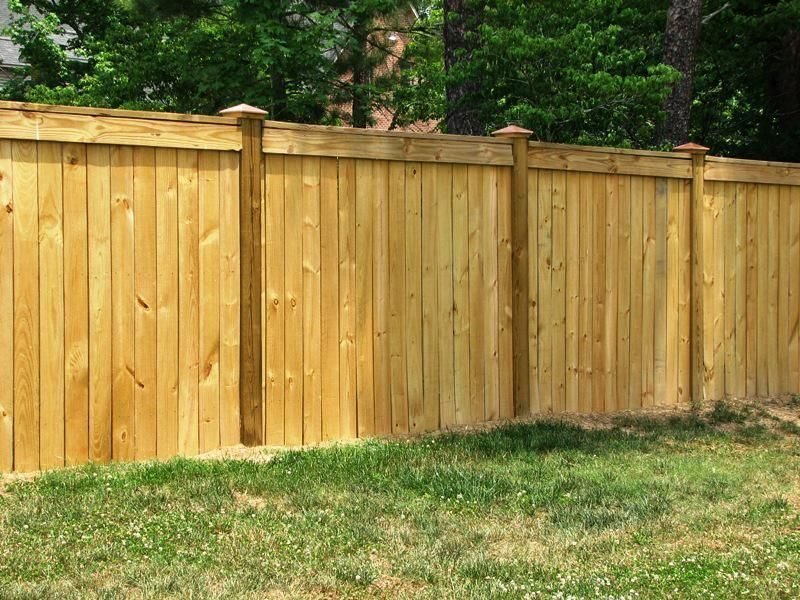
If the job is privacy, wood is where cheap begins to qualify. A DIY pressure-treated pine privacy fence runs $12 to $20 per linear foot in materials; professionally installed, $25 to $45. Cedar costs more up front — $15 to $30 per foot in DIY materials — and looks better, resists rot naturally, and asks less treatment over its life. Wood’s cons ride along: it wants stain or sealant every few years, boards warp and shrink into gaps, and posts rot at the ground line first — the 15-to-20-year lifespan is written in its maintenance. Split rail ($10 to $25 per foot) is the budget rustic option for large rural yards where the fence is a boundary marker more than a barrier; welded wire on wood posts ($8 to $18 per foot) is the garden-and-dog compromise — nearly invisible, genuinely containing, no privacy. Bamboo screening ($10 to $20 per foot) buys fast, cheap privacy with the shortest life on this page; treat it as a season-by-season product.
Vinyl: the expensive way to stop maintaining
Vinyl privacy fencing at $40 to $70 per foot installed is the opposite pole: the highest material price among common options, buying a fence that never needs paint or stain, washes clean, and holds its look for decades. Its economics only work on a long horizon and a long ownership — for a household planning to stay twenty years, vinyl’s lifetime cost approaches wood’s once wood’s staining cycles and board replacements are honestly totaled; for anyone moving in five years, it is a gift to the next owner. It is also the most DIY-unforgiving material here, since posts must be set precisely and panels cut accurately, which is why most vinyl prices you will see are installed prices.
The hidden costs that ambush every budget
Fence budgets die at the edges, not the line items. Gates cost $150 to $400 each, and every yard needs at least one — wide enough for a mower and a wheelbarrow, say four feet minimum. Permits and surveys: many areas require a permit and limit heights (typically 6 feet for backyards, 4 for fronts), and a fence built on the wrong side of the property line is a legal problem with a removal bill attached — a survey at around $300 is cheap insurance on an unsurveyed lot. Check HOA rules and utility easements before materials are ordered, and call the free utility-locating service before any digging, always. Rocky or sloped ground raises labor in ways per-foot quotes hide, and removing an old fence runs $3 to $5 per foot unless the contract includes it. Finally, the DIY ambush is the digging itself: post holes go about 2 feet deep — below the frost line in cold climates — and a gas-powered auger rents for about $75 a day for a reason; hand-digging twenty post holes is the moment good intentions meet geology.
DIY installation: the weekend sequence
For households taking the DIY route, the order of operations decides whether the fence is a satisfying project or a slow argument. Day zero, before materials: confirm the property line (survey or existing pins), mark the line, call the utility-locating service, and check the permit and height rules — every later step assumes the fence is legal and correctly placed. Day one is posts: lay out the line with string and stakes, space posts per the material’s standard (typically 6 to 8 feet), rent the auger, dig to about 2 feet — below the frost line where winters demand it — and set posts in concrete, plumbing each one and bracing the corners and gate posts, which carry the fence’s real loads. Let the concrete set before rails and pickets ask it to work. Day two is infill: rails level between posts, then pickets or mesh, checking plumb and line as you go rather than at the end. Gates come last and get the day’s freshest attention, because a sagging gate is the only part of a fence that moves, and it is judged daily. Two weekends is the honest estimate for 150 feet with a helper; the fantasy of one is how fences end up half-built through a season.
Corner cases: slopes, diggers and pool codes
Three situations rewrite the cheap answer. Sloped yards force a choice between racking (panels that follow the slope, standard for chain link and some vinyl) and stepping (level panels in stairs, typical for wood privacy) — stepping leaves triangular gaps at the downhill side that small dogs treat as a door, so containment yards on slopes need a buried board or mesh along the grade. Diggers are the second: a dog that excavates under the fence line needs a buried apron of wire mesh or a concrete mow strip along the fence bottom, an adder of a dollar or two per foot that no per-foot quote includes. Third, pool fencing is its own legal category in most jurisdictions — minimum heights, self-closing and self-latching gates, climb-resistant surfaces — and the cheapest fence that meets pool code is a specific subset (often chain link with small mesh, or aluminum) that must be chosen from the code outward, not from the price list inward. None of these corners makes fencing expensive; all three make the wrong fence expensive twice.
Neighbors, lines and the diplomacy of fences
The cheapest fence can still be the most expensive if it is built in the wrong relationship. Talk to the neighbors on the line before the survey flags go in: shared boundaries sometimes produce shared costs — splitting a boundary fence with the household it also serves is a normal arrangement in many places, occasionally even a legal default — and a neighbor consulted early rarely becomes a neighbor objecting to the permit office later. The etiquette has a practical edge: the fence’s finished face traditionally faces outward toward the neighbor and the street, with posts and rails on the builder’s side, and many local rules and HOA codes codify exactly that; building the pretty side inward is both a social and sometimes a compliance error. Height, style and material rules may also live in the HOA documents rather than the city code, and discovering them costs one email before the project and one rebuild after it. Fences make good neighbors, as the poem says — but only the ones whose owners did the paperwork first.
The verdict, by job
For containment — the dog must not leave, and most yards asking this question are really asking about the dog, whose indoor half of life is covered by the best flooring for homes with dogs — chain link wins outright: cheapest to buy, cheapest to own, finished in a weekend. For privacy on a budget, DIY pine privacy is the value champion, with cedar as the upgrade that reduces maintenance regret. For the twenty-year stay, price vinyl against wood’s lifetime honestly and let the spreadsheet decide. Whatever the material: survey first, permit second, gates budgeted, auger rented. The line around the yard is simple; buying it without ambush is the real project, and it is entirely doable.