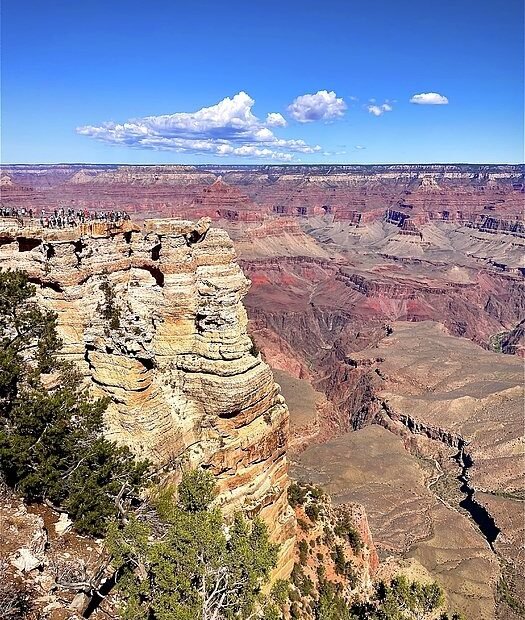
Sunrise at Mather Point, and for once the early alarm is the easiest decision of the whole trip: the canyon in first light, layer after layer of rock turning from grey to rose to fire, is the single finest free show in the American West, and it sets the terms for the day. The Grand Canyon is 277 miles long and a mile deep; nobody “sees” it in a day. But one well-built day on the South Rim — the rim that is open year-round, reachable in a day from Phoenix, Flagstaff, or Las Vegas — delivers a complete experience: the rim at three lights of day, a walk below the rim into the canyon’s silence, the geology explained in one small museum, and sunset from a point the crowds have not found. Here is that day, in order.
The night before and the first hour
The day actually starts the night before. Sleep as close as you can: Tusayan, the small town at the park’s south entrance, puts you ten minutes from the rim; Flagstaff and Williams are honest alternatives at an hour to an hour and a half, at kinder prices. Entry is $35 per vehicle, or covered by the America the Beautiful pass — buy the pass if this trip joins a bigger parks tour, a piece of arithmetic our budget parks planning covers in the best day trips from Las Vegas, which also treats the canyon as the region’s anchor day out. Pack tonight, not at dawn: more water than feels sane (a liter per person minimum for the morning, with refills available at rim stations), salty snacks, sun protection, and layers — the rim sits at 7,000 feet, runs about 20 degrees cooler than the canyon floor and the desert below, and holds real wind even in summer. Check the forecast and the shuttle schedule, set the alarm for an hour before sunrise, and sleep.
Sunrise to 11 a.m.: the rim, then below it
Watch sunrise from Mather Point or Yavapai Point, then take breakfast as the tour buses begin to arrive and do the day’s smartest thing: go down. The below-rim hike is what separates a canyon visit from a canyon viewpoint. Bright Angel Trail is the corridor of choice for a first day — maintained, watered in season, and honest about its grades. Time-box it with the canyon’s iron rule: descending takes a third of the effort of climbing out, so whatever time you walk down, budget double to walk up. The 1.5-mile round trip to the first tunnel (about an hour down and back at a sightseeing pace) delivers the essential experience — the walls rising around you, the river’s world opening below — while the run to the 1.5-Mile Resthouse (three miles round trip) suits stronger walkers with the whole morning. Turn around by time, not by how you feel: every ranger story begins with someone who felt great at the bottom of their ambition. Back on the rim by late morning, refill everything, and give the Yavapai Geology Museum fifteen minutes — the canyon’s whole story in one room of windows and exhibits, and the context that makes the afternoon’s views mean more.
Midday: the village, the shade, the west rim road
Midday light is the canyon’s least flattering and the heat at the rim is real, so spend the middle of the day the local way: in the historic village. Walk the rim trail past the old lodges and studios — the Kolb Studio and the Hopi House, the Bright Angel Lodge’s fireplace built of the canyon’s own strata — eat a real lunch, and let the crowds have the noontime overlooks. Then take the free shuttle west along Hermit Road, closed to private cars in season, stopping as the light begins to improve: the Abyss, where the wall drops sheer for three thousand feet, and Hopi Point, the classic wide view. The shuttle runs every few minutes and every stop is a different cross-section of the canyon; ride it out, walk the rim trail back between two or three stops, and you will have the trail nearly to yourself. Check the National Park Service’s Grand Canyon trip planner for the current shuttle schedules and water-station status the night before, because seasonal changes are routine.
Late afternoon: the east road and Desert View
As the light lengthens, drive east — Desert View Drive is open to private cars and holds the day’s most varied stops. Lipan Point offers the widest river view on the South Rim, the one place where the Colorado’s bends read as a map. Grandview Point carries the mining history and a steeper, older trailhead. Finish at Desert View itself: the 1932 Watchtower, built of native stone with murals inside, climbs 70 feet above the rim and takes in the canyon, the river’s turn, and the Painted Desert beyond. The east side draws a fraction of the village crowds, and in the late light the canyon’s colors deepen by the minute — this is the connoisseur’s half of the park, and the reason a one-day itinerary should always end facing east.
Safety, stated once and plainly
A one-day plan earns one blunt paragraph. The canyon kills and injures visitors every year, almost never through bad luck: the pattern is underestimating the climb out, running out of water in the heat, or stepping past railings for photographs at rim edges where the rock is polished slick. The rules that prevent all three cost nothing — turn around on time rather than distance, carry and actually drink the water (a liter per hour of hiking in summer heat is the park’s own guidance), eat the salty snacks because water alone is not enough, and treat every edge as if it were greased. Heat illness announces itself with headache, nausea, and confusion; the treatment is shade, water, and stopping, and the trail will still be there next year. Children stay within arm’s reach below the rim, full stop. None of this diminishes the day; it is precisely this respect that separates the rim’s regulars from its rescue statistics.
Season notes: the same day, four ways
The itinerary above bends with the calendar and is honest about when it works best. Spring and autumn are the canyon’s prime: mild rim temperatures, long light, thinner crowds, and hiking conditions that let the below-rim walk stretch a little longer. Summer brings the crowds, the midday heat (the inner canyon passes 100°F, which is why the rim-level plan and the early start matter so much), and the monsoon season’s afternoon thunderstorms — spectacular over the canyon, and a hard rule for hikers: be off exposed points and out from below the rim when lightning is anywhere in the sky, and never enter side drainages with storms upstream. Winter is the secret season: the South Rim stays open, the crowds vanish, sunrise comes at a humane hour, and snow on the rim above the red rock is the canyon at its most beautiful — balanced against icy trail tops (carry traction for the first shaded stretch of Bright Angel) and short days that compress the schedule. The Desert View road and some facilities reduce hours in winter; the planner linked above carries the current status.
If you only have half a day
Compressed versions serve the travelers passing through on a longer route. With four hours: sunrise or mid-morning at Mather and Yavapai points, the Geology Museum, the first tunnel on Bright Angel and back, and the rim trail west to Hopi Point — a greatest-hits arc that respects the rules and touches every element once. With two hours, honesty improves the trip: skip the hike entirely, because a rushed descent is how accidents happen, and spend the time on the rim trail between the village and Yaki Point instead, where the views change every hundred yards and nobody has to climb out of anything. A short visit done calmly beats an ambitious one done in a panic, and the canyon — which measures its own history in billions of years — is entirely indifferent to how long you stayed. It rewards attention, not endurance.
Sunset and the walk out under stars
Sunset belongs to Hopi Point if you want the classic (arrive 45–60 minutes early for position in peak season), or to Pima Point and Lipan Point if you want the same light with a tenth of the company. Then do the thing almost nobody does: stay. The canyon does not close at dark, and twenty minutes after the last color, on a clear night, the rim becomes one of the darkest, starriest benches in America. Give your eyes the full twenty minutes to adjust, lie back (well away from the edge), and look up — the Milky Way over a mile-deep darkness is the canyon’s final exhibit, and it does not appear on any tour schedule. Drive out slowly and carefully; elk and deer own the park roads after dark. One day: a sunrise, a descent, a museum, two rim roads, a sunset, and the stars. One day is not enough for the Grand Canyon. But a day built like this is enough to be changed by it.