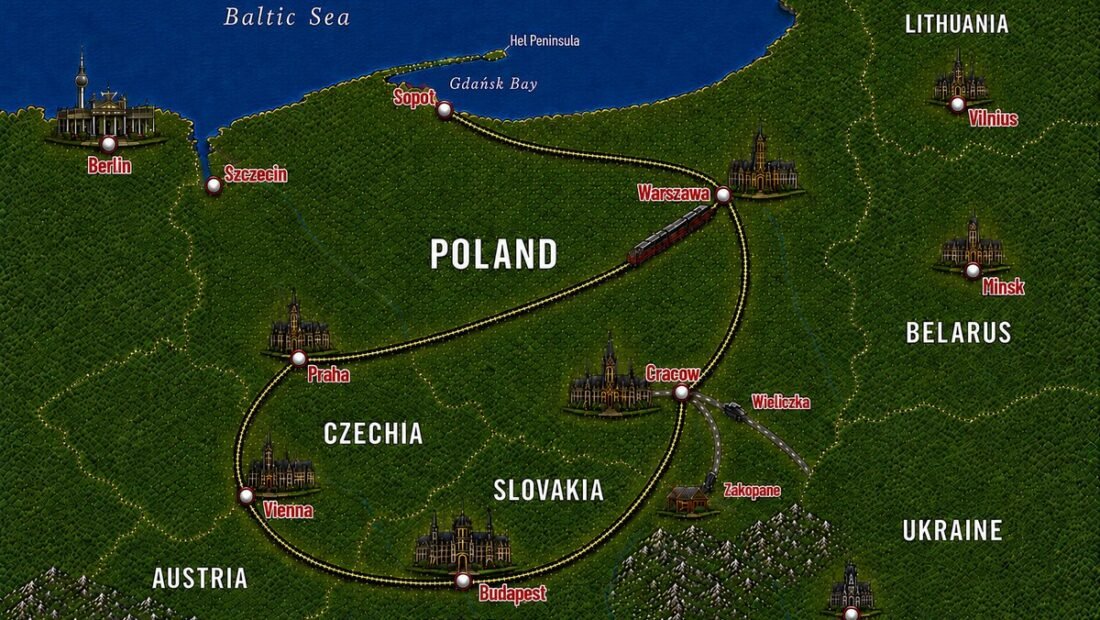
Most multi-city Europe trips do not blow the budget on sights, food, or hotels. They bleed it on motion: the backtracked rail line, the airport an hour on the wrong side of a city, the €29 flight that cost €90 by the time the bag, the bus, and the lost morning were added. Europe rewards the router. The continent is dense, its trains are fast, its budget airlines are ruthless and cheap in equal measure, and the savings live almost entirely in the shape of the itinerary. Five cities in fourteen days for under $2,500 all-in from the US East Coast is a real, repeatable budget — not by suffering, but by routing. Here is the method, step by step.
Step 1: Draw a line or a loop, never a zigzag
Open a map before you open a booking site. Multi-city trips should read as geography: a line (Lisbon–Madrid–Barcelona), a loop (Amsterdam–Bruges–Paris–Amsterdam), or a river’s logic (Vienna–Budapest–Prague triangle), with each hop shorter than the last day’s patience. The rookie mistake is six cities in ten days chosen from a greatest-hits list — London, Rome, Barcelona, Prague in one trip — which spends the vacation inside stations and security lines. The counter-rule: three to four days per major city, one to two for small ones, and fewer cities overall than your ambition wants. Three cities in twelve days beats six in twelve on cost, on rest, and on what you will remember in a year. Book open-jaw flights to match the shape — into city A, home from city D — which deletes the most expensive leg of most trips: the return to where you started.
Step 2: Choose trains and planes by the four-hour rule
Between cities, the working rule: under four hours, take the train; over six, fly; between four and six, price both honestly. Honestly means all-in. The budget airline’s €29 fare becomes: the fare, the bag fee if you have more than a personal item, the bus or train to the secondary airport at both ends, and the two extra hours those airports cost you — frequently losing to a €60 train that ran center-to-center in three hours while you slept, ate breakfast, and watched the countryside do the sightseeing. Trains reward early booking with steep discounts on many national systems, and sleeper trains are the budget traveler’s double agent: transport and a hotel night in a single fare, waking in the next city with the day intact. A rail pass (the options are laid out at Eurail’s pass and timetable information) pays off at roughly four or more long train legs — do the arithmetic against point-to-point early fares before buying one, because on short-hop itineraries the singles often win.
Step 3: Sleep strategically, city by city
Your lodging strategy should change with the city’s price level, not stay fixed across the trip. The sweet spot across most of Europe: private rooms in good hostels ($60–$100, with privacy plus a kitchen and a social common room), dependable budget chains (Ibis and Premier Inn are the metronomes — consistent, well-located, usually under $100), and vacation rentals for stays of three nights or more, where the kitchen converts restaurant meals into market meals. In the genuinely expensive capitals — London, Paris, Zurich — apply the twenty-minute rule: stay one ring out on a fast transit line and take the 40 percent saving, crossing the trip with the cheapest month to fly to Europe from the US so the fares underneath the itinerary are low-season to begin with. Sleep is typically 40 percent of a multi-city budget; the traveler who flexes the format city by city — hostel private in Berlin, rental in Lisbon, chain hotel in London — out-saves the loyalist every time.
Step 4: Eat like a resident with a kitchenette
Food across cities follows one rhythm: bakery breakfast (cheap, local, and better than most hotel buffets), market or bakery lunch eaten in a park or on a train, and one real dinner out a day — ideally the day’s splurge, chosen well rather than nightly by default. Every city on the route has a market hall; make it a ritual stop, because it feeds you, entertains you, and stocks the train picnic for the next leg at a third of restaurant prices. Free walking tours (tip what it was worth) and museum free days exist in nearly every European city and quietly zero out the sightseeing line for the travelers who plan around them — check each city’s museum calendar when you draw the route, not when you arrive. Tap water is safe and free across almost all of Europe; the bottled-water habit is an import worth leaving at home.
A worked example: twelve days, three cities, one line
Watch the method price a real route: Lisbon, Madrid, and Barcelona in twelve days, traveling in a shoulder month. Flights are open-jaw — into Lisbon, home from Barcelona — which in this example removes the return leg entirely and keeps the route a clean west-to-east line. Lisbon gets four days at rental-apartment prices for a stay of that length, with market breakfasts and one splurge dinner on the Alfama side. The Lisbon–Madrid leg is the itinerary’s one judgment call: a short flight priced all-in (fare, bag, both airport transfers, the morning it consumes) against the slower rail options; on this corridor the honest math usually favors flying, booked early, and the example takes the flight. Madrid gets three days — a budget chain by the station, two museum free windows used on purpose, tapas as the daily splurge rather than a seated dinner. Madrid–Barcelona is the train’s showcase: under three hours center-to-center at an early fare that costs less than the airport bus math of flying. Barcelona gets four days, staying one transit ring out. Transport inside the route thus totals a few hundred euros instead of the zigzag version’s cascade of transfers, and every leg was priced against its alternative rather than assumed. That is the whole skill, visible in one route: nothing exotic, just each decision taken in the right order.
Three routing mistakes that survive good intentions
Even careful planners inherit three classic errors. The first is anchoring on a cheap fare into the wrong city — a $60 flight to a place your route then has to escape from, at a cost of a day and a second fare. The route comes first; fares serve it, never the reverse. The second is the overnight bus booked to “save a hotel night”: it saves the hotel and spends the following day, which was the actual currency of the trip, and it is a false economy on any itinerary under three weeks. The third is collecting capitals: capital cities are the most expensive beds and the most touristed sights on the continent, and a route of nothing but capitals skips the second cities — Porto, Valencia, Ghent, Bologna, Krakow — where Europe is often better and always cheaper. Mix one or two into every line and the budget line and the memory line improve together. Backtracking, false overnight savings, and capital-collecting account for most blown multi-city budgets; the five steps exist precisely to catch all three before money does.
Step 5: Run the formula before you book anything
Compress the method into the checklist the plan must pass: route drawn as a line or loop with no backtracking; open-jaw flights priced before any hotel; every intercity leg tested against the four-hour rule with all-in airline math; trains booked at early fares or the pass justified leg by leg; lodging format flexed per city, twenty minutes out in the capitals; one splurge meal a day and markets for the rest; free days and free tours mapped per city. A route that passes those seven tests lands within a few euros of its planned budget almost every time — and leaves the surprises in a European trip where they belong: in the cities, not in the receipts. It also leaves the budget with a margin, which matters more than it sounds: the routes priced this way typically hold 10–15 percent in reserve against the things no formula predicts — the festival nobody knew was on, the train strike rerouted by bus, the small town that deserved a second day and got one. That reserve is not inefficiency; it is what converts a rigid plan into a trip that can say yes. The routers are not the travelers who spent the least in Europe. They are the ones who knew, within a few euros, what the trip would cost before they left home — and spent the difference on being there, rather than on getting there twice. Draw the line, test the legs, flex the beds, eat at the markets — and the continent, for once, will fit both the calendar and the wallet you brought for it. Europe has been rewarding good routers for a century, ever since the first grand tours were plotted by hand on railway maps. The tools are faster now. The geography, and the arithmetic it rewards, have not changed at all.