
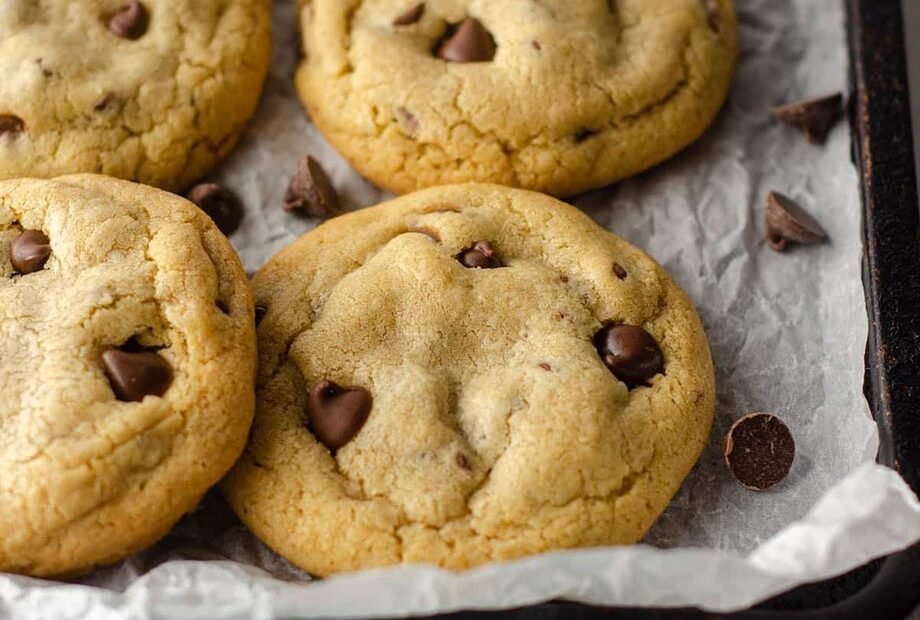
Same dough, same pan, same kitchen. One tray comes out thick and soft, with pale tops and chewy centers. The next tray spreads thin, browns deep at the edges, and crisps as it cools. Nothing changed except one dial. Oven temperature decides how fast butter melts, how far a cookie spreads before it sets, and how much browning and caramel flavor you get in the short time a cookie spends in the heat.
There is no single best number for every cookie. There is a best number for the texture you are after, and conditions that let it work. Heat, dough, pan, and oven accuracy all pull on each other.
What temperature controls inside a cookie
A chocolate chip cookie is a race between spread and set. When dough hits hot air, the butter melts first and the ball begins to flatten and spread. At the same time, heat starts to set the edges as flour hydrates, eggs cook, and sugars change. If the set wins early, the cookie stays thick. If spread runs longer before the set catches up, the cookie goes thin.
Temperature sets the pace of that race. Lower heat melts butter slowly and gives the dough more time to bake through without deep browning. Higher heat melts butter fast, pushes spread hard, and drives strong browning on the edges and bottom. Sugar plays a large part in the second half. As the outside gets hotter for longer, sugars caramelize and proteins brown, which is where the toffee-like, golden flavor comes from. The center, protected by moisture and thickness, can stay soft even while the rim turns crisp.
Time and temperature cannot be separated. Lower heat needs more minutes to bake the center. Higher heat finishes the outside quickly and leaves a narrow window before the bottom goes too dark.
The classic setting: 350°F
For the cookie most people picture — chewy in the center, crisp at the edges, golden all over — 350°F is the classic choice. At this heat, butter melts at a moderate pace. The edges have time to set while the center stays tender, and browning is even without rushing. Most standard doughs bake in 10 to 12 minutes at 350°F, depending on size.
Pull the tray when the edges look set and lightly golden and the centers still look a little soft and puffy. The cookies will finish setting on the hot pan as they cool. If you wait until the center looks fully firm in the oven, it will be dry by the time you eat it. At 350°F the margin for error is wider than at higher heat, which is why so many recipes default to it. It forgives small differences in dough ball size and oven hot spots better than any other setting in this range.
Use this setting when the dough is new to you or you want a balanced result. It will not give the thickest cookie or the crispiest edge, but it gives both in good measure.
Lower and slower: 325°F
At 325°F the whole process slows down. Butter melts more gently, spread is reduced, and the cookie bakes through with less browning. The result is thicker, paler, and softer, with edges that are only lightly crisp. Plan on 13 to 15 minutes for standard-size cookies.
This setting suits cakey and ultra-chewy styles. Doughs with more flour, oats, or brown sugar do well here, because gentle heat keeps them tender. It also helps large cookies, where the center needs more time before the outside gets too dark.
The trade-off is color and flavor. Pale cookies can look underdone even when they are fully baked, and they develop less caramel depth. Check doneness by the set of the edges and a matte, non-wet look in the center, not by color alone. If you love a soft, thick cookie and do not mind a lighter top, 325°F is the dial to choose.
Hot and fast: 375°F
At 375°F the race speeds up. Butter melts quickly, the dough spreads fast, and the outside browns deeply in a short bake of 8 to 10 minutes. Edges turn crisp and well caramelized, and the flavor shifts toward butterscotch and toasted sugar. Centers can still stay chewy if you pull the tray on time, but the window is narrow.
Check at 8 minutes without fail. At this heat, one extra minute can take a bottom from deep golden to burnt, especially on a dark pan. The reward for that attention is real. Thin, lacy cookies with crisp rims live at this setting, and doughs that hold their shape well — those with more flour or oats and less free butter — can take the heat and gain extra browning without collapsing into puddles.
Above 375°F, most home doughs run into trouble. Bottoms scorch before centers set, and spread becomes hard to control. Unless a recipe was built and tested for a hotter oven, treat 375°F as the top of the useful range for chocolate chip cookies.
Your oven may not be telling the truth
Home ovens commonly run about 25°F hot or cold compared with the number on the dial. That single fact explains many mystery batches. A recipe written for 350°F baked in an oven that is really at 375°F will spread more, brown faster, and finish earlier than expected. The same recipe in an oven that is really at 325°F will stay pale and thick and may seem underbaked at the listed time.
A cheap oven thermometer solves the guessing. Hang it or set it on the center rack, where you bake, and read it after a full preheat. Give the oven 15 to 20 minutes to preheat properly. Many ovens signal ready when the air first reaches temperature, but the walls and racks are still catching up, and that stored heat matters for even baking. Bake on the center rack for the most even exposure. If your oven has a strong hot spot, rotate the pan once halfway through, quickly, so you do not dump too much heat.
The same patience with heat applies to morning baking. A cook who learns to trust a thermometer and a full preheat for cookies will use the same habit for other bakes, from cookies at night to how to make fluffy pancakes without buttermilk on a weekend, where steady, accurate heat matters just as much.
How the dough changes the right temperature
Temperature does not act alone. The dough you bring to the oven decides how much spread you need to control in the first place.
High-butter doughs spread more. Soft, rich dough with a high share of butter will flatten fast, especially if it goes in warm. For those doughs, stay at the lower end — 325°F to 350°F — and chill the dough well. The cold start slows the butter melt and gives the edges time to set before the cookie gets too wide.
Doughs with more flour or oats hold their shape. They resist spread, keep a thicker profile, and can handle 375°F when you want deeper browning. If a sturdy dough comes out pale and bland at 350°F, a move to 375°F with a close eye on the clock is a reasonable next test.
More brown sugar adds moisture and can increase spread. When you change a dough in a big way, bake a test tray of two or three cookies at 350°F first, then adjust the dial for the rest.
Chilling, pans, and other details that act like temperature
Chill the dough for at least 30 minutes before baking. Overnight is better when you have time. Cold dough spreads more slowly at any temperature, so cookies stay thicker and bake more evenly. Chilling also lets the flour hydrate fully, which improves texture and helps the center set cleanly. Scoop the dough into balls before chilling if you want the fastest path from fridge to tray.
Pan color matters as much as a small temperature change. Dark pans absorb more heat and send it into the bottoms, so cookies brown and burn faster underneath. At 375°F a dark pan can ruin a batch that would be perfect on a light pan. Use light-colored sheet pans when you can. If all you have is a dark pan, consider dropping the temperature by about 10 to 15 degrees in practice, watch the first tray closely, and pull it early. Let pans cool between batches. Dough placed on a hot pan starts spreading before it even reaches the oven, which flattens the second batch.
Size must be consistent. A scoop gives balls of the same weight, so they set at the same rate. Space balls about 2 inches apart so edges can crisp instead of steaming against each other.
For deeper background on how time, temperature, and dough hydration interact across many cookie styles, King Arthur Baking’s cookie recipes and baking science guides lay out the same principles with tested recipes you can compare side by side.
Convection and baking from frozen
If you bake with a convection fan, reduce the temperature by 25°F from the standard setting. Moving air transfers heat faster, so a convection oven at 350°F bakes more like a still oven at 375°F. A dough meant for 350°F should go into a convection oven at 325°F, with the same check for set edges and a soft center. Watch the first tray. Some fans brown the back row much faster than the front, so a mid-bake rotation helps.
Frozen dough is useful for fresh cookies on demand. Scoop balls, freeze solid on a tray, then store in a bag. Bake straight from frozen at the same temperature, adding 2 to 3 minutes. Do not thaw first, or the balls will spread like warm dough.
Reading the tray and finding your number
Each oven, dough, and pan combination has a best number, and you find it by reading the tray, not by obeying a single rule. Flat and greasy points to warm dough, too much spread, or an oven running hot. Thick and pale points to low heat, very cold dough, or too much flour for the temperature chosen. Burnt bottoms with raw tops point to a dark pan, a low rack, or heat that is too high for the size of the cookie.
Change one variable at a time. Keep the dough and pan the same and move the dial by 25 degrees. Note the time, spread, and color. Within two or three trays you will know whether your best cookie lives at 350°F, at 325°F for thickness, or at 375°F for crisp edges.


1 comment