Washington, DC is the great exception to the rule that capital cities are expensive: the largest museum complex on earth, the most famous monuments in America, the working rooms of a superpower’s government — and the entry price for almost all of it is zero dollars. The Smithsonian museums are free. The monuments are free. The galleries, the gardens, the zoo, even many of the best tours are free. What DC charges for instead is your planning: the free things run on timed passes, seasonal hours, and lines that punish anyone who shows up at noon in July without a strategy. Below is the full list of 25 — every one genuinely free — followed by the tactics that turn them into an actual trip.
The 25, on one list
- The National Mall — two miles of lawns, monuments, and people-watching between the Capitol and the Lincoln Memorial.
- National Air and Space Museum — the Wright Flyer, Apollo hardware, and the most-visited collection of flight history anywhere.
- National Museum of American History — the original Star-Spangled Banner and Julia Child’s kitchen.
- National Museum of Natural History — the Hope Diamond, the great elephant rotunda, the ocean hall.
- National Gallery of Art — a world-class painting collection, including the only Leonardo da Vinci painting in the Americas.
- National Museum of African American History and Culture — the Smithsonian’s most powerful museum; timed passes go fast.
- National Portrait Gallery — the official presidential portraits, in a beautiful old patent office building.
- Lincoln Memorial — best at dawn or dusk, when the crowds thin and the light does its work.
- Vietnam Veterans Memorial — the Wall; quietest and most moving early in the morning.
- Korean War Veterans Memorial — nineteen steel soldiers in the mist, steps from the Wall.
- Martin Luther King Jr. Memorial — the Stone of Hope on the Tidal Basin.
- Franklin Delano Roosevelt Memorial — four outdoor rooms of waterfalls and quotes along the Basin.
- Thomas Jefferson Memorial — the domed rotunda, made for cherry blossom season.
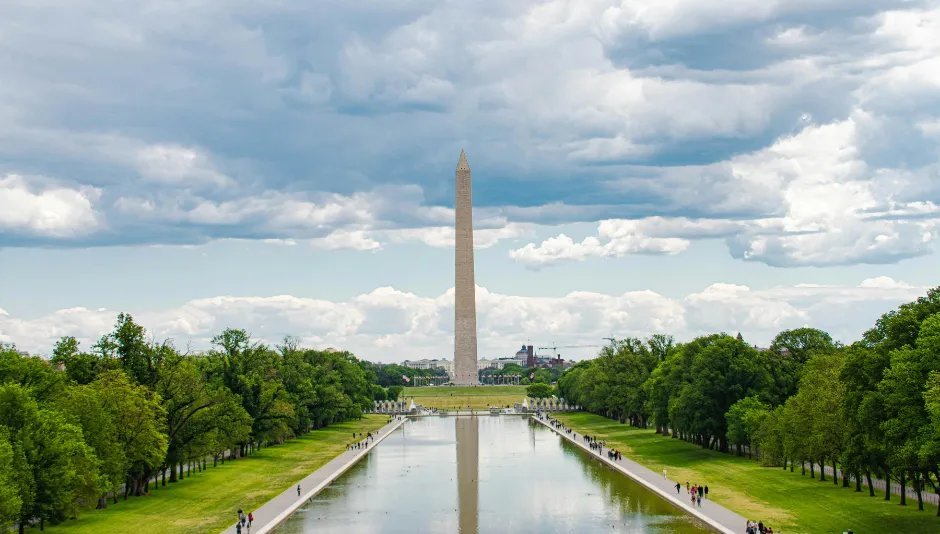
- Washington Monument — the grounds are open to all; the elevator to the top is free but needs a timed ticket.
- World War II Memorial — fountains and fifty-six pillars between the Washington Monument and Lincoln.
- US Capitol grounds and visitor experience — the Capitol grounds and Visitor Center are free; tours are free with advance passes.
- Library of Congress — arguably the most beautiful interior in Washington; free timed-entry passes.
- National Archives — the Declaration of Independence, the Constitution, and the Bill of Rights, in one hushed room.
- Smithsonian National Zoo — a full zoo, free, in a leafy hillside park; timed entry passes in busy seasons.
- US Botanic Garden — a living museum of plants at the foot of the Capitol, conservatory included.
- National Arboretum — 446 acres of gardens, including the original Capitol columns standing in a meadow.
- Rock Creek Park — a forested valley of trails running through the middle of the city.
- The Phillips Collection (pay-what-you-wish hours aside, free days) — check its calendar for free community days in Dupont Circle.
- Evening monument walk — the memorials are open 24 hours and are better lit, and less crowded, than at noon.
- The Supreme Court and its courtroom lectures — free talks by curatorial staff on days the Court is not sitting.
The Smithsonian strategy
Eleven of these sit within a short walk of each other on the Mall, which tempts visitors into museum-whiplash — six museums in a day, remembering none. The institutions are vast; Air and Space and Natural History can each swallow a full morning without showing their B-sides. Pick two majors per day, anchor the day on one, and let the second be optional. Timed passes are the one modern wrinkle: African American History and Culture, Air and Space, the Zoo, and a few others use free timed-entry passes that are released in advance and vanish on spring weekends — book them the moment your dates are set, through the official channels summarized on the Smithsonian’s visitor information pages. Within each museum, go against the crowd flow: start at the top floor or the far wing and work back, and hit the headline object (the Hope Diamond, the Banner) first, before the tour groups organize themselves.
Monuments: timing is everything
The memorials charge nothing and ask only that you come at the right hour. Dawn is the veteran’s choice — the Lincoln Memorial at sunrise, with the Reflecting Pool like glass and a handful of runners for company, is a different place from the noon version with forty tour buses. The evening shift is the other insider move: the monuments are illuminated, the crowds evaporate after dinner, and the walk from the Washington Monument to the Lincoln Memorial, past the World War II fountains and the Wall, becomes the finest free evening in American travel. Rangers staff the memorials until late and their short talks are worth stopping for. One warning: the Mall is bigger than it looks on a map — the Lincoln-to-Capitol walk is about two miles — so plan the day in clusters and use the $1 Circulator bus on the Mall loop to save legs for the museums. The Metro fares ($2–$6 a ride) are the only transport cost this whole list really needs, and after days of free sightseeing you will still want the energy for how to find good local restaurants while traveling when the museums close and the city’s other scene opens.
How to build three free days
The list becomes a trip when it is sequenced. Day one belongs to the Mall’s spine: the Washington Monument grounds, the World War II Memorial, the Wall and the Korean War memorial in the morning quiet, the Lincoln Memorial, then one anchor museum — American History — for the afternoon. Day two pairs the Archives and the Library of Congress in the morning (the two most beautiful interiors, back to back) with Air and Space or Natural History after lunch, and ends with the evening monument walk, when the same memorials you saw at dawn show their second face. Day three leaves the Mall: the Zoo in the morning when the animals are active, the Arboretum or Rock Creek in the afternoon, and a free museum you missed — the Portrait Gallery stays open later than most and sits in a lively neighborhood for dinner. Notice what the plan never does: it never stacks three museums into one day or treats the memorials as a checklist to be sprinted. Free admission removes the pressure to extract value from a ticket, which is exactly the freedom most sightseeing lacks.
The practical footnotes
A few details decide whether free DC feels effortless or exhausting. Many Smithsonian museums open at 10 and the best hour in any of them is the first one; the memorials have no hours at all, which makes them the flexible pieces in every day’s puzzle. Security screening at the museums is quick but adds up across a day, so travel light. Water and restrooms are plentiful and free inside the museums — use them as your pit stops, since the Mall itself has few facilities. Spring (cherry blossoms, roughly late March to early April) is the famous season and the most crowded; autumn brings the same city with thinner lines and better light. School-group season peaks in spring weekdays — if your dates are flexible, a fall Tuesday is the connoisseur’s DC. Finally, keep perspective on the one true cost: your feet. Two miles of Mall, museum floors of marble, and a zoo on a hill can total ten walking miles a day without trying, so shoes matter more than any pass you will book.
The free days that are not on the Mall
Visitors who only do the Mall miss the city’s second layer. The National Arboretum’s Capitol Columns — the original sandstone columns of the Capitol’s east portico, standing in an open meadow — is one of the most surreal free sights in the country, and it is a short drive or bus ride from downtown. Rock Creek Park offers genuine forest hiking inside the city limits. Georgetown’s C&O Canal towpath, the Phillips Collection’s free community days, the Botanic Garden’s conservatory on a cold day, the Library of Congress’s reading room tours — DC keeps dealing free cards. The pattern is that the famous sights are free and the slightly-less-famous sights are freer and emptier. A visitor with three days should spend the third one off the Mall entirely; it is usually the day they talk about most. And if the trip stretches to four days, the surrounding region starts dealing free cards of its own — Mount Vernon’s grounds, the National Park Service trails along the Potomac, and the Smithsonian’s second Air and Space site out by Dulles, where the space shuttle Discovery waits in a hangar big enough to make the Mall museum look like its annex; the Udvar-Hazy Center is free too, and only the parking costs money. Washington’s real luxury is abundance: more world-class free culture than any traveler can exhaust, stacked inside one walkable city, renewed every season. The only ticket you truly need is the one that gets you there.