
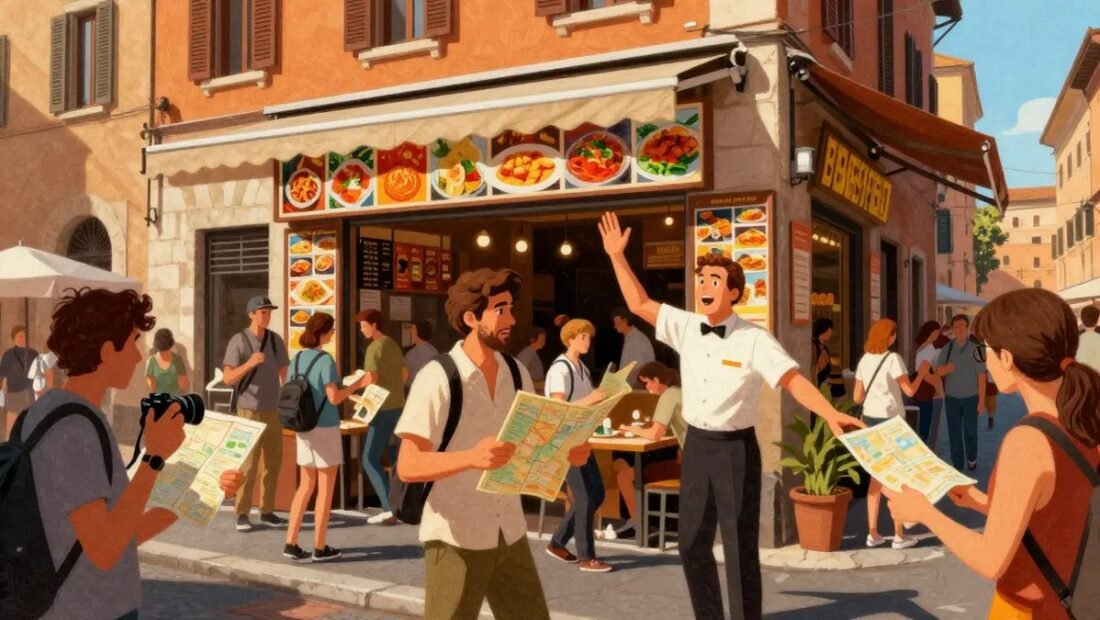
There is a specific, expensive sadness to the tourist-trap meal: a $42 plate of pasta three blocks from a Roman piazza, eaten at a table with a laminated photo menu, while two nights later a cab driver points you to a family trattoria where the same dish costs $14 and tastes like somebody’s grandmother is supervising. The two restaurants can be four hundred yards apart. What separates the traveler who finds the second one from the traveler who funds the first is not luck or language — it is a small set of habits, and the willingness to avoid a handful of mistakes that reliably deliver visitors into the hands of the mediocrity industry. Here is what goes wrong, and then what to do instead.
Mistake 1: Eating where the sights are
The single most reliable predictor of a bad, overpriced meal is a famous view. Restaurants on the main square, beside the cathedral, along the marina’s first row, pay fortunes in rent and recoup it from one-time customers they will never see again — and food quality is the first budget cut. The fix costs five minutes of walking: two or three streets away from the landmark, in any direction, rents fall, repeat local customers appear, and the same city’s cooking improves by half while prices drop by a third. Make it a hard rule on the road: never eat within sight of the thing you came to see. Eat where you can no longer see it, among people who are not looking at it.
Mistake 2: Trusting the first page of reviews
Review platforms help, but the naive use of them is its own trap: sorting by rating alone surfaces the places best at soliciting reviews, which is a marketing skill rather than a cooking one, and the top of the list near any major sight is a battlefield of bought enthusiasm. Read like an investigator instead. Prefer places with a deep bench of reviews in the local language — a restaurant praised in Spanish, Italian, or Japanese by people who live there is a different signal from one praised only in English by people passing through. Weight recent reviews over lifetime averages, look for specific dishes named again and again (order that dish), and treat a cluster of one-star reviews mentioning the same concrete failure (the bill, the wait, the fish) as data. Cross-check a promising name against a second source — a local food blog, a guidebook, or the map listings of Eater’s city dining guides where they cover your destination.
Mistake 3: Reading the menu wrong
The menu itself is a field of signals, and travelers misread it in both directions. A menu in six languages with photographs of the food is a restaurant marketing to people who cannot evaluate it — walk on. A short menu, partly handwritten, heavy with dishes you do not recognize, is a kitchen cooking what the market delivered that morning for people who will notice. A menu with no prices is not always a scam — in some cultures it is a formality for guests — but abroad it should quicken your step toward the door unless a local brought you. The lunch menu deserves special attention: in much of Europe and Latin America the midday set menu is where great kitchens feed their own neighborhoods at half the dinner price, and the traveler who makes lunch the main meal eats better for less all trip long.
Mistake 4: Never asking a human
The most underused restaurant technology in the world is a question, asked of the right person. Not the hotel concierge alone — concierges sometimes work from a list with arrangements attached — but the barista at the morning coffee bar, the market vendor, the taxi driver, the shopkeeper: “Where do you eat on your day off?” lands differently from “what do you recommend,” because it asks for their restaurant, not a tourist’s. Ask two or three locals independently and take the name that repeats. Ask specifically — for the dish the city is proud of, for the place that cooks it without compromise — and you will be directed with the seriousness of a person giving directions to their own family’s table. Politeness and a little of the language open these conversations; even effortful fragments work, and the effort itself is received as respect.
Mistake 5: Confusing busy with good, and empty with bad
Crowds are data, but only the right crowds. A full terrace of tourists at 6 p.m. tells you the marketing works; a plain room full of locals at 9 p.m., eating the regional specialty at neighborhood prices, tells you the cooking works. Judge by who is eating and what is on their plates, at the hour the city itself eats — which in Spain means late, in Germany early, and everywhere means not when the tour groups are fed. An empty restaurant at the locals’ dinner hour is a verdict; the same room empty at 5:30 may simply be early. Pair this with the money basics and the trap loses its teeth: carry the payment method the place prefers, know the tipping custom before the bill arrives (the companion piece on the best way to exchange currency before a trip covers the cash side of eating abroad), and never let the payment moment sour a meal you chose well.
There is a final signal, subtle and almost ethical in feel: how a restaurant treats the people who are not eating there. The kitchen whose staff are fed well, whose regulars are greeted by name at the door, whose owner is visibly working the room rather than absent behind an investment — these predict the food on your plate more reliably than any star or sticker. Travelers cannot audit a business, but they can read a room in ninety seconds, and the room they want is the one where somebody clearly cares. Care is the ingredient no supply chain delivers and no photograph fakes. When you find the room that has it, order what the room is proud of, and eat it slowly — you have done the thing the whole method exists for.
Do the homework before the trip, lightly
Restaurant hunting starts at home, but the goal is a shortlist, not a schedule. In the weeks before departure, save — don’t book — five to ten candidate restaurants per city: the famous one you genuinely want, two local favorites from food writing, two near your hotel for tired nights, and a market or food hall as the flexible option. Pin them on your phone’s map. This creates the traveler’s ideal position: every neighborhood you wander already contains a vetted option, so hunger never negotiates from weakness. The failures this prevents are the hunger decisions — the 8 p.m. capitulation to the place with the tout outside — which account for most bad travel meals. One caution from the other direction: resist the influencer itinerary, where every meal is a famous queue. One pilgrimage meal per city is a pleasure; five is a part-time job with worse food than the place next door that had no line at all.
Special cases: solo diners, kids, and dietary needs
The method adapts. Solo travelers hold a hidden advantage — the bar or counter seat, often available without reservation at restaurants booked out for tables, where the kitchen’s energy is the entertainment and the staff actually talk to you; some of the best travel meals happen on those stools. Families invert the timing rule: the great local restaurant at 6 p.m., empty by big-city standards, is both calmer and kinder with children, and kitchens in family cultures (Italy, Spain, Mexico, Japan) welcome kids as a matter of course when the hour is sane. Travelers with dietary restrictions carry the method’s one extra tool — preparation: learn or print the key phrases for your restriction in the local language, target cuisines where your needs are native to the cooking rather than an exception to it, and treat the market hall as your reliable friend. In each case the principle survives intact: the good meal was findable, and the finding was a skill, not luck.
The correct way, compressed
Assembled, the method fits on an index card: walk three streets from the sight; shortlist from reviews written by locals, cross-checked once; read the menu for brevity and seasonality; ask two humans where they eat on their day off; make lunch the main event; eat at the city’s hour, at the table the city fills. Run it for one trip and a pattern emerges that no app sells: the good restaurants were never hidden. They were simply not marketed to you — because their customers were already inside, eating. Join them. And keep the habit compounding: save the winner of every meal to your map with a note (“order the duck,” “cash only,” “the owner will seat you at the bar”). Trip by trip, those pins become a private atlas of the world’s tables that no guidebook can sell you, because it is indexed by your own taste. Other travelers collect sights. The ones who eat well collect addresses — and of the two collections, theirs is the one that feeds them for the rest of their traveling lives.


2 Comments