
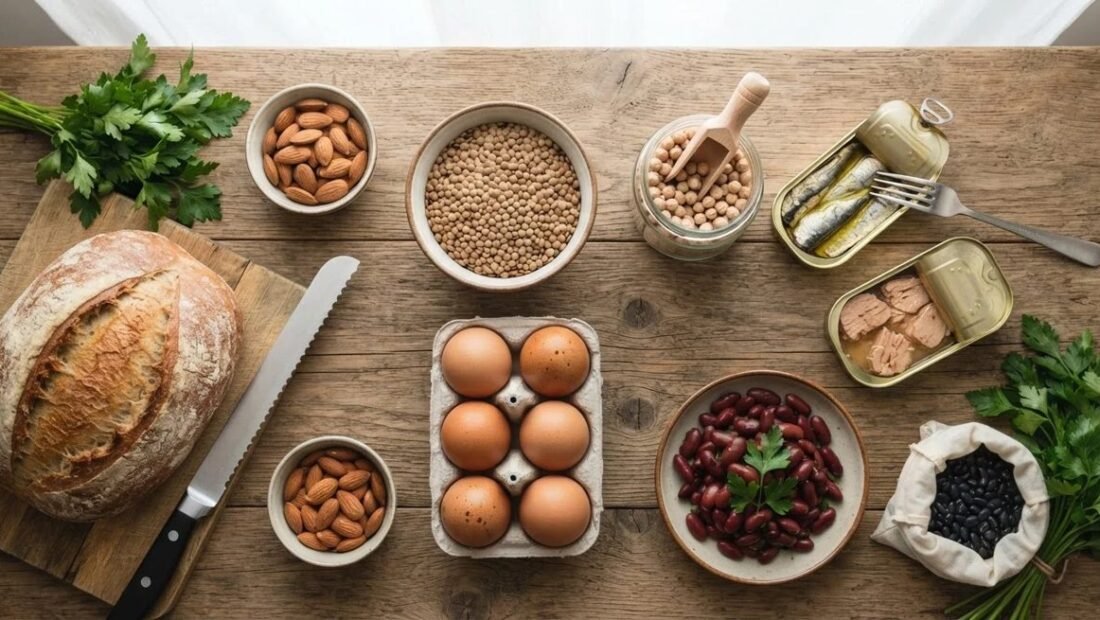
Protein looks expensive until you change the unit. Priced per package, everything at the meat counter seems costly and everything in a tub seems like a deal. Priced per 10 grams of protein — the unit your body actually spends — the grocery store rearranges itself completely: some fashionable sources cost three times what others do per gram, and the cheapest ones are nutritional equals of the pricey ones. A week of high-protein eating on about $60 is genuinely achievable, but most people blow the budget in predictable places first. These are the mistakes, in the order they drain money, and the system that replaces them.
Mistake 1: Buying protein in bar and powder form
Protein bars and shakes are the most expensive protein in the store — routinely three times the cost per gram of ordinary food — because you are paying for processing, packaging, and convenience marketing. As an occasional convenience they are harmless. As staples, they quietly consume the budget that would have bought a week of eggs, lentils, and chicken. The hierarchy they hide is worth memorizing: dried lentils and beans are cheapest by a wide margin (pennies per 10 grams of protein), then eggs at roughly $0.15 to $0.20 per 10 grams, then chicken thighs and drumsticks, canned tuna, peanut butter, store-brand Greek yogurt, and cottage cheese, then ground turkey — and far above them all, the bars and powders. Every dollar moved down that list buys the same grams for less.
Mistake 2: Defaulting to chicken breast
The breast is the most expensive common cut of chicken and, cooked carelessly, the driest. Thighs and drumsticks carry more flavor, forgive overcooking, and cost meaningfully less per pound — and bought as family packs on sale at around $0.80 a pound, portioned into meal-sized bags and frozen flat, they anchor the whole budget. The freezer is the budget protein eater’s real appliance: it converts a one-day sale into a month of cheap protein, and even a small chest freezer (about $150) pays for itself within months in a high-protein household by making bulk buying possible. Paying full price for small packs of breast, weekly, is how a $60 budget becomes a $110 one without a single gram of extra protein to show for it.
Mistake 3: Ignoring the dried-bean math
Lentils and beans sit at the top of the cheap list and the bottom of most shopping carts, usually for one reason: dried beans demand planning. Red lentils are the exception that removes the excuse — they cook in about 20 minutes with no soaking and disappear into soups, curries, and a bolognese-style sauce that eats like it cost money. For the rest, a pressure cooker (about $60 to $80) collapses the time problem entirely, cooking dried beans in roughly 30 minutes unsoaked. The honest time-versus-money trade is real, but it is a one-time equipment decision, not a weekly tax. Households running tight food budgets at scale will recognize the same logic in the $150-a-week meal plan for a family of five: cheap proteins are load-bearing, pricey ones are accents.
Mistake 4: Letting cooked food die in the fridge
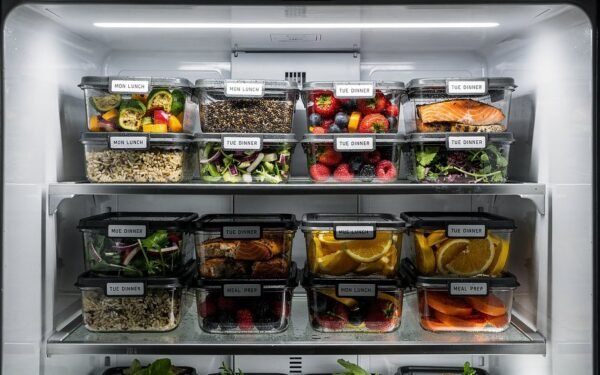
Waste is the invisible budget line. The average careless week throws away a meal or two of cooked protein — which is the same as buying 15 percent more food than you eat. The defenses are dull and total: cook deliberate double portions only of things that freeze well, label everything with a date, and run a weekly use-it-up meal (fried rice, soup, wraps) built from what is left. Food thrown away costs its full price and delivers zero grams.
What a high-protein day on this budget actually contains
Budgets persuade nobody until they become meals, so here is one day at roughly 150 grams of protein, priced at the hierarchy’s cheap end. Breakfast: three eggs scrambled with cottage cheese folded in, plus oats with a spoon of peanut butter — about 35 grams, built from the two cheapest animal sources and the cheapest jar in the cupboard. Lunch: a big bowl of red-lentil soup with a swirl of Greek yogurt — about 30 grams, costing well under a dollar a serving, because lentils at pennies per 10 grams are doing the heavy lifting. Snack: Greek yogurt with oats, or a can of tuna on toast — 20 to 25 grams, depending on the day’s sales. Dinner: two chicken thighs with rice and frozen vegetables — about 45 grams, the day’s largest plate built on the $0.80-a-pound family pack. Evening: cottage cheese or a glass of milk closes the last 15 grams. Total: roughly 150 grams, at a daily cost in the $8 to $9 range — inside the $60 week with room for the vegetables and variety that keep a diet a diet rather than a punishment. The pattern is visible at a glance: no meal is carried by an expensive source, every meal stacks two cheap ones, and the day’s most costly ingredient is chicken on sale.
A word on plant protein and the completeness worry
Lentils and beans are sometimes dismissed in budget discussions because their amino acid profiles are individually incomplete, and that dismissal costs people the cheapest protein in the store. The practical answer is old and unglamorous: variety across the day handles it. Grains supply what legumes lack and legumes return the favor — rice and beans, lentils and bread, peanut butter and oats — and a diet that also includes eggs and dairy, as this one does, covers the profile several times over without a single deliberate combination at any single meal. The body assembles from the day’s total, not from one plate’s perfection. For a tight budget, the completeness objection is a rounding error standing in front of a genuine saving: the sources it dismisses are the ones that make the $60 week possible at all.
Mistake 5: Cooking protein-rich food badly enough to waste it twice
The last budget leak is culinary rather than financial. Cheap proteins punish lazy technique, and food cooked badly gets eaten reluctantly, wasted quietly, and replaced by takeout — the budget paid three times for one failure. The corrections are small and specific. Chicken thighs want high heat and patience: skin rendered crisp in a cold-start pan or roasted until the skin crackles, because flabby thigh skin is the main reason people claim to dislike the cut. Lentils want salt added after they soften and an acid finish — lemon or vinegar at the end wakes up a pot that tasted flat no matter what went into it. Eggs want low heat and to be taken off early, since chalky, overcooked eggs are how a $0.15 protein becomes an uneaten one. Canned tuna wants texture and acid — celery, onion, lemon — not just mayonnaise. Ground turkey, the leanest and blandest of the set, wants aggressive seasoning and the company of beans or sauce. None of this is advanced cooking. It is the recognition that on a tight budget, technique is a financial instrument: the difference between food that gets eaten and food that gets replaced is worth more per week than any coupon.
Tracking is the habit that keeps the system honest after the first enthusiastic fortnight. A single page — paper or phone — recording each week’s protein spending and the rough daily total does two jobs: it catches the slow creep (the convenience protein sneaking back, the small packs replacing the family packs) while the creep is still a rounding error, and it builds the price memory that makes sale-spotting automatic. Nobody needs an app or a spreadsheet with formulas; three columns and thirty seconds on Sunday night are sufficient, because the goal is awareness, not accounting theater. The households that sustain a budget like this for a year are not the ones with the most discipline. They are the ones whose lapses get noticed in week two rather than month four — by a page that remembers what their intentions were.
The $60 week, assembled
Here is the arithmetic that makes the claim concrete: $15 of chicken (thighs, on sale, family pack), $10 of eggs and dairy, $10 of beans, lentils, and grains, $10 of frozen vegetables, $10 of peanut butter and oats, and $5 of spices and incidentals. That is $60, and portioned across a week of breakfasts built on eggs and oats, lunches on lentil soup, bean burritos, and tuna, and dinners on chicken thighs with rotating sauces, it delivers high-protein days without a single bar or shake. Nutrition.gov’s USDA-backed nutrition resources can help check protein content per food while building the list. The lesson the tight weeks teach is durable: protein was never expensive. Unranked protein was. Rank it per gram, buy the bottom of the list on sale, freeze it flat, waste nothing — and the budget stops being the reason the goal fails. The grams were always affordable. They were just waiting to be priced correctly, one honest grocery run at a time.


1 comment