
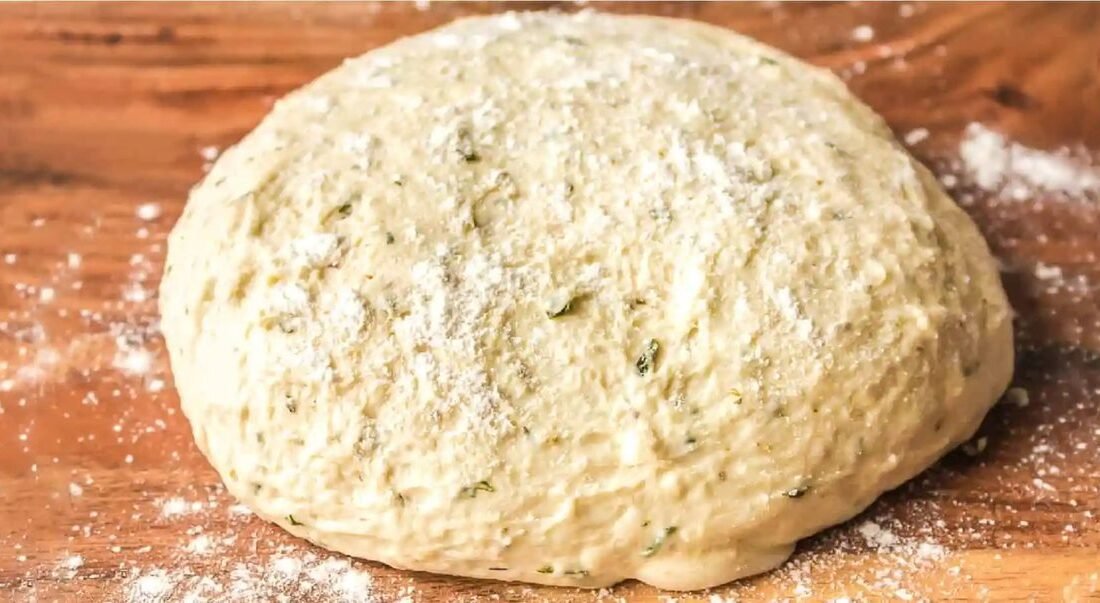
Pizza night is Friday at seven. Working backward from that hour, the dough in the oven has three possible birthdays: it could be mixed Friday afternoon, mixed Thursday and cold-fermented overnight, or mixed Tuesday and given the full three days that pizzerias swear by. All three start from the same five-minute recipe; they diverge in flavor, texture, and how much Friday they consume. What follows walks the whole timeline — the formula, each schedule laid against the clock, and the bake that all three roads lead to — so you can pick the birthday that fits your week.
The formula (identical on every timeline)
For two 12-inch pizzas: 500 grams bread flour (about 4 cups), 325 grams water (about 1⅓ cups — a 65 percent hydration dough, wet enough for an open crumb, dry enough to handle), 10 grams salt (2 teaspoons), 7 grams instant yeast (2¼ teaspoons), and 15 grams olive oil (1 tablespoon). Mix until shaggy and combined. From here, the timelines split. Costs, for perspective: about $2 of ingredients per pizza, against delivery prices that need no elaboration. The flour question resolves quickly too — Italian 00 flour makes a marginally more tender crust, but good bread flour gets you roughly 90 percent of the way, and it is already in most cupboards.
Timeline one: same-day dough (Friday, 3 p.m. to 7 p.m.)
Knead the mixed dough 8 to 10 minutes until smooth and elastic — it should stretch thin without tearing immediately. Rest it in a covered bowl at room temperature for 1 to 2 hours, until roughly doubled. Divide, ball, rest the balls 20 to 30 minutes so the gluten relaxes (a dough that springs back when stretched needs exactly this rest, another 10 minutes at a time; fighting it tears it), shape, top, bake. Flavor verdict: good, clean, bready — the crust of a solid homemade pizza. This is the timeline for spontaneous decisions, and it is the same respect-the-clock logic that makes the easiest homemade bread recipe for beginners work overnight on the counter.
Timeline two: the overnight cold ferment (Thursday to Friday)
Mix the dough Thursday evening, knead briefly or not at all, oil it lightly, cover, and put it straight in the fridge. Over the next 24 hours the yeast works slowly in the cold, and the dough develops flavor compounds a same-day rise cannot produce — a mild complexity and tang that reads as “bakery” without any sourdough starter. Friday: pull the dough out 1 to 2 hours before shaping so it loses the chill and relaxes, then divide, ball, shape, and bake as usual. Effort on Friday is barely more than the same-day version; the flavor is a clear step up. For most households, this is the sweet spot.
Timeline three: the full 48 to 72 hours (Tuesday to Friday)
The pizzeria schedule. Mixed Tuesday, the dough ferments in the fridge for two to three days, and the flavor deepens further — more tang, more chew, a crust that blisters and leopards at the edges. The dough also becomes easier to stretch thin without tearing, because days of slow fermentation relax and condition the gluten. Two cautions: past 72 hours the yeast tires and the dough can over-acidify and slacken, so the window has a back wall; and the dough needs a container with headroom, since it still expands in the cold. Dough also freezes well after its first rise — portioned, oiled, and bagged for up to 3 months, then thawed overnight in the fridge and brought to room temperature for 1 to 2 hours before shaping. The freezer turns timeline three into pizza on demand.
Shaping: the ten minutes the timelines cannot do for you
Fermentation builds flavor; shaping decides whether the pizza is round, thin-centered, and properly rimmed. The method that works for all three timelines: tip the rested ball onto a well-floured surface, press the center flat with your fingertips while pushing the air outward into the rim — never roll it with a pin, which crushes the rim’s bubbles and with them the crust’s whole character — then stretch the disc over your knuckles, rotating and letting gravity do the work, until it reaches about 12 inches. The rim stays untouched and puffy; the center goes thin enough to read light through. If the dough resists and keeps shrinking back, it is not a flour problem or a kneading problem: it is rested insufficiently, and the answer is to walk away for 10 minutes and let the gluten relax, exactly as with the same-day timeline. A torn patch is patched by pinching dough from a thick spot over the hole, not by starting over. Sauce goes on lightly, in a spiral from the center, leaving the rim bare; cheese stops short of the edge too. The pizza that launches cleanly onto a hot steel is built on parchment for beginners without shame — the paper can be slid out after two minutes, or left under for the whole bake at a small cost to the base’s crispness.
Hydration and flour: the two dials for tuning the crust
The 65 percent formula is a starting point, and both dials move the result in predictable directions. Hydration: pushing toward 70 percent yields a softer, airier, more open crumb — the Neapolitan direction — at the price of a stickier dough that demands floured hands and confidence; dropping toward 60 percent gives a firmer, crisper, more cracker-edged crust that is easier to handle and the right choice for a first month of pizzas. Flour: bread flour’s higher protein builds the chew and structure that support toppings; all-purpose flour works and simply makes a more tender, less chewy crust — a preference, not an error. Whole wheat flour can replace a quarter of the bread flour for flavor and fiber before the dough starts fighting back. Every combination of these dials is still the same recipe and the same three timelines; the settings are how a household’s pizza becomes its own over a season of Fridays rather than a copy of a pizzeria’s.
Friday, 6:15 p.m.: the bake every timeline shares
Home ovens struggle here, and the fix is thermal mass. Preheat a pizza stone or steel at the oven’s maximum — usually 550°F — for at least 45 minutes. A steel (about $80 to $100) outperforms stone in home ovens, transferring heat faster for a better-crisped base. Shape the dough on a floured peel or parchment, top lightly (excess moisture is the enemy of crispness), and launch it onto the steel. Bake 6 to 8 minutes until the crust is leopard-spotted and the cheese bubbles in patches. Ooni’s pizza dough recipes and oven resources are worth browsing for shaping and launching technique, which is the one skill the timeline cannot supply.
The freezer as a fourth timeline
Beyond the three birthdays, the dough tolerates a pause button that turns any free half hour into a future pizza night. After the first rise on a same-day schedule — or straight after mixing and a night’s cold ferment — portion the dough into balls, oil them lightly so they do not dry or stick, and freeze them in individual bags with the air pressed out, for up to 3 months. The thaw is gentle and non-negotiable: overnight in the fridge, then 1 to 2 hours on the counter to lose the chill and relax before shaping, exactly like a cold-fermented ball on pizza day. Frozen dough is not quite the equal of a fresh 72-hour ferment — the yeast loses a fraction of its vigor to the cold — but it is far better than any frozen pizza from a box, and it converts pizza night from a plan into a possibility on evenings when planning failed. Households that make dough in double batches whenever they make it at all end up with a freezer bank of Fridays, which is the closest home cooking gets to a delivery service with no delivery fee.
Sauce and cheese, though not the dough’s department, obey the timeline too: a sauce made from crushed tomatoes benefits from being made whenever the dough is mixed — even three days ahead — because its raw edge mellows in the fridge, while cheese should be grated or torn the day of baking and kept cold so it melts in patches rather than sliding into one sheet. Low-moisture mozzarella is the working cheese; fresh mozzarella is the delicious hazard, weeping water onto the crust unless it is torn, salted, and drained on towels for half an hour before the pizza is built. None of this is the dough’s fault when it goes wrong, but the dough gets the blame at the table — one more reason to give the toppings the same respect for timing that the timelines gave the crust.
Troubleshooting, in one breath
Dough tears while shaping: it is under-rested, not under-kneaded — give it 10 minutes and return. Dough is slack and sticky after three days: it has gone past its window; bake it anyway as a flatbread and shorten the next ferment. Crust is pale: the steel was not preheated long enough, or the oven’s true maximum is lower than its dial claims. Base is soggy: too much sauce or wet toppings — mozzarella should be low-moisture and toppings patted dry. Every one of those is a timeline or temperature problem, and now you hold both levers.


1 Comment