
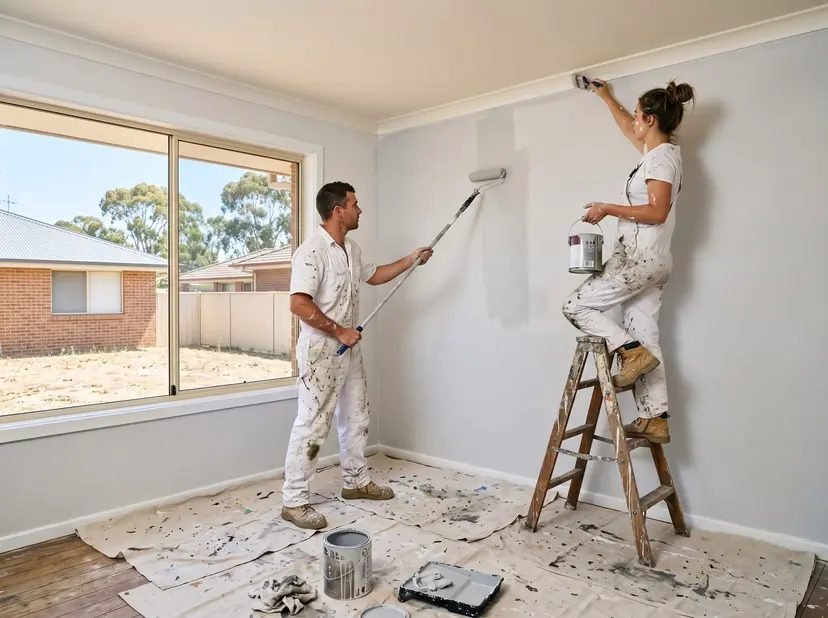
Ask three painters to repaint the same 3-bedroom house and the quotes come back spread like a poker hand — $2,800 from one, $7,500 from another, and every painter certain the others are the problem. The spread is not random, and it is not mostly about paint. It is about scope: what prep is included, whether ceilings and trim are in, whose paint, and how many coats. This guide prices the job three ways — full professional, full DIY, and the hybrid most households should actually buy — with each option’s real total, then gives the verdict by situation. The honest headline: in most US markets, a professional whole-house interior repaint runs $3,000 to $6,000, and doing it yourself runs $500 to $1,000 in materials and a great deal of your time.
Option one: the full professional job
Professional painters typically price interior work at $2 to $6 per square foot of floor space for walls, and a whole 3-bedroom house with ceilings and trim usually lands between $3,000 and $6,000 in average markets. High-cost cities — New York, Boston, San Francisco — run 30 to 50 percent above that; smaller Midwest markets can come in under $3,000. A professional crew needs three to five days for walls, ceilings and trim, and what the money really buys is preparation: filling, sanding, caulking, masking and priming, the unphotogenic hours that decide whether the finish looks like glass or like a landlord special. Paint itself is a minor character — quality paint costs $40 to $70 a gallon, a whole house drinks 10 to 15 gallons, and materials are rarely more than about 15 percent of a professional quote. For a second benchmark while collecting bids, HomeAdvisor’s interior painting cost guide tracks what homeowners nationally report paying, which helps flag a quote that is an outlier in either direction.
Option two: full DIY
The DIY math is genuinely compelling: $500 to $1,000 covers quality paint and every supply for an entire house, against $3,000 to $6,000 hired out. The currency you actually pay in is hours — a careful do-it-yourselfer should expect 40 to 60 hours across the whole house including prep, spread over weekends, because paint dries on its own schedule and rooms must be emptied, painted and re-inhabited in sequence. The quality gap between amateur and professional work shows in predictable places: the cut line where wall meets ceiling, the trim edges, and the third room, where patience runs out and coats get thin. DIYers also underestimate the tooling tail — ladders, a decent sprayer or quality brushes and rollers, drop cloths, an orbital sander — though most of it survives to serve the next decade of projects. Where DIY wins outright: single-story houses, standard ceiling heights, rooms emptied anyway for a move, and households that can tolerate a room-a-weekend pace. Where it loses: two-story entry halls, heavy trim detail, textured repairs, and any deadline with movers attached to it.
Option three: the hybrid most people should buy
Between the two poles sits the arrangement painters quietly do for their own relatives: hire out the hard 30 percent and roll the easy 70 percent yourself. Professionals earn their fee on ceilings, stairwells, high walls and trim — the ladder work and the brush work — while flat bedroom and living-room walls are the most forgiving painting in a house. A common split: the crew does ceilings, trim and the entry for perhaps $1,200 to $2,000, and the household rolls the walls room by room for $300 to $500 in paint. The hybrid also solves the two DIY failure points — the wobbly ceiling line is a pro’s problem now, and the walls you roll sit beneath it forgivingly. However you split it, settle colors before anyone prices anything: a quote built on indecision gets padded, and color decisions belong to calmer tools, like weighing the best paint color for a small dark living room before a gallon is opened.
What a good quote looks like — and the red flags
A serious quote is itemized: rooms listed, prep spelled out, primer named, coat count stated (two finish coats is the standard to hold), paint brand and line specified, ceilings and trim explicitly in or out, and a timeline. Numbers given without seeing the house are not quotes but lures. Deposits of 10 to 20 percent are normal; a demand for 50 percent upfront is a reason to end the conversation. Proof of insurance should be offered without drama. The dramatically low bid deserves the most suspicion, because in painting, money not charged is usually prep not done — skipped primer on patched walls, one coat stretched over two rooms’ worth of paint, edges cut freehand by the cheapest hand on the crew. Timing helps the honest bidder: late fall and winter are painters’ slow season in most markets, and 10 to 15 percent below peak pricing is a realistic negotiation then, especially for a job that fills a January gap.
Paint quality: where the extra $20 a gallon goes
Since paint is only about 15 percent of a professional job, the upgrade from bargain paint to a quality line is one of the cheapest decisions in the whole project — and one of the most consequential. Better paint covers in fewer coats (which is labor, whichever route you chose), resists scrubbing in kitchens and halls, and holds its color years longer before chalking and fading nudge you toward repainting. The $20-per-gallon difference between a budget and a premium line amounts to a few hundred dollars across a whole house, spent once, on the only part of the job that remains visible for a decade. Specify the paint by brand and product line in the quote, not by the word “premium,” and the same logic disciplines the DIY route: the household that buys cheap paint to save $200 and applies three coats instead of two has purchased extra weekends at a terrible rate.
Reading three real quotes: a worked comparison
The spread that opens this article becomes legible once quotes are forced onto the same scope. Imagine the $2,800 bid itemized: walls only, one coat of builder-grade paint over existing color, no ceiling, trim extra, prep “as needed.” The $7,500 bid: walls, ceilings and trim, two coats of premium paint, full prep and patching, furniture moved and protected, high-cost metro labor. And the middle bid at $4,200 — the shape of a sensible purchase: walls and ceilings, trim included, two coats of named quality paint, prep spelled out, three days of crew time. None of the three numbers is dishonest; two of them are answers to different questions. The buying skill is making every bidder answer the same question — same rooms, same surfaces, same coats, same paint line — at which point the quotes converge to an honest band and the remaining differences are labor rate and schedule, which are fair things to choose on. Homeowners who skip this normalization are the ones who “save” $1,400 and repaint in three years.
Scheduling and living through it
However the job is bought, somebody lives in the house while it happens, and the sequence determines the misery level. Paint room by room in an order that always leaves one bedroom and one bathroom fully functional; move furniture to the center of each room rather than out of the house where possible, since a crew with clear walls works faster and a household with its own beds sleeps better. Ventilation is a real constraint: modern low-VOC paints have tamed the fumes but not abolished them, and bedrooms should cure a day before they are slept in, with children and pets given the longest margins. Dust from sanding prep travels further than any drop cloth’s authority — seal the work room’s doorway with plastic when heavy patching is planned, and remove or cover soft furnishings in adjacent rooms. Professional crews compress all of this into three to five days of managed disruption; DIY households stretch it across weekends, which argues for painting in the mild seasons when windows can stand open and a room can be surrendered without freezing or roasting its occupants. Plan the season, the sequence and the sleeping arrangements with the same care as the paint color, and the project is remembered for the result instead of the fortnight.
The verdict
Hire the full job if the house has high ceilings, heavy trim, a deadline, or occupants whose weekends are genuinely scarce — and budget $3,000 to $6,000 without flinching, because a good repaint lasts the better part of a decade. Do it entirely yourself if the house is simple, the timeline is elastic and the household contains at least one person who finds painting meditative; budget $500 to $1,000 and protect the prep hours from being squeezed, since prep is where DIY quality is decided. Everyone between those poles should price the hybrid and watch it win most comparisons. Whichever route you take, buy 10 percent more paint than the estimate, keep the leftover labeled by room, and remember the sentence every painter knows: the paint is the cheap part — you are paying, in money or in weekends, for the preparation underneath it.

1 Comment