The first real storm of autumn is when a clogged gutter stops being an abstraction. The water sheets over the edge in a solid curtain beside the front door, the mulch floats out of the bed, and every trip in or out of the house passes through a cold waterfall that was supposed to be running quietly down a spout twenty feet away. Cleaning the gutters fixes it in an afternoon. The catch is that the job happens at the top of a ladder, which is exactly where a rushed Saturday chore turns into an injury. Done in the right order, with the right setup, it is a dull, safe, twice-a-year task. Here is that order.
What you need
- A sturdy extension ladder, long enough to extend 3 feet above the gutter line
- A ladder stabilizer (also called a standoff) that spans the gutter, about $30 to $50
- Work gloves — gutter edges and old screws are sharper than they look
- A plastic scoop or garden trowel, and a bucket with a handle or a ground tarp
- A garden hose with a spray nozzle
- A second person at home who knows you are up there
Step 1: Set the ladder like it matters, because it does
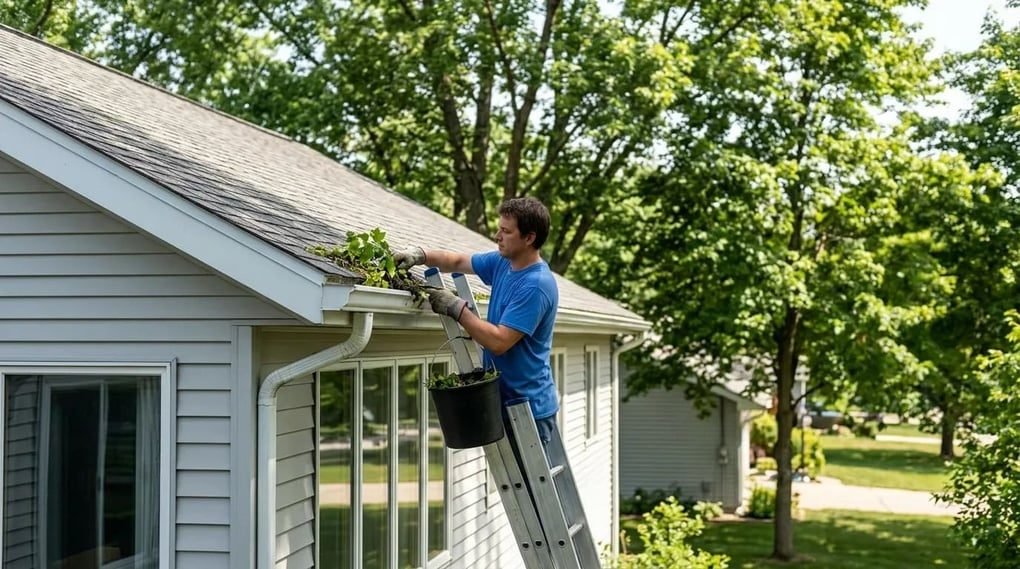
Most gutter injuries are ladder injuries, and most ladder accidents are setup failures rather than bad luck. Place the ladder on firm, level ground — never on a slope, a wet deck, or a stack of bricks to even it out. Set it at the 4-to-1 angle: for every four feet of height to the gutter, the base sits one foot out from the wall. Extend the ladder so the top three feet rise above the gutter line, giving you a handhold to step around rather than a rim to grab. Fit the stabilizer before you climb. It braces against the wall or roof on either side of the gutter, keeps the ladder’s weight off the soft aluminum trough itself, and stops the sideways wobble that makes people overgrip and tire fast. Lean the ladder against the gutter directly and you can dent the trough or slide along it. Neither is a good start.
Step 2: Work in short reaches and move the ladder often
The single most dangerous habit in gutter cleaning is leaning out to stretch the job between ladder moves. The rule is simple: your belt buckle stays between the ladder rails. If you cannot reach it from inside the rails, you climb down and move the ladder. It feels slower. It is actually faster than the alternative outcomes, and a full gutter run on a typical house only needs a dozen or so moves. Scoop toward yourself, working away from the downspout first so the loose debris does not wash into it when you flush. Drop debris into the bucket or onto a tarp below rather than scattering it across the beds you just cleaned. Wear the gloves: gutters collect roofing screws, sharp granule grit, wasp nests, and the occasional dead animal, and none of those should be discovered barehanded.
Step 2½: The ground-based options, honestly graded
Every autumn, hardware stores sell alternatives that promise gutter cleaning without a ladder: telescoping wands that blast water from the ground, vacuum attachments, and gutter spoons on extension poles. They deserve a fair grading. For a single-story house with light, dry debris, a high-pressure wand from the ground can move leaves along a straight run, and it keeps both feet on the lawn. But the wand cannot see what it is doing, struggles at corners and downspout elbows where clogs actually live, and showers the operator in gutter water. Pole-mounted scoops share the blindness problem. The honest summary: ground tools are a reasonable maintenance rinse between proper cleanings on low houses, and a poor substitute for the twice-a-year ladder job on anything taller or genuinely clogged. What they never replace is the inspection — half the value of the ladder trip is what your eyes report about seams, hangers, and pitch while you are up there.
Step 3: Clear the downspouts before you declare victory
A gutter can be spotless and still overflow if the downspout is plugged at the elbow, which is where plugs almost always form. After scooping, run the hose along the gutter toward the downspout and watch the bottom. A healthy spout discharges a strong, steady stream. A weak trickle means a blockage; try blasting upward from the bottom with the nozzle, then downward from the top. A plumber’s snake works the stubborn ones. While you are tracing water, check where the downspout ends: it should discharge at least 4 feet from the foundation, with an extension or splash block if it dumps closer. Water delivered neatly to the base of the house is barely better than water spilled over the edge.
Step 4: Flush, then read what the gutters are telling you
With the troughs clear, flush each run with the hose and watch how the water behaves. It should flow steadily toward the downspout with no standing pools. A pool in the middle of a run means the gutter has sagged and lost its pitch — usually a failed hanger — and the fix is a new hanger driven into the fascia, not more cleaning. Drips at seams and corners call for gutter sealant after the joint dries. Streaks down the siding below a joint, rust spots, and screws backing out are the gutter system filing its maintenance report; cleaning day is when you read it. Ten minutes of sealant and hanger work during the clean prevents the slow water damage that leads people to research how much it costs to replace a roof on a small house a few years later.
Step 5: Decide whether guards end the argument
If your gutters fill faster than twice-a-year cleaning can handle — heavy tree cover is the usual reason — micromesh gutter guards run about $7 to $12 per linear foot installed and genuinely reduce maintenance for most debris types. They do not make gutters maintenance-free, whatever the brochure says: fine sediment and roof grit still accumulate, and the guards themselves need an occasional rinse. But in heavy-tree areas they can pay for themselves in avoided cleanings within a few years. Cheap foam inserts and wide-hole screens, by contrast, tend to become debris shelves that make cleaning harder. For broader technique on ladders, troughs and seasonal roof care, This Old House’s gutter and roof maintenance guides are a solid reference library.
Weather, wiring, and the two conditions that cancel the job
Two conditions should postpone gutter cleaning without debate. The first is wind and wet: a ladder on slick ground under a gusty sky converts a stable setup into a wager, and wet leaves on a roof — if you are tempted to work from the roof itself, which you should not be — are a skating rink. Gutter work belongs on a calm, dry day, full stop. The second is overhead power lines. The service drop to the house usually lands near roof height, and an aluminum extension ladder is a conductor looking for an excuse. If your ladder’s working zone comes anywhere near the drop or a street line, that section of gutter belongs to a professional with fiberglass equipment, or the ladder stays in the garage. There is no gutter dirty enough to argue with either rule.
The twice-a-year rhythm, and what each season leaves behind
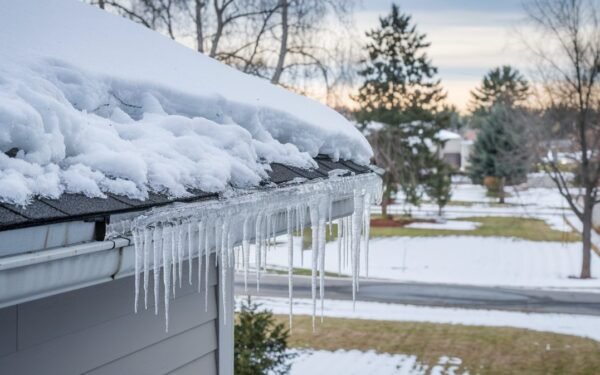
Timing is the last piece of the system. The late-spring clean removes the seed drop, blossoms, and pollen sludge that accumulate through spring, before summer thunderstorms test the system at full volume. The late-autumn clean — after the last leaves are down but before the first hard freeze — is the more important of the two, because a gutter that enters winter full of wet leaves freezes into a solid, heavy trough that pulls hangers loose and sets up the overflow-and-ice cycle for months. Houses under heavy tree cover may earn a third, mid-autumn pass. Each visit follows the same loop: scoop, clear the spouts, flush, read the system’s report, repair what it filed. Twenty to forty-five minutes of unglamorous work, twice a year, is the entire maintenance contract a gutter system asks for — and the waterfall by the front door is simply what it looks like when the contract lapses.
When to hire it out instead
Professional cleaning runs about $100 to $250 for most homes, and there are days when that is the smartest money in home maintenance. Hire it out if the house is two or more stories and you are not fully comfortable at that height, if the roof is steep, if the ground around the house slopes so a ladder can never sit level, or if you have any balance, vertigo, or health concern that belongs nowhere near a ladder rail. There is no savings in a DIY job that ends in an emergency room. Twice a year — late spring after the seed drop, late autumn after the leaves — keeps the system ahead of the weather. Set up slowly, reach short, move the ladder, and the job stays what it should be: boring.