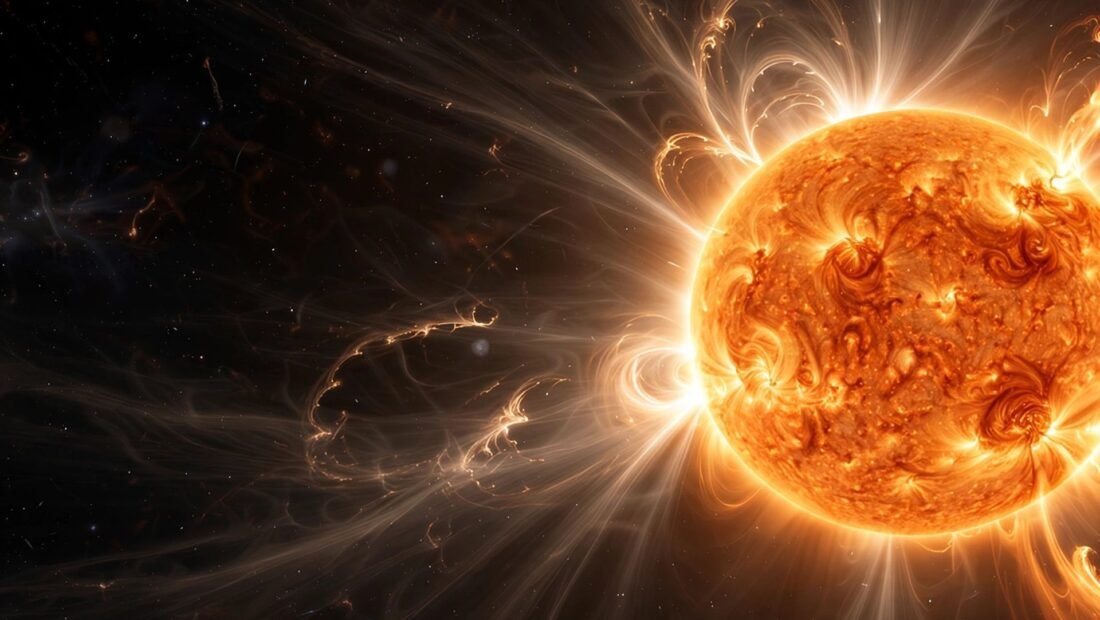
Nobody has ever stuck a thermometer in the Sun. Nothing built by humans could survive the trip, and even our toughest probe keeps millions of miles of distance. Yet scientists quote the Sun’s temperatures with real confidence: about 5,500 degrees Celsius for the visible surface, about 15 million degrees at the core. That confidence did not come from one clever instrument. It came in stages, over more than a century, with each stage using a different trick to read heat from light, from motion, and from particles that escape the Sun itself.
Think of the measurement as a process that moves inward, then outward again. Color gave the surface. Fingerprints in the light mapped the air above it. Energy arriving at Earth checked the totals. Theory and ghost particles reached the core no eye can see. And at the end of the process, a spacecraft finally flew into the outer layer to test what the distant readings had claimed.
Stage One: Read the Surface From Its Color
Hot objects glow, and the color of that glow shifts in a regular way with temperature. A cooling ember is deep red. A hotter flame burns blue-white. Laboratory work turned that pattern into a reliable rule, often called Wien’s law: find the wavelength where the light is strongest, and you can work out the temperature of the surface that emitted it.
Sunlight peaks in the green-yellow part of the spectrum. Our eyes blend the full spread of colors, and the air scatters some blue, so the Sun looks yellow-white from the ground. The peak is what counts. Put that peak wavelength into Wien’s law and you get roughly 5,500 degrees Celsius — about 9,932 degrees Fahrenheit — for the photosphere, the visible surface. It is not a guess from how warm a summer day feels. It is a lab-tested relationship applied to measured light.
The same stage works on other stars, which is a good check on the method. Blue stars come out hotter, red stars cooler, and those readings line up with everything else astronomers learn about them. If the color trick were badly wrong for the Sun, it would fail across the sky as well. Instead it gives one consistent scale, from cool red dwarfs to fierce blue giants.
Stage Two: Read the Atmosphere From Its Fingerprints
Color alone gives an average surface number. The next stage splits sunlight into a fine spectrum, where dark lines appear at exact wavelengths. Those lines are fingerprints. Each element absorbs light at its own set of wavelengths, and the strength of the lines changes sharply with temperature because heat strips electrons from atoms in stages. An atom with all its electrons behaves differently from the same atom partly ionized, and the spectrum shows the difference.
By matching thousands of observed lines against lab measurements of atoms at known temperatures, scientists build a temperature map layer by layer through the Sun’s atmosphere. That map produced one of solar science’s lasting puzzles. Just above the 5,500-degree surface, the thin outer atmosphere — the corona, seen as a pale crown during a total eclipse — runs at roughly one to two million degrees. Hotter as you move away from the heat source sounds backward, and in a simple sense it is. Measuring the temperature precisely did not explain it. It proved the puzzle was real.
Two leading ideas are still being tested. One blames countless tiny magnetic explosions, sometimes called nanoflares, each small but together frequent enough to heat the corona. The other blames magnetic waves that travel up from below and dump their energy in the thin air. Both may play a part. The honest position is that stage two gave a superb thermometer and an unsolved problem at the same time.
Stage Three: Check the Totals From the Energy at Earth
A temperature claim should also match how much energy actually arrives. Space-based instruments measure the flow of solar energy at Earth’s distance — about 1,361 watts per square meter above the atmosphere — and track its small ups and downs over time. Work backward from that flow, the Sun’s size, and the surface temperature from stage one, and the numbers have to agree. They do, within tight limits. That agreement is why the surface figure is trusted: two different routes, color and total energy, land in the same place.
This stage matters on the ground as well. Careful records of solar output let climate scientists separate a small solar nudge from the larger warming driven by greenhouse gases. Without a long, precise record, that argument would be settled by opinion. With it, the solar share can be measured and set beside the human share. The same habit of reading light for temperature also sits behind everyday tools, from infrared thermometers to the heat cameras used to find poor insulation in Texas homes. The physics is shared, even if the scale is wildly different. A related use of sunlight, closer to the kitchen than the observatory, is how photosynthesis converts sunlight into energy in every green field and garden across the state.
Stage Four: Reach the Core With Theory
No light escapes directly from the core. Photons made there bounce through dense material for an immense time before they reach the surface, losing any simple message about where they began. So the core temperature had to be built from constraints. Scientists know the Sun’s mass, its makeup, its size, and how much energy it pours out. They model the inside as stacked layers, each with a pressure, density, and temperature that must support the layers above and feed the fusion below.
Fusion is the strict judge in that model. The Sun shines by joining hydrogen into helium, and the rate of that joining climbs very steeply with temperature. Set the core a little too cool in the model and the Sun comes out too dim. Set it too hot and it comes out too bright and the wrong size. Only a narrow band balances — centered near 15 million degrees Celsius, about 27 million degrees Fahrenheit. That is the number in the familiar headline, and it comes from the model being forced to match a real star, not from anyone choosing a dramatic figure.
Stage Five: Confirm the Core With Neutrinos and Sound
A model alone would leave room for doubt, so this stage checks it with two independent witnesses. The first is the neutrino, a particle made in core fusion that barely interacts with anything. Neutrinos stream straight out of the core at nearly the speed of light while ordinary light is still struggling through the interior. Large detectors deep underground count the solar neutrinos that reach Earth. The counted flow matches what a roughly 15-million-degree core should produce. In effect, scientists sample a particle born in the furnace itself — as close to putting a sensor in the core as physics allows.
The second witness is sound, or something close to it. The Sun vibrates constantly, ringing with waves that run through its interior. The pattern of those vibrations — studied as helioseismology — depends on temperature and density at each depth. Measure the ringing precisely and you can test the interior model the way a bell’s tone tests its shape. Fusion theory, neutrino counts, and solar vibrations point to the same core temperature. Three routes that share almost no equipment and almost no assumptions agree. That agreement, not any single reading, is the real reason the core number is stated plainly.
Stage Six: Fly Into the Outer Layer and Test It
The last stage closes the loop by going there — or as close as engineering allows. The Parker Solar Probe, launched in 2018, has flown through the corona itself, passing within a few million miles of the surface and moving faster than any human-made object before it. It survives behind a carbon-composite shield about 4.5 inches thick. The front of that shield glows at roughly 2,500 degrees Fahrenheit while the instruments in its shadow stay near room temperature, and the craft never lingers long in the worst heat.
What it sends back tests the earlier stages where they were weakest. It samples the solar wind where it is born, traces the sudden magnetic kinks called switchbacks, and gathers the evidence needed to settle how the corona gets so hot. Readers who want mission detail and imagery can start with NASA’s solar science and Parker Solar Probe mission pages, which collect the results as they arrive. A probe inside the atmosphere it studies does not replace the light-based methods. It grades them.
Why This Process Matters in Texas
Solar measurement is not distant trivia for a state that runs on summer sun. Bursts of solar activity can disturb the power grid, and grid operators watch space weather for the kind of storm that can stress transformers. Solar output records feed the climate and water planning that Texas farms and cities depend on. And on a clear night far from city lights — in Big Bend country, for example — every star overhead had its surface temperature read by the same color process used in stage one. The sky is full of thermometer readings, once you know how they were taken.
The full process, in order, is worth holding onto. Color for the surface. Spectral fingerprints for the atmosphere, and a million-degree puzzle as the reward. Total energy at Earth as a cross-check. Theory to reach the core, then neutrinos and vibrations to confirm it. Finally, a shielded probe flying through the corona to test the claims in person. No thermometer ever touched the Sun. A chain of careful tricks did something better: it measured the same star in several unrelated ways, and let the agreement carry the confidence.