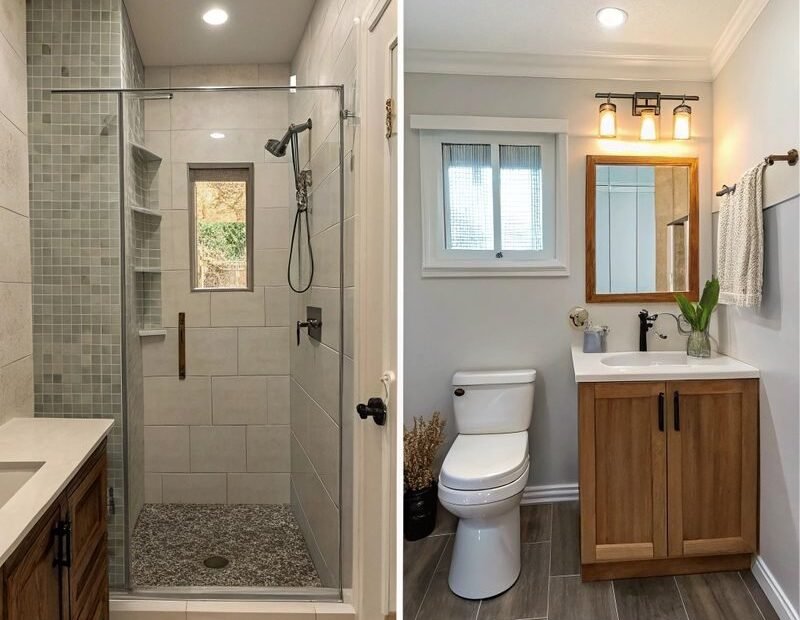
A small bathroom remodel is three different purchases wearing one name. The same 5-by-8 room can be refreshed for $6,000, rebuilt in place for $15,000, or gutted to the studs for $28,000 — and all three homeowners will describe the job with the same sentence: “we remodeled the bathroom.” The tiers differ by what moves, what gets replaced, and who does the work, and choosing between them is mostly a matter of knowing which problem you actually have. This guide prices each tier honestly, opens up a mid-range budget line by line so quotes stop being mysterious, and ends with the verdict by situation.
Tier one: the cosmetic refresh — $5,000 to $10,000
The cosmetic tier keeps the layout and every pipe exactly where it is, and replaces the room’s visible age: new vanity or a refinished one, new toilet, fresh fixtures, new lighting and exhaust fan, paint, flooring laid over or replacing the surface layer, reglazed or resurfaced tub where needed. It delivers roughly 80 percent of the wow for about 40 percent of the money, for one structural reason: moving plumbing is what makes bathrooms expensive, and this tier moves none of it. Expect one to two weeks of work, much of it DIY-able — demolition, painting and fixture swaps are homeowner-scale tasks. Households not yet sure they need even this much should first run the purely visual playbook on how to make a small bathroom look bigger, which solves the “feels tired and tiny” complaint for a few hundred dollars in the many rooms where the fixtures themselves are sound.
Tier two: the mid-range remodel — $10,000 to $20,000
The mid tier replaces everything in place: new tile floor and shower surround, new vanity and top, new toilet, updated fixtures, lighting, fan, drywall and paint — the full room, renewed, on the existing plumbing map. Timelines run three to four weeks. To see where the money actually goes, open a typical $15,000 mid-range budget: tile and installation $3,500; vanity and top $1,500; toilet $400; plumbing fixtures $800; shower or tub $1,200; electrical and lighting $800; exhaust fan $300; drywall and paint $1,000; demolition and disposal $800 — with contractor overhead and profit making up the rest. Seen itemized, quotes stop being mysterious: when one bid lands $4,000 above another, there is now a list to interrogate, line by line, and the answer is usually tile, labor rate, or overhead. Labor runs 40 to 60 percent of the total at this tier, which is why DIY demolition and painting — the unskilled ends of the job — can shave thousands without touching quality. Cross-check any contractor’s number against HomeAdvisor’s bathroom remodel cost guide, which tracks reported costs nationally and flags outliers in both directions.
Tier three: the high-end gut — $20,000 to $35,000
The gut renovation strips the room to studs and subfloor and spends its premium on what the other tiers forbid: layout changes, relocated plumbing, heated floors, custom tile work, luxury fixtures. The cost drivers are honest about themselves — a plumber relocating a toilet or shower drain can add $2,000 to $5,000 alone, before a single fixture is bought — and timelines stretch to five to eight weeks, with the household down a bathroom throughout. The verdict on this tier should be equally honest: buy it if this is your long-term home and the bathroom is a daily sanctuary; do not buy it as an investment, because bathrooms typically return about 60 to 70 percent of their cost at resale, and that percentage shrinks as the budget climbs past the neighborhood’s standard. The gut tier purchases joy and correctness — new waterproofing, new pipes, a layout that finally works — and those are legitimate things to buy with open eyes.
The rules that protect every tier
Three rules apply regardless of budget. First, the contingency is sacred: budget the target plus 15 to 20 percent, and never spend the contingency on upgrades — it exists for the rotted subfloor, the surprise galvanized pipe, and the shower valve entombed in tile since 1974, and small bathrooms hide those at a remarkable rate. Second, sequence purchases before demolition: fixtures, tile and the vanity should be on-site or confirmed in stock before the room is opened, because a remodel stalled three weeks on a back-ordered vanity costs goodwill and sometimes labor twice. Third, keep the only bathroom usable if there is only one: negotiate the order of work — toilet reinstalled nightly, shower last — before signing, because a household cannot camp in its own home for a month and the time to solve that logistics problem is in the contract, not in week two.
Choosing and managing the contractor
The tier decision survives contact with reality only if the contractor does. Get at least three itemized bids on identical scope — the itemization exercise from the mid-tier budget above is the comparison tool — and check references specifically for bathrooms: ask prior clients about waterproofing diligence, schedule honesty and how surprises were priced, because those three answers predict the job. The contract should name the contingency process in advance: how discoveries are documented, priced and approved before work proceeds, since the rotted subfloor phone call is a negotiation that goes better when its rules were set in calm. Payment follows progress, never the calendar — a deposit, staged draws at demolition, rough-in, tile and completion, with a final holdback until the punch list closes. Keep one channel of communication, put changes in writing, and photograph the waterproofing before tile covers it; in bathrooms, the most important work in the room is the work that will never be seen again, and the photo album is the only inspection it will ever get.
Where to save without lying to yourself
Each tier has legitimate savings and false ones. Legitimate: doing your own demolition and painting (sweat-priced, quality-neutral); choosing excellent mid-range fixtures over luxury brands whose premium is a logo; stock tile in a generous format rather than custom mosaics; keeping the existing tub with a professional reglaze at the cosmetic tier; and shopping the vanity from quality flat-pack and big-box lines. False economies: skipping or skimping waterproofing behind the shower — the single most expensive shortcut in the building trades, repaid in rot; bargain faucets and valves whose cartridges will be discontinued within the decade; the cheapest exhaust fan, which will be loud enough that nobody runs it, and the bathroom’s moisture budget will pay for that silence in mold. The pattern is plain: save on the visible and the replaceable, spend on the buried and the mechanical. A bathroom is a machine for managing water that happens to be decorated; fund it in that order.
Living without the bathroom: the timeline problem
Every tier’s timeline conceals a logistics problem, and households with one bathroom must solve it on paper before demolition. The workable pattern at mid-tier: demolition and rough plumbing first, with the toilet reset the same evening wherever possible; tile and curing days grouped so the household’s bathing plan — gym, family, a kind neighbor, a rented portable unit for gut jobs — covers a known number of nights rather than an open-ended exile; fixtures and glass last, in an order that returns a working shower before the final cosmetic touches. Get the sequence written into the schedule, with the toilet’s nightly status stated explicitly, because “three to four weeks” describes the room’s journey, not the household’s: a well-run mid-tier job can keep a toilet working on all but a few nights, and a badly run one can strand a family for a fortnight over a $400 part. This is also where the cosmetic tier quietly wins again — its one-to-two-week, fixtures-in-place rhythm never fully evicts anyone — and where honest contractors distinguish themselves, by raising the subject before the homeowner has to.
The verdict
Choose cosmetic if the layout works and the plumbing is quiet — it is the best value in home improvement. Choose mid-range if fixtures and tile are worn out but the floor plan is right; it is the tier most small bathrooms actually need, at $10,000 to $20,000. Choose the gut only when the layout itself is the problem or the bones are bad, and choose it as a lifestyle purchase with a $20,000-to-$35,000 budget and a 20 percent contingency riding on top. Whichever tier you sign, itemize the quote, protect the contingency, and remember the sentence that governs all bathroom economics: the expensive part of a bathroom is never the tile you can see — it is the water you cannot. One last piece of arithmetic comforts every tier equally: divide the total by the days it will serve. A $15,000 mid-range bathroom used daily for fifteen years costs about $2.70 a day — less than the coffee made in the kitchen outside it. Framed that way, the right tier is the one whose daily experience you would buy at that price, in the home you actually plan to keep.