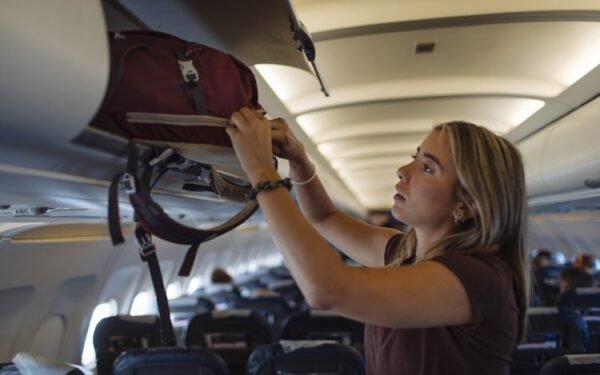
The carry-on fee is best understood as a tax — one the airlines charge people for packing the way everyone packed when checked bags were free. Budget carriers have built their whole pricing around it: the ticket is cheap, the personal item is free, and everything larger is a toll booth. A round trip on Spirit or Frontier with a carry-on can add $120 or more to the fare, which is real money redirected from the trip itself to the overhead bin. Traveling with only the free personal item — a bag that fits under the seat — is not a stunt. Done right, it is five to seven days of clothing in about 25 liters, zero baggage fees, no lost-luggage risk, and the fastest airport exit of your life. Done wrong, though, it is a week of wrinkled shirts and a bag that will not close. Most failures trace back to the same seven mistakes.
Mistake 1: Guessing the size limit
The standard personal item allowance on many US airlines is around 18 x 14 x 8 inches, but “around” is doing heavy lifting — every airline sets its own dimensions, budget carriers enforce them with sizer boxes at the gate, and a bag that fits under one airline’s seat gets flagged on another. The fix takes two minutes: check your airline’s exact personal item dimensions on its site before you pack, and measure your bag with a tape, including wheels and handles. Soft-sided bags are the forgiving choice because they compress into sizers and under seats; a rigid bag that’s one inch too tall is simply too tall. Legacy carriers are often looser in practice than budget ones, but “usually gets away with it” is a poor packing strategy when a gate agent with a sizer box decides otherwise.
Mistake 2: Packing for the trip you imagine
The classic personal-item failure is the just-in-case layer: the second pair of shoes, the dress-up outfit for a dinner that exists only in theory, the book, the backup sweater. Twenty-five liters forgives nothing — every speculative item displaces a real one. Pack instead for the trip as scheduled: one outfit per day drawn from a tight capsule of pieces that all match each other, in two or three colors that can be mixed freely. The rule that makes it work: nothing goes in that does not combine with at least two other things you are bringing. A shirt that only works with one pair of trousers is dead weight wearing a disguise.
Mistake 3: Bulky fabrics and wasted air
Cotton hoodies, denim, and chunky knits are volume thieves. The personal-item wardrobe is built from thin, quick-drying fabrics — merino wool and modern synthetics — that pack to a fraction of the space, resist odor across two wears, and dry overnight after a sink wash. Rolling clothes tightly or using compression cubes typically saves a fifth to a third of your volume, which on this scale is the difference between five days and seven. Wear your bulkiest items on the plane — the boots, the jacket, the heaviest layer — because the clothes on your body do not count against anyone’s size limit, and planes are cold anyway.
Mistake 4: Full-size toiletries
A full toiletry bag can eat a quarter of a personal item before a single shirt goes in. The liquids rule (containers of 3.4 ounces or less in a quart bag, per the TSA’s what-can-I-bring list) is the least of it — the real fix is going solid: solid shampoo and conditioner bars, toothpaste tablets, solid sunscreen and deodorant sticks take a fraction of the space, never leak, and never count as liquids at all. Decant what remains into small bottles honestly sized to the trip; nobody needs eight ounces of anything for five days. Buy the bulky consumable at your destination if you must — a travel-size bottle bought on arrival is cheaper than a carry-on fee.
Mistake 5: No laundry plan
Five days of clothes in 25 liters is arithmetic; seven to ten days is laundry. The sink wash is the range extender: a flat sink stopper, a strip of travel detergent or a little hotel shampoo, twenty minutes in the evening, clothes hung on the shower rail or a travel clothesline, dry by morning in quick-dry fabrics. Merino underwear and socks are made for exactly this rotation — wash two, wear one. Travelers headed somewhere with laundromats or a hotel laundry can stretch further still. The travelers who fail at personal-item-only almost never fail at packing; they fail because day six arrives and everything they own is dirty at once.
Mistake 6: The wrong bag shape
A personal item bag is not a small suitcase; it is a soft rectangle that thinks like a backpack. The features that matter: it opens like a suitcase (clamshell) so you pack in layers instead of digging, it has one external pocket reachable in the airport for documents and a phone charger, and it totals around 25 liters without rigid framing. Duffles waste their corners; rolling bags waste a third of their volume on the handle and wheels you do not need at this size. If you are ready to graduate from the under-seat bag to the overhead bin on longer trips, that is a different discipline with different gear — our rundown of the best carry-on bags for frequent flyers covers what actually holds up. For the personal item, small, soft, and structured beats stylish every time.
What a working five-day loadout actually looks like
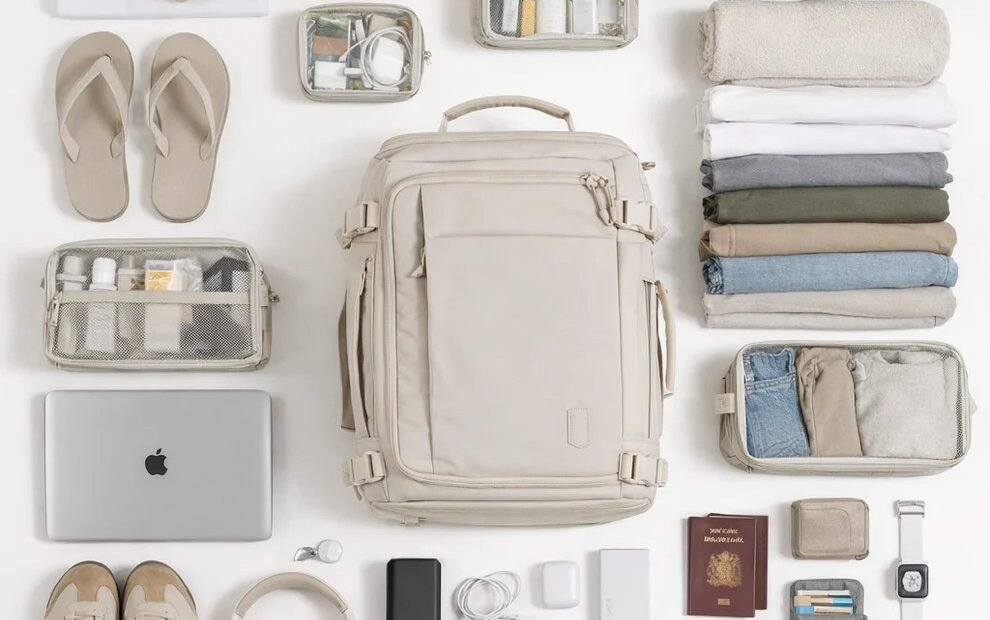
Abstract rules are easy to agree with and hard to pack by, so here is the concrete version that fits a standard personal item with room to spare. Worn on the plane: your heaviest shoes, your jacket, one full outfit including the bulkiest trousers you are bringing. In the bag: two more tops and one more bottom that all match the worn outfit and each other; underwear and socks for three days in merino (washed in rotation); one sleep set that doubles as loungewear; a swimsuit or workout set if the trip calls for it; solid toiletries and a palm-sized tech kit — charger, cable, earbuds, a small power bank. That is the whole wardrobe: three full outfits in play at any time, one being worn, one ready, one drying. The loadout survives a delayed laundry day, a coffee spill (rinse and rotate), and weather a layer either side of the forecast. What it does not survive is additions — the system works because it is closed, and every “one more thing” is a small withdrawal from the space the system needs to breathe.
When the personal item is the wrong tool
Honesty requires the limits. A winter trip with real coats, a wedding with formal clothes, a work trip needing a suit that must arrive crisp, any trip with sports gear — these fight the format, and forcing them into 25 liters produces a worse trip than the fee ever cost. The same goes for trips where you are the mule: gifts for family, supplies for a group, shopping as a primary activity. The mature version of this skill is not using it always; it is recognizing the trips where it fits — warm weather, casual dress, three to seven days, one base hotel — and taking the free win there, while paying for the carry-on without resentment on the trips where the gear list is the point. Mistake zero, underneath all seven others, is turning a money-saving tactic into an ideology.
Mistake 7: Treating arrival like departure
The last mistake happens on the ground: travelers pack a perfect bag, then spend the trip buying things with nowhere to put them. Plan the return before you leave — leave a genuine margin of space, or carry a foldable tote inside the bag for souvenirs and layers, used as your “personal item plus” only where rules allow, or shipped home in a flat-rate box when it is not. And keep the system’s deeper promise in view: this way of packing is not about deprivation. It is about the $120 that stayed in the trip budget, the bag that cannot be lost, the twenty minutes not spent at a carousel while everyone else watches the belt. Freedom, at 18 by 14 by 8 inches, fits under the seat in front of you.
Run a test pack before the trip, not the night of it: load the bag fully, close it without sitting on it, carry it around the house for ten minutes, then set it in a box or under a chair with the same footprint as the airplane seat it has to fit beneath. If it will not close calmly or will not slide into the space, the trip is where you will find out the expensive way. The test takes fifteen minutes and converts every rule above from theory into a bag that is actually ready — which is the entire point of traveling this light: the packing stops being an event, and the trip starts at the front door instead of the baggage carousel.