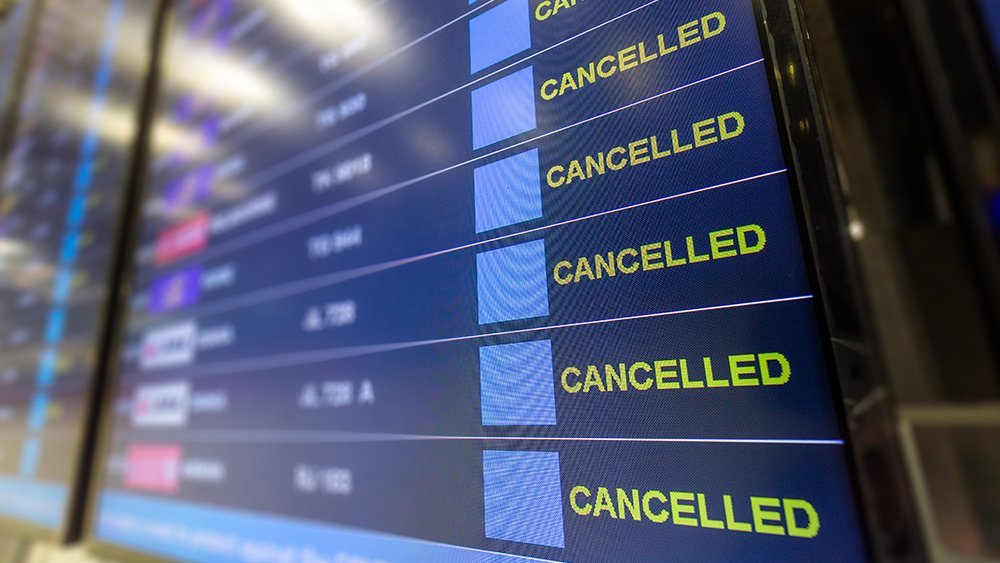
The cancellation text always lands at the worst moment — standing at the gate, coffee going cold, watching the departures board flip your flight from delayed to cancelled while two hundred people have the same thought at the same time. A cancelled flight is a race, and the prize (the last seats on the next plane out) goes to whoever moves first, not whoever complains loudest. The good news: the system has rules, your ticket has rights attached to it, and the next hour has a clear order of operations. Here is that order, as a checklist to work through in sequence.
The checklist: work it top to bottom
- Rebook yourself in the app immediately. The moment the cancellation posts, open the airline’s app and rebook on the best available alternative — this is faster than any queue. Do it while walking to the service desk, not instead of it.
- Join the desk queue and call at the same time. Three channels at once: the app, the phone line (the international call centers sometimes answer faster), and the physical desk. Whichever human or screen helps you first, wins.
- Ask about other airlines and nearby airports. Agents can sometimes put you on a partner or even a rival carrier, or route you to an airport an hour away. They rarely volunteer this; ask directly.
- Decide fast on the overnight question. If nothing leaves today, the hotel-and-food question below becomes urgent — airport-area hotels fill up within the hour.
- Screenshot everything. The cancellation notice, your new itinerary, every receipt. Documentation is what turns expenses into reimbursements later.
- Do not accept a refund until you know your plan. Accepting cash back can end the airline’s obligation to rebook you; if you still need to get there, keep the ticket alive until you are rebooked.
What the airline owes you
Know the shape of your rights before you negotiate. In the United States, if an airline cancels your flight and you choose not to travel, you are entitled to a refund to your original form of payment — that part is firm federal policy, not airline generosity. What US rules do not guarantee is compensation for your time; meal vouchers and hotel rooms for controllable cancellations (mechanical problems, crew issues) are airline policy commitments, so ask for them explicitly — passengers who ask politely and specifically receive them far more often than passengers who simply wait. Weather cancellations are treated as outside the airline’s control, and hotels then usually come out of your pocket or your credit card’s coverage. In the European Union and UK, the rules are stronger: cash compensation for longer delays and cancellations is built into the law on covered routes, on top of care and rebooking. Wherever you are, IATA’s passenger travel information is a useful starting point for the general framework, and your airline’s own contract of carriage spells out its specific commitments.
The European system is worth understanding in numbers, because it shows what strong rules look like. On routes covered by EU and UK air passenger rights law, a cancellation or a long delay caused by the airline itself triggers fixed compensation set by flight distance — €250 for short flights, €400 for medium-haul, and €600 for long-haul — paid in cash, not vouchers, on top of your choice of rebooking or refund, plus meals and hotel care while you wait. Flights departing the EU or UK on any airline are covered, as are flights into the region on European carriers. The practical lesson travels home with you: if any leg of your trip touches Europe, your cancelled flight may be worth real money, and the claim windows are generous but the paperwork matters — keep the same screenshots and receipts either way. Even on purely domestic US trips, knowing that the rest of the world treats cancellation compensation as normal is useful context when an agent implies that a meal voucher is the outer limit of what is possible.
Meals, hotels, and the credit card safety net
If you are stranded overnight, sort the hotel before the airport-area supply vanishes — book something refundable on your phone while the desk sorts your flight. Then check the card you paid with, because it may quietly be the best insurance you own. Many premium travel cards include trip delay reimbursement (commonly $500 or more per ticket for delays of 6+ hours, covering hotels, meals, and essentials), trip cancellation and interruption cover ($10,000 or more per trip), and lost baggage protection ($3,000 or more). The claim process is straightforward but documentation-heavy: save every receipt, keep the cancellation and delay notices, hold on to boarding passes, and file within the deadline — usually 60–90 days. One covered cancellation, with a $400 hotel night and $200 in meals, pays back a card’s annual fee several times over, which is why frequent travelers treat this coverage as part of the ticket price calculation. If disrupted trips are a pattern in your life, it is also worth deciding in advance whether dedicated cover fits you better — our breakdown of whether travel insurance is worth it for domestic trips walks through exactly that math.
One category of passenger should never improvise: anyone whose delay cascades into something bigger — a cruise departure, a wedding, a non-refundable tour start. If that is you, tell the agent exactly what is at stake and when it happens. Airlines keep escalation paths for precisely these cases, and a sailing-away cruise concentrates minds in a way that “I would like to get home sooner” does not. The same applies if you are traveling with medication that will run out, an infant, or an elderly parent: state the concrete fact, calmly, once. Agents triage by consequence, and consequences have to be spoken to be counted.
Stranded mid-journey is a different problem
Where you are when the cancellation hits changes the playbook. At your home airport, the calculation is simple: a rebooked flight tomorrow costs you nothing but time, and you sleep in your own bed. Mid-journey — at a connection city, or at your destination trying to get home — you have no bed, no kitchen, and luggage that may already be checked. Ask the desk three specific questions: where will my checked bag go if I take a different routing (bags do not always follow a last-minute change), can I be routed through a different hub even on a partner airline, and if I take the train or a rental car for the last leg, what happens to the rest of my ticket — an unflown segment can sometimes be refunded or credited, but only if you agree it with the airline before you leave the airport, not after. Families and groups should also ask to be rebooked together and say so plainly; automated systems split parties onto separate flights with cheerful indifference. And if the delay stretches past a day, check whether your travel insurance or card coverage will pay for a flight on another airline that you buy yourself — some policies will, with documentation, and on a ruined trip that can be the difference between losing a day and losing the whole vacation.
The ground option: knowing when to stop flying
Sometimes the fastest way home is not a plane. For trips under roughly 300 miles, a one-way rental car or a train often beats waiting for tomorrow’s flight, especially once you count the hotel night the wait requires. Airlines will not always refund the unused ticket if you simply walk away — but during major disruptions many issue travel waivers that let you cancel for credit or a refund, and it is always worth asking at the desk before you leave. If you do drive, photograph the cancellation notice and keep every receipt anyway: the credit card coverage discussed above sometimes reimburses reasonable alternative transport, and you cannot claim what you cannot prove. The deeper point is that a cancelled flight is a logistics problem, not a verdict. The travelers who get home first are the ones who weigh every mode — rebooked flight, different hub, train, car — in the first twenty minutes, instead of camping at the gate waiting for the airline to solve it for them.
While you wait, and next time
A few habits turn a bad day into a manageable one. Keep a photo of your passport and your itinerary in your phone. Pack the first night’s essentials — medication, chargers, a change of clothes — in your carry-on, always, so a lost evening never becomes a lost day. Be decent to the agent in front of you: they cannot un-cancel the flight, but they choose who gets the last seat, the hotel voucher, and the better routing, and they choose the courteous passenger first. And build the prevention in from the start of your next trip: book the first flight of the day (planes and crews are already in place, and delays have not cascaded yet), avoid the last connection of the evening, and leave a buffer before anything that truly matters — a wedding, a cruise, a once-a-year event. Cancellations will still happen. With this checklist, they become an inconvenience with a procedure attached, instead of the day the trip fell apart.