
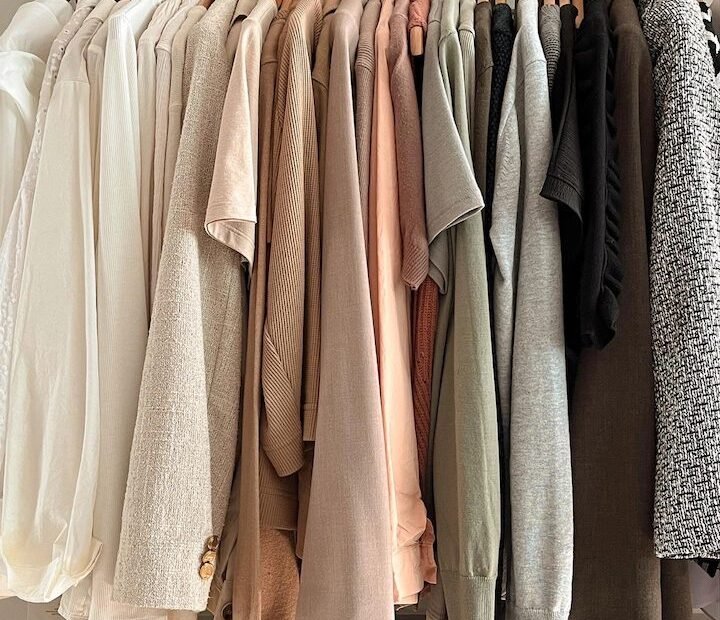
A closet stuffed with clothes and nothing to wear is not a shopping problem — it is a system problem, and more shopping will not fix it. A capsule wardrobe fixes it by subtraction and sequence: a small set of pieces, in a tight color palette, every one of which goes with most of the others, bought in the right order so that $500 builds a working wardrobe instead of fifteen unrelated garments. The sequence matters as much as the pieces. Here is the build, phase by phase, in the order that makes the budget work.
Phase 1: The audit (spend nothing yet)
Before a dollar moves, empty the closet onto the bed and sort with ruthless honesty into four piles: worn constantly, worn sometimes, not worn in a year, and damaged or ill-fitting beyond rescue. Keep the first pile where it is — those pieces are data about your real life and real taste. The not-worn pile goes out (donate, sell, recycle), because a capsule cannot be built inside a crowd. This phase usually reveals the actual situation: most people already own a partial capsule buried under noise — two good pairs of trousers, four shirts that work, one jacket — plus gaps in predictable places. Write the gaps down. They become the shopping list, and the list is what protects the $500. If the physical closet itself is part of the problem, how to organize a small closet with too many clothes is the companion cleanup.
Phase 2: Lock the color palette
A capsule works because everything matches, and everything matches because the colors were chosen before the clothes were. Pick two neutrals that suit you and your life (navy and grey, black and white, brown and cream — whatever you already lean toward), one or two accent colors you genuinely enjoy wearing, and commit. Every purchase from here on must pass one test: does it work with at least three things I already own? Pieces that fail the test are how wardrobes re-clutter themselves. If you want a proven frame for the experiment, Project 333, the original minimalist capsule wardrobe challenge, runs on 33 items for three months — a useful proving ground even if your final capsule lands a little larger.
How many pieces should all this add up to? Honest answer: somewhere between 25 and 40 items including shoes and outerwear is the range where most people stop feeling deprived and start feeling liberated — Project 333 uses 33, and many settled capsules land near it. The exact number matters less than the two failure modes at the extremes. Too few, and laundry logistics and one spilled coffee can break your whole system, which is how capsules get abandoned by month two. Too many, and you have not built a capsule; you have built a smaller version of the original problem. Count your audit survivors honestly — many people discover they are already at 30 wearable pieces with 8 gaps, which reframes the whole project: you are not starting from zero, you are finishing a wardrobe you half-own already.
Phase 3: Buy the “third piece” first
Counter-intuitive, and the highest-leverage move in the whole build: before basics, buy the layer that finishes outfits — a blazer, a structured jacket, a good overshirt. The third piece is what turns “jeans and a tee” into “an outfit,” and it is the item people perpetually postpone because it costs the most per unit. In the budget below it claims its own line for exactly that reason. Thrift and secondhand are gold here: blazers are the most commonly donated quality garment in existence, and a well-made one in wool or a wool blend turns up secondhand for $12 to $30 in a way that equivalent trousers never do. Fit across the shoulders is the part tailors cannot easily change — buy for the shoulders and tailor the rest.
Phase 4: The $500 breakdown
Now the core buys, in a split that has proven workable:
- Jeans or trousers — about $120: two pairs, in your palette neutrals, the best fabric you can manage. These are worn more than everything else combined.
- Tops — about $100: four to five, mixing tees, a shirt or blouse, and one knit, all within the palette.
- Shoes — about $80: one versatile pair that covers most of your life; shoes are the worst place to go ultra-cheap because they carry you all day.
- Jacket or blazer — about $60: the third piece from phase 3, ideally thrifted quality at this price.
- Layering pieces — about $50: cardigan, sweatshirt, or light sweater that works over the tops.
- A dress or equivalent — about $40: or the occasion piece your life actually requires.
- Buffer — about $50: underwear, socks, and — critically — the tailoring reserve in phase 5.
Bought retail, those numbers are tight. Bought with thrifting in the mix, they are comfortable: strategic secondhand shopping routinely delivers $500 of retail value for around $150, releasing money toward the new items that should be new (shoes, underwear) and toward the phase most people skip entirely.
One decision inside phase 4 deserves its own paragraph, because it doubles the budget’s power: knowing which categories to thrift and which to buy new. Thrift aggressively for blazers, coats, knitwear, dresses, and denim from quality brands — these are durable, plentiful secondhand, and cheap to tailor. Buy new for shoes (worn-in shoes carry someone else’s gait), underwear and socks (obviously), and basic tees (thrifted ones are usually at the end of their life — that is why they were donated). In the middle sit shirts and trousers, where the answer is condition: inspect collars, cuffs, and seats of trousers for shine and wear, and walk away from anything tired, because a tired garment tailored is still a tired garment. A capsule built this way looks like it cost three times its budget, because half of it originally did.
Phase 5: Tailoring — the step that makes it look expensive
Reserve $30 to $50 of the budget for a tailor, and treat this as sacred. Fit beats everything at this price point: a $20 thrifted shirt taken in for $15 looks better than a $100 shirt that fits poorly, and hemming trousers or nipping a waist is the difference between “assembled” and “thrown on.” This is also where forgiving fabrics matter. At a capsule budget, avoid 100% linen (it wrinkles if you look at it) and the cheapest polyesters (they pill and shine within a season). Cotton, cotton blends, wool blends, and sturdy knits survive both wear and alteration. An altered $30 garment beating an unaltered $300 one is not a slogan; it is what any tailor will tell you, and it is the whole economic argument for this phase.
Phase 6: One in, one out — keeping it a capsule
The build ends; the discipline continues. From here the rule is mechanical: a new piece enters only when a piece leaves, and only if it passes the palette and three-pairings tests from phase 2. This is not minimalism as a moral stance — it is what stops the slow re-accumulation that created the original stuffed closet. Review the capsule at each season change: what earned its place, what quietly never got worn (and why — fit, fabric, or a life you do not actually live), and what gap genuinely appeared. A humble tool helps here: photograph the outfits on the days you feel genuinely well-dressed. Within a month you will own a small album of proof about what your best combinations actually are, taken from your real life rather than from a mood board of somebody else’s. The Good Trade’s guide to building a capsule wardrobe offers a similar phased approach with a sustainability lens if you want a second perspective on the same method.
The first fortnight in the finished capsule teaches the last lesson: outfits stop being decisions and start being formulas. Trousers plus knit plus blazer. Dress plus layering piece. Jeans plus shirt, sleeves rolled, third piece over the shoulders when the day needs authority. Most capsule owners settle into six to eight formulas they rotate, which is precisely the point — decision fatigue was the hidden cost of the stuffed closet all along. If the fortnight exposes one piece that goes with nothing despite the palette test, do not defend it out of pride: swap it while returns are possible or re-donate it and note what fooled you. Capsules converge over two or three seasons, not one shopping trip, and a 90%-right capsule worn happily beats a theoretically perfect one still being planned.
Done in this order — audit, palette, third piece, core buys, tailoring, discipline — $500 stops being a compromise and becomes a design constraint that does you a favor: it forces the palette tight, the fits right, and the pieces into conversation with each other. A capsule wardrobe is not fewer clothes. It is the first wardrobe where everything in it is on your side.


3 Comments