The striped tie is fine. The checked shirt is fine. Together, they start an argument — too many lines going too many directions at similar sizes, all competing for the same patch of chest. Matching a tie to a patterned shirt puts most men off because it feels like a puzzle with secret rules, but the rules are neither secret nor many. Three of them decide everything: one pattern leads and the other supports, the two patterns must differ in scale, and the tie pulls a color out of the shirt rather than bringing a new one. Every option below is judged against those three rules.
Option one: the solid tie — the safe harbor that never looks like a surrender
The simplest pairing, and the one to default to whenever the shirt is busy: a solid tie in a color taken from the shirt itself. A blue-and-white striped shirt takes a solid navy, burgundy, or forest tie; a pink gingham takes a solid navy; a tattersall check takes a solid in whichever of its lines is quietest. Two refinements lift it above “safe.” First, add texture instead of pattern: a knitted tie, a grenadine, or a matte wool tie adds visual interest without adding a second pattern, and texture never clashes. Second, match the tie’s weight to the shirt’s mood — a chunky knit tie on a flannel check, a smooth silk on a fine poplin stripe. Judged against the rules, the solid wins on all three counts automatically: the shirt leads, there is no second scale to clash, and the color is borrowed. It is the recommendation for interviews, weddings, and every morning when you do not want to think.
Option two: stripes with stripes — vary the scale, and it sings
The pairing men fear most is often the most elegant when one rule is obeyed: the stripes must be different widths. A wide-spaced repp stripe tie over a fine pinstriped shirt works because the eye reads them as two different patterns in the same family. A tie whose stripes are the same width as the shirt’s is the classic disaster — the two patterns merge into a vibrating mess, especially in photographs. Direction helps too: a diagonally striped tie already angles its lines against the shirt’s verticals, which is why diagonal ties exist in the first place. If you are building toward this pairing, start with the easiest version — a bold, wide-striped tie over a subtle hairline-stripe shirt — and check the result in a mirror from six feet away. At conversation distance is how the outfit will actually be judged; if it reads calm from there, it works.
Option three: dots, paisleys, and figures — the middle path
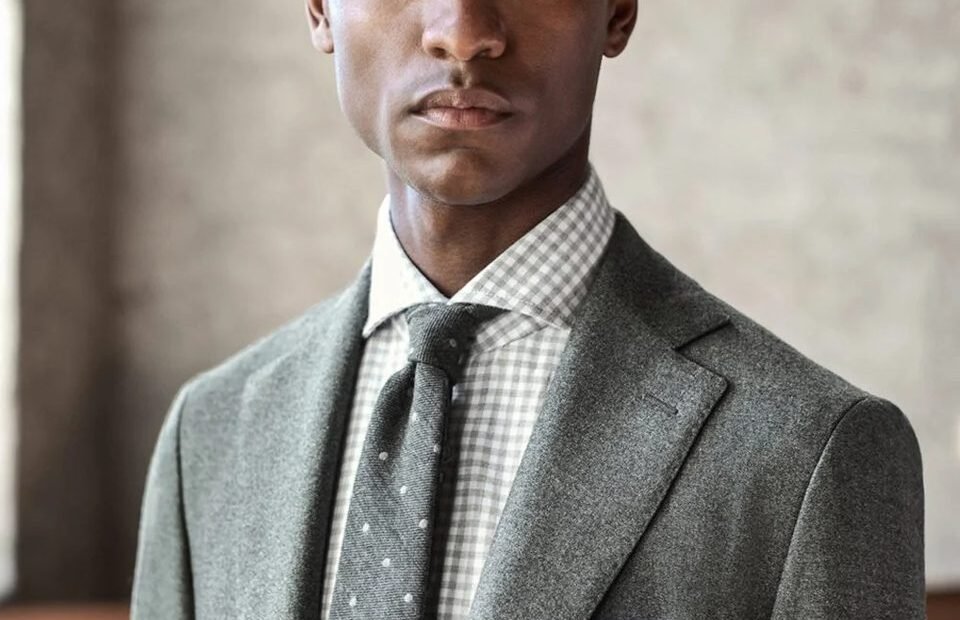
Between solid and stripe sits the patterned tie whose pattern is a different species from the shirt’s: small dots on a striped shirt, a neat paisley on a check, tiny geometric figures on a gingham. These pairings work because the shapes do not compete — lines versus spots is a conversation, not an argument. The same scale rule applies inside the family: a large, loud paisley over a loud check is two leads fighting; a small, tight dot over a bold stripe is a lead with a good supporting act. Keep the tie’s ground color close to the shirt’s world (a navy ground under a blue shirt) and let the small motif carry the contrast. This is the option with the most personality per unit of risk, and the one that makes an ordinary shirt look chosen rather than defaulted.
Color: pull from the shirt, never import
Every option above depends on one discipline: the tie’s main color should already exist in the shirt — in its stripe, its check, or its ground. A tie that introduces a brand-new color has to fight the shirt and everything else you are wearing. The easiest borrow is the shirt’s secondary color: the thin red line in a blue-checked shirt is an invitation to a burgundy tie; the white ground of a colored stripe shirt supports any deep, rich tone. Contrast level matters too. A pale shirt with a dark tie is the classic, calm arrangement; a dark shirt needs a tie lighter or richer than itself, and dark-on-dark pairings are advanced territory that usually ends in a muddle. Dressing this way is a small system, not a talent — the same pull-from-the-outfit logic runs through Ties.com’s guide to matching a tie with a shirt, which lays out the pairings by shirt type.
The six-foot test: how to check a pairing honestly
Every failed pairing in history looked acceptable at arm’s length in a bedroom mirror, because at arm’s length you see the tie or the shirt, not the combination. Judge the pairing the way the world will: from about six feet away, in ordinary light, ideally in a photograph. At that distance, clashing scales reveal themselves instantly — the outfit either settles into one calm pattern with a supporting accent, or it shimmers. If it shimmers, one of the three rules is broken, and it is nearly always scale: swap to a tie whose pattern is clearly bigger or clearly smaller, or retreat to the solid. The phone camera helps twice over, because photographs flatten patterns the way other people’s eyes do — and because half the occasions you dress up for now survive mainly as photographs.
A five-tie rotation that covers every patterned shirt
You do not need a drawer of forty ties; you need five that between them satisfy the rules against any shirt. One: a navy knitted tie — solid, textured, endlessly forgiving, the default answer. Two: a burgundy grenadine or matte silk, for borrowing the warm line out of checks and stripes. Three: a small white-dot tie on navy or burgundy, the middle-path pattern that sits politely on stripes. Four: one wide-striped repp tie in a classic colorway, kept for fine-stripe shirts where its scale can lead. Five: one tie in the color family of your loudest shirt, bought specifically to tame it — this is the tie that rescues the shirt you love and never wear. With those five, “what goes with this?” becomes a ten-second question. Rotate them and the same shirt produces three different outfits, which is the entire economics of a working wardrobe in miniature.
When to skip the tie entirely
The honest final option is no tie at all, and sometimes it is the correct one. A boldly patterned shirt — a large check, a strong floral, a loud plaid — worn open at the collar under a blazer looks more confident than the same shirt with a tie straining to compete. The modern rule of thumb: the louder the shirt, the more the tie has to justify its place, and past a certain volume it cannot. Skipping the tie also suits creative workplaces, summer, and any setting where a tie would be the only one in the room. What “no tie” still requires: a collar that stands up properly instead of splaying, one button open rather than two, and the rest of the outfit doing the polish work. It is a look plenty of well-dressed men build whole wardrobes on — see what to wear to an interview in a creative industry for how the tie-optional end of dressing works in practice.
The quick reference: shirt family by shirt family
For the mornings when you want the answer without the theory: a fine pinstripe shirt takes the widest range — solid, dot, or wide-stripe ties all work. A bold bengal stripe shirt narrows it — solid or small-dot only, and let the stripe lead. Gingham and small checks are friendly shirts: solids, knits, and small figures all sit well, and they are the best shirts to practice on. Tattersall and windowpane checks carry several colors, so borrow the quietest line for a solid tie and stop there. Florals and loud plaids are statement shirts: solid dark tie in a borrowed color, or no tie at all. A plain shirt, for completeness, reverses everything — it is the invitation for the tie to lead, with the boldest pattern you own. Tape that list inside the wardrobe door and the puzzle is permanently solved.
The verdict
Default to the solid, textured tie pulled from the shirt’s own colors — it cannot clash and never looks like you gave up. Graduate to stripe-on-stripe by changing the scale, not the family. Use dots and small figures when you want the outfit to have a point of view. And when the shirt is the statement, let it be one: skip the tie. Three rules, four options, and the morning mirror argument is over. If you take one habit from all of it, take this: decide the pairing the night before, shirt and tie laid out together. Every rule in this article is easier to obey at 10 p.m. than at 7 a.m., and the men who always look put together are mostly just the men who stopped making the decision under time pressure.