
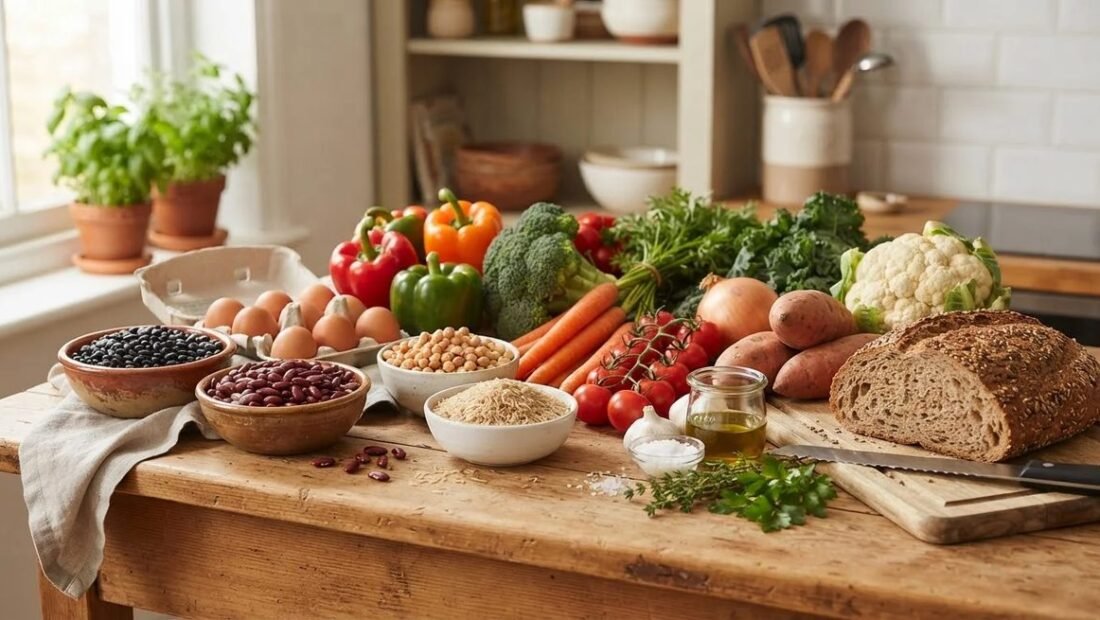
Fifty dollars a week, one person, real food. That budget sounds like a punishment until you see how it is actually built: not on coupons or suffering, but on a short list of buying rules that redirect money from packaging to nutrition. Eating healthy on a tight budget fails when the cart is filled by habit and hope. It works when the cart is filled from a checklist. Here is the checklist first, in the order you would walk the store, and then the reasoning behind each item — because understanding why these foods earn their place is what makes the system survive contact with a real week.
The tight-budget healthy cart: the checklist
- Produce anchors (fresh, in season): cabbage, carrots, onions, sweet potatoes, bananas
- Frozen produce: peas, mixed vegetables, spinach, berries — whatever is cheapest per pound
- Dry and tinned staples: oats, rice, dried lentils, dried or canned beans, canned tomatoes, pasta
- Proteins: eggs, one whole chicken or chicken thighs, ground turkey or beef when on sale, canned tuna
- Dairy and fats: milk or yogurt, a block of cheese, peanut butter, cooking oil
- Flavor kit (buy once, use for months): garlic, chili flakes or hot sauce, soy sauce, vinegar, curry powder or taco seasoning
- One planned treat — because a budget with no joy in it gets abandoned by week three
Everything below explains how to run that list like a system rather than a wish.
Start with the dollar foods that punch above their weight
Every supermarket contains a quiet roster of foods that deliver serious nutrition for around a dollar or less per unit: cabbage, carrots, onions, sweet potatoes, canned tomatoes, oats. These are the foundation. Cabbage keeps for weeks in the fridge, works raw, slawed, stir-fried, and souped, and costs almost nothing per serving. Sweet potatoes bring fiber, beta-carotene, and enough natural sweetness to anchor a meal. Oats are the cheapest respectable breakfast in the building. Build the week’s skeleton from these before you buy anything with a brand name, and the budget arithmetic changes completely — the expensive part of eating well was never the vegetables; it was the products pretending to be vegetables.
Frozen produce is not a compromise
Frozen vegetables and fruit are picked at ripeness and frozen fast, which preserves their nutrients at least as well as “fresh” produce that spent a week in transit and another on the shelf — nutritionally they are equals, and for smoothies, soups, and cooked dishes the texture difference vanishes. Frozen is also the budget’s insurance policy: it cannot rot in the crisper drawer waiting for a plan that never came. Stock the freezer with peas, spinach, mixed vegetables, and berries when they are on special, and you have permanently solved the saddest line in tight-budget cooking: “the fresh stuff went bad, so we ordered out.”
Cook once, eat three times
The economics of home cooking live in batch size. A pot of lentils costs under $2 in ingredients and makes four meals. A whole chicken becomes dinner, then sandwiches, then soup from the carcass. A big tray of roasted sweet potatoes and onions becomes tonight’s side, tomorrow’s burrito filling, and the base of a hash with a fried egg. Cooking in deliberate surplus drops the per-meal cost under $2 and — just as important — kills the tired-weeknight takeout order, which is where food budgets actually go to die. The Academy of Nutrition and Dietetics’ meal-planning guidance makes the same structural point: a loose plan for the week, built around a couple of cooked anchors, is what turns cheap ingredients into actual meals instead of good intentions.
Use meat as a flavoring, not the main event
The single biggest lever on the grocery bill is demoting meat from centerpiece to seasoning. A stir-fry stretched with cabbage, carrots, and rice needs a modest handful of chicken to taste like a chicken stir-fry. Chili built on beans carries a small amount of ground meat a long way. Bacon, sausage, and cheese deliver enormous flavor per ounce — use them the way chefs do, in ounces, scattered over lentils, eggs, and greens rather than in slabs. You are not becoming a vegetarian (unless you want to); you are rebalancing the plate so the expensive ingredient does the seasoning and the cheap ingredients do the feeding. Most people who try this are surprised to find the meals do not feel smaller. They feel like the food they already liked in restaurants, which has quietly used this ratio all along.
Shop the perimeter and the sales — and dodge the health halo
Stores are laid out so that whole foods ring the edges and packaged products fill the profitable middle. Shopping the perimeter first loads the cart with the checklist before the middle aisles get their chance. Then chase the sales on proteins and frozen goods, which freeze well and anchor future weeks. The trap to name explicitly is the health halo: the $8 gluten-free crackers, the $6 bottled green juice, the protein bar at $2.50 a bite. Packaged “healthy” food is where tight budgets bleed out while feeling virtuous. If it comes in a box with a wellness claim on the front, it is almost certainly charging you for the claim, not the nutrition.
Waste: the raise you are already owed
A commonly cited estimate holds that around 30% of the food Americans buy ends up thrown away — on a $50 budget, that is $15 a week, $60 a month, vanishing into the bin. Cutting waste is therefore the largest single “raise” available to a tight food budget, and it is mostly a systems problem: a visible “eat first” spot in the fridge, leftovers planned into the next day’s lunch rather than discovered next week, a weekly soup or stir-fry that absorbs the odd ends of vegetables, and a freezer used as a pause button for bread, herbs, and cooked grains. The breakfast end of the day deserves its own mention because it is where cheap and healthy overlap most easily — the healthiest cheap breakfast for busy mornings builds five of them at about a dollar each.
Shop your own kitchen first
The cheapest grocery store in your life is your own cupboard, and most households are sitting on two or three forgotten meals’ worth of ingredients at any moment — the half-bag of rice, the tin of beans from a sale two months ago, the pasta bought for a recipe that never happened. Before writing the weekly list, inventory the pantry, fridge, and freezer, and plan the first two dinners of the week around what is already paid for. This one habit does three things at once: it cuts the week’s list by several items, it rescues food before it expires (compounding the waste win above), and it forces variety, because forgotten ingredients are rarely the ones you would choose by habit. Pair it with the simplest list discipline there is: write the list from the week’s meal plan, shop once, and treat anything not on the list as requiring a reason said out loud. Impulse items are not evil, but on this budget they are a line item, not an accident.
What three days actually look like on this system
Day one: oatmeal with frozen berries and peanut butter; lentil soup with bread for lunch; chicken, cabbage, and carrot stir-fry with rice for dinner, cooking double rice and extra stir-fry on purpose. Day two: eggs and toast; leftover stir-fry reborn as fried rice with a fried egg on top; bean and sweet potato chili with a sprinkle of cheese. Day three: oatmeal again, varied with banana and cinnamon; chili leftovers over a baked sweet potato; a “fridge-clearing” soup built from the week’s vegetable ends, canned tomatoes, and whatever protein remains. Notice the rhythm: two real cooking sessions power three days, every leftover has an assigned second life, and nothing on the plate costs more than about $2. Multiply the pattern by a rotating cast — different bean, different grain, different sauce — and the system runs for months without repeating itself into boredom.
Is organic worth it on this budget?
Mostly, no — and this is a prioritization answer, not an ideology answer. If the choice is between organic processed food and conventional whole food, the whole food wins by a wide margin; the nutritional difference between a conventional cabbage and an organic one is trivial next to the difference between cabbage and crackers. If money ever loosens, spend it in this order: more variety of produce, better protein, then — if it matters to you — organic versions of the few items you eat daily with their skins on. On $50 a week, organic is a luxury line item competing with the eggs. Let it lose.
None of this requires talent, equipment, or a personality transplant. It requires a checklist, a freezer, two cooking sessions a week, and the discipline to let cheap ingredients do the heavy lifting. $50 a week feeds one person genuinely well with this playbook — not adequately, well — and the meals stop feeling like a budget at all once the flavor kit is stocked and the rotation is familiar. That is the real goal: a system ordinary enough to run on your tiredest Wednesday.



1 Comment