
The trap is set every weekday morning: you are short on time and long on hunger, so breakfast becomes a $6 pastry grabbed on the way — tasty for ten minutes, gone by ten o’clock, and your stomach is filing a complaint in the middle of your first meeting. It does not have to work that way. The healthiest cheap breakfasts share one formula, take under five minutes, and cost around a dollar. Here is the system, step by step.
What you need on hand
Keep this short list stocked and every recipe below becomes a two-minute decision instead of a project: rolled oats, eggs, plain Greek yogurt in the big tub (never the single cups — same product, triple the price), bananas, peanut butter, cottage cheese, whole-grain bread or tortillas, frozen berries, milk, and cinnamon. Total weekly cost for one person eating from this list every day: roughly what two café breakfasts cost. Buy the store brands of oats, yogurt, and peanut butter without a second thought — for staple ingredients like these, the label difference is mostly packaging, and the savings across a year of breakfasts are real money. Frozen fruit deserves the same logic: it is picked ripe, it keeps for months, and it removes the quiet tax of fresh berries going soft in the crisper drawer before Wednesday. Perishables rotate fast because you are actually eating them, and everything else waits patiently in the pantry or freezer. The Academy of Nutrition and Dietetics’ meal-planning guidance makes the same point at the household level: a small, planned staple list is what makes cheap healthy eating repeatable instead of aspirational.
The formula every good breakfast follows
Protein plus fiber plus a little fat. Protein is what keeps you full — it is the difference between a breakfast and a snack. Fiber slows the whole meal down. Fat carries flavor and staying power. A pastry fails because it is fast sugar with none of the three. Every build below hits the formula, which is why they last until lunch.
Step 1: Overnight or microwave oats
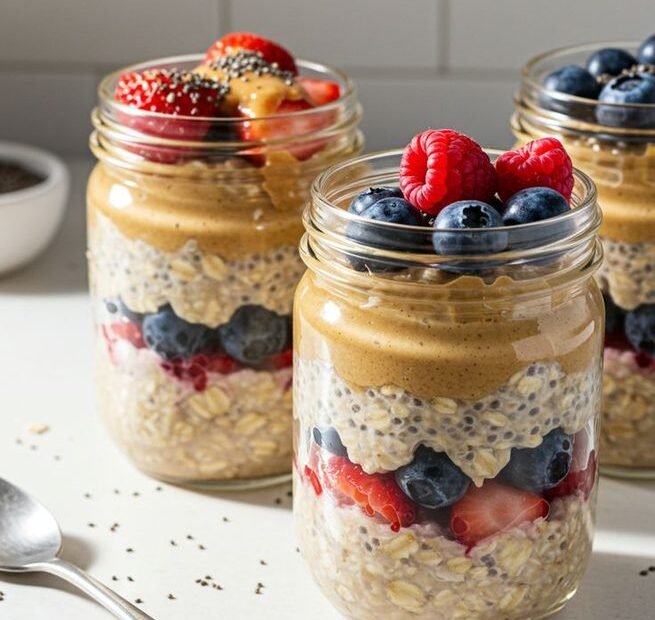
Half a cup of rolled oats, milk or water, a spoonful of peanut butter stirred in, a handful of frozen berries, cinnamon on top. Microwave for two minutes, or mix it in a jar the night before and grab it cold. The oats bring fiber, the peanut butter brings fat and protein, the berries bring the sweetness you would otherwise get from sugar. Cost: well under a dollar. This is the breakfast that most often converts pastry people, because it is ready before the coffee is.
Step 2: Eggs, the budget king
Two eggs — scrambled in a mug in the microwave if the stove feels like too much — give you roughly 12 grams of protein for pennies, plus nutrients that are genuinely hard to get elsewhere. Add a slice of whole-grain toast and a piece of fruit and you have the most complete cheap breakfast in existence. Batch note: hard-boil six on Sunday and breakfast for the rushed days is peel, salt, go. If cholesterol has you cautious, talk to your doctor about your personal picture — but for most people, eggs at breakfast are a nutritional bargain, not a risk.
Step 3: Greek yogurt, bought the smart way
Plain Greek yogurt from the large tub, sweetened by your own hand with berries or half a banana, a spoonful of oats or nuts for crunch. You control the sugar — which is the entire game, because flavored yogurts routinely hide dessert-level sugar behind a health halo. Cottage cheese deserves its comeback here too: similar protein, even cheaper, and excellent on toast with sliced tomato or with fruit if you lean sweet. Both options take ninety seconds to assemble and travel well in a jar.
Step 4: Peanut butter banana toast
The fastest legitimate breakfast on this list. Whole-grain toast, a real layer of peanut butter, banana slices, a dusting of cinnamon. Protein, fiber, fat, potassium, and it tastes like something you would choose on purpose. It is also the most portable: wrapped, it survives a commute. If mornings include training, this same combination doubles as fuel — the timing logic is laid out in our guide to what to eat before and after a workout.
Step 5: Freezer breakfast burritos (the Sunday batch)
For the mornings when even toast is too much: scramble a dozen eggs with black beans, peppers, onions, and a little cheese; roll into tortillas; wrap and freeze. Two minutes in the microwave on a weekday and you have a hot, protein-heavy breakfast that costs about a dollar and would sell for seven. Twenty minutes of Sunday effort buys a week and a half of mornings. The burrito is also where leftovers go to be useful — the last of the roasted vegetables, the end of a rotisserie chicken, the spinach that is about to turn.
Make it a system: the ten-minute Sunday setup
None of the five builds works on a chaotic morning if the ingredients are scattered. The whole approach holds together because of a ten-minute reset once a week. Boil the eggs. Portion oats into four jars with the berries and cinnamon already in, so a weekday hand just adds milk. Confirm the yogurt tub, bananas, and peanut butter are stocked. Slide the burritos to the front of the freezer. That is the entire ritual — and it converts breakfast from a daily decision (decisions are what busy mornings run out of) into a daily grab. Rotation matters too: alternate the builds across the week and none of them gets a chance to become boring, which is the real reason people drift back to the pastry. Monday oats, Tuesday eggs, Wednesday yogurt, Thursday toast, Friday burrito requires no thought at all after the first week — the menu is simply what the day says it is.
Three special cases
The very early trainer. If you work out at 5:30 a.m., a full breakfast beforehand is impractical and unnecessary — a banana or a few dates is enough fuel for most sessions, with the real breakfast (eggs or the burrito) afterward. Eating the big meal post-workout is not a compromise; it is the standard arrangement.
The school run. Everything on this list works for kids with zero adaptation, and the burritos and overnight oats are the standouts because they can be eaten in the car without a mess catastrophe. A child who eats protein and fiber at 7:30 is a different student at 10 than one running on a frosted pastry — teachers have always known what the blood-sugar curve explains.
The shift worker. “Breakfast” means the first meal after your main sleep, whatever the clock says. The formula and the builds are identical; only the hour changes. Night-shift workers who anchor one real meal get the same staying-power benefit as any 7 a.m. eater, and the grab-and-go structure matters even more when your “morning” is someone else’s evening and every café is shut.
What to drink alongside needs one line: water first, then coffee or tea as you like them. Juice is the impostor at the breakfast table — the sugar of several oranges with none of the fiber that made the fruit a good idea. Eat the orange; drink the water.
Price it out honestly
Because “cheap” does a lot of work in this topic, here are the real numbers. The oat jar, all-in with berries and peanut butter, lands around 60 to 80 cents. Two eggs with toast run roughly the same. A yogurt bowl from the big tub is about a dollar; the burrito, about a dollar. A week of breakfasts from this list costs most households somewhere between five and eight dollars. The café alternative — pastry and a coffee at $6 to $10 a day — runs $30 to $50 across the same week. Over a working year, the gap between the two habits is on the order of a thousand dollars, which buys a lot of groceries, and the homemade version wins on protein, fiber, and the 10 a.m. crash test while doing it. Cheap here does not mean austere. It means the markup was the only thing you removed.
The trap to avoid, and the honest word on skipping
The classic mistake is the healthy-looking breakfast that is secretly dessert: the $7 smoothie bowl, the granola bar with more sugar than a candy bar, the flavored yogurt cup, the “protein” pastry. Read one label — if sugar is doing the heavy lifting, it is not breakfast, it is a treat with good marketing, and the 10 a.m. crash will confirm it.
And is skipping breakfast itself a problem? For most healthy adults, no — the evidence does not show breakfast is mandatory, and plenty of people eat well in a later window. The real question is what skipping leads to in your day. If skipping means a sensible lunch, skip in peace. If it means raiding the vending machine at 10:30 and over-ordering at noon, breakfast was load-bearing for you, and one of the five builds above — at a dollar, in five minutes — is the cheapest fix in your whole food budget.




2 Comments