Sunday night, a 7 a.m. flight, five days of meetings, and a carry-on that is somehow already full — with the suit still on its hanger and the shoes still in the closet. Week-long business trips defeat packers in one predictable way: they pack seven days of clothing for a trip that needs four days of clothing and one laundry. The system below is a checklist first, because checklists are what work at 11 p.m., followed by the reasoning that lets you adapt it — to a checked bag, a colder city, a more formal week.
The checklist: one carry-on, five working days
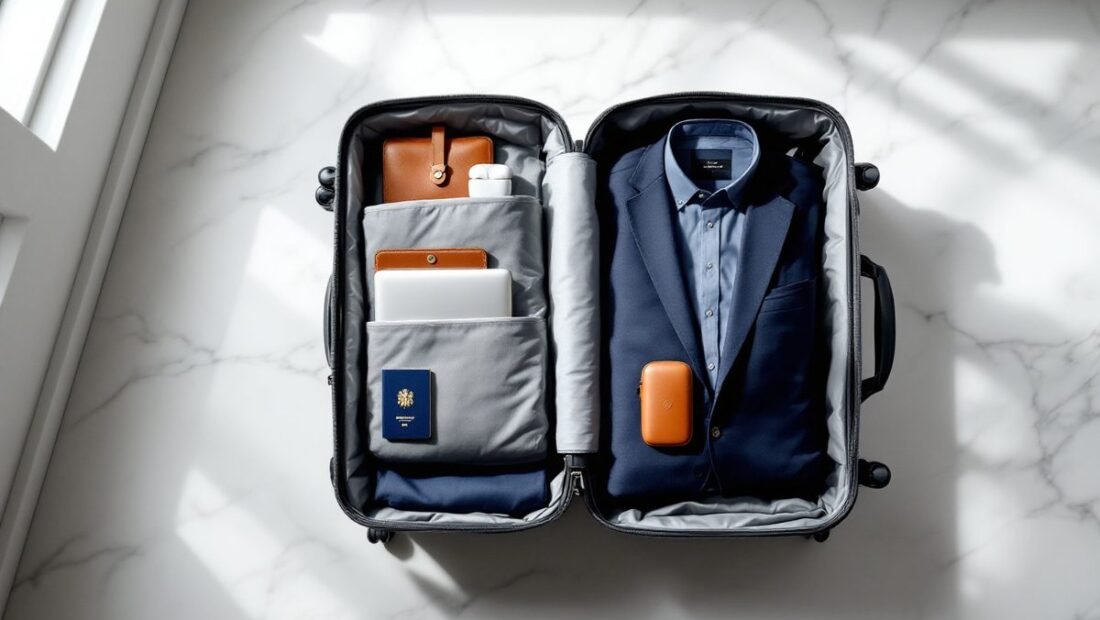
- The palette: one base color family for everything — navy/grey/black — so every top matches every bottom
- Tops: 4 shirts or blouses (one worn in transit), chosen to rotate under one jacket
- Bottoms: 2 trousers or skirts (one worn), both in the palette
- The jacket: 1 blazer or suit jacket, worn on the plane
- Shoes: 1 pair worn, 1 pair packed maximum — dress shoes double for evenings
- Underlayers: 5 sets underwear and socks, plus sleepwear that can answer a hotel door
- The reset kit: travel steamer or wrinkle-release spray, a spot-clean wipe, a spare shirt against disasters
- Dopp kit: decanted, liquids-rule legal, and edited to what you actually use daily
- Tech and documents pouch: chargers, cables, adapter, earbuds, ID, one printed itinerary copy
- Laundry plan: hotel wash or a sink-wash kit scheduled for day 3 or 4
Why the palette does the heavy lifting
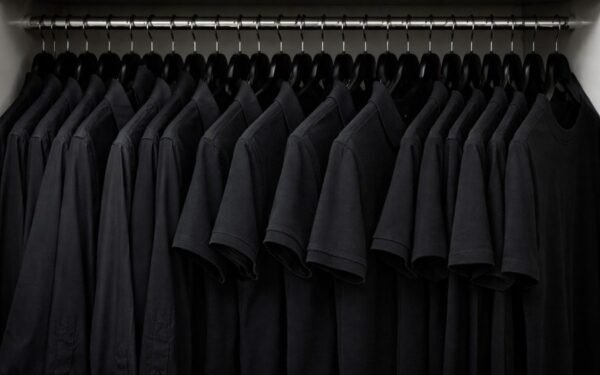
Five days of outfits from nine garments is a math problem, and one shared palette is what makes the math work: when every bottom matches every top and the jacket goes over all of it, four tops and two bottoms produce eight combinations before anything repeats obviously. Break the palette — one pair of brown trousers that only matches one shirt — and you start packing single-purpose outfits, which is how a week eats a checked bag. Choose fabrics inside the palette for their travel behavior: wool-blend and synthetic suiting that sheds wrinkles, knit tops that cannot crease, dark colors that hide a day’s wear. The suit question resolves inside this system too: wear the jacket in transit (it is the bulkiest item you own and planes have hooks and overhead space for it), pack the trousers rolled inside a dry-cleaning bag, and revive anything creased by hanging it in a steamy bathroom during your first shower — steam is the traveling iron. Veteran light-packers preach the same palette gospel; Rick Steves’ tips for packing light build an entire travel philosophy on the mix-and-match core, and business travel is simply that philosophy in a blazer.
Pack four days, launder once: the arithmetic of the week
Packing for four days plus one laundry beats packing for seven days in weight, in case space and — counterintuitively — in freshness, because you rewear the best combinations instead of descending into the dregs by Friday. The laundry can be the hotel’s (expensive, effortless, claim it as a trip cost), a local wash-and-fold (cheap, takes a day), or a ten-minute sink wash of shirts and underlayers on day three with travel detergent sheets. Shoes are where the weight discipline bites: one worn pair and at most one packed pair, because shoes are the densest, bulkiest items in any case. The worn outfit on travel day should be the trip’s heaviest and bulkiest legal combination — boots, jacket, the thick knit — because your body is the only free luggage allowance you have. If you travel weekly, the bag itself becomes part of the system; the tested favorites are compared in the best carry-on bags for frequent flyers, and a bag that fits the sizer and your packing style ends the Sunday-night negotiation permanently.
When the week is formal: the variant
A week with a client dinner, a presentation in the good suit or an event with photographs runs the same checklist at a higher register, and the adjustments are surgical rather than structural. The palette tightens to the formal end — the second bottom becomes the matching suit trouser, the knit tops give way to shirts with collars, and the packed shoes become the best pair rather than the second-best. Add one evening piece that changes the day outfit’s meaning: a tie or scarf in a considered color, the better watch, the bag that is not the laptop bag. Formal weeks also justify the one exception to the laundry arithmetic: pack five shirts, not four, because a formal shirt’s second wear is more visible than a knit top’s, and send the laundry out on day two so it returns by day four. The system survives formality intact — it just spends its margins differently, on shirts and finish rather than on variety.
Building in resilience: delays, spills and the second day
Business trips fail in transit, not in meetings: the cancelled connection, the coffee in the lap at 30,000 feet, the bag that tours a second airport without you. Resilience is packed, not hoped for. The spare shirt on the checklist is the resilience garment — it lives in the case against the spill, and if the spill lands on travel day, the shirt you are wearing becomes the casualty and the spare becomes the meeting. Keep one full change — shirt, underlayer, socks — in your personal item rather than the overhead bag, because the personal item is the luggage that cannot be taken from you at the gate. A small stain stick and a wrinkle spray in the dopp kit handle the middle-sized disasters. And photograph your packed case’s contents on your phone before departure: if the bag is lost, the photo is your claim list, your shopping list and your memory, all three, at the worst moment to be relying on any of them.
The night-before ritual: staging instead of stuffing
The difference between packers who glide and packers who wrestle is rarely the list — it is the staging. Lay the checklist out on the bed by category rather than packing straight from drawers: palette garments in one row, shoes and jacket apart, the pouch and dopp kit open and visible. Build outfits physically — each day’s combination folded together or at least counted against the calendar pinned in your head (Tuesday’s client, Wednesday’s dinner) — because a case packed by category can still omit the one shirt the important day needed. Roll the soft garments, fold the structured ones flat with the jacket on top or worn, and put the resilience change in the personal item before the case closes. Then weigh the case in your hand and walk it around the room once. Business travel punishes the bag you cannot comfortably carry up a broken escalator, and Sunday night is the last cheap moment to correct that. Staged this way, packing a week takes twenty unhurried minutes — the checklist’s final gift is that it makes the night before a formality.
Flying in it: the outfit that travels
The checklist assumes the clothes arrive; the travel outfit decides how you arrive. Wear the heaviest items rather than packing them — the jacket and the substantial shoes — which frees case space and keeps the best pieces out of the crush entirely. The travel day’s own combination should be built from checklist members, not a separate travel wardrobe: the knit top and second bottom you will wear again at destination, so the flight adds a wear rather than consuming a slot. Layers for the cabin’s unpredictable temperature come from the same kit — the jacket over, the knit beneath — and anything irreplaceable or meeting-critical rides in the personal item with the spare change, never in a bag that can be gate-checked into the hold. Dressed this way, a delayed flight or a lost case degrades the trip’s comfort without touching its purpose. You can walk from the airport to the meeting in what you are wearing, and the case, when it reunites with you, is a bonus rather than a rescue.
The dopp kit edit and the pouch that saves mornings
The dopp kit is where carry-on plans go to die, usually at security: decant everything into small containers, and keep the liquids bag honest against the TSA’s liquids rule for carry-on bags — quart-sized bag, containers of 3.4 ounces or less — rather than discovering a full-size bottle at the belt. Edit to what a normal day at home actually uses; the “just in case” products are what hotels, pharmacies and the kit’s own weight are for. The documents-and-tech pouch is the second small system: every cable, charger, adapter and earbud in one zippered place, with ID, cards and one paper itinerary copy. Its value is not tidiness — it is that packing up a hotel room at 6 a.m. becomes a two-minute sweep instead of a forensic search, and nothing critical gets left in a bedside socket in another time zone. Carry-on or checked for a week, the standing question, resolves on trip shape: carry-on if the itinerary has connections, tight transfers or a same-day meeting, because a lost checked bag cannot be allowed to matter; checked if the week includes formal changes, materials, or weather extremes that honestly exceed one bag. Pack the checklist either way — the palette is the packing — and Sunday night stops being a negotiation.