
Can you actually enjoy eating in a country where you cannot read the menu — or even the ingredient list? For travelers with dietary restrictions, that question sits underneath every trip plan, and the honest answer is yes — with a system. Whether the restriction is a celiac’s gluten, a peanut allergy that does not negotiate, a vegan commitment, or a medical diet with fine print, the travelers who eat well abroad share the same structure: they choose destinations and cuisines that cook their way natively, they carry their communication in the local language, they build one or two meals a day they control completely, and they let restaurants be the adventure rather than the gamble. The questions below are the ones that actually get asked, answered in the order a trip unfolds.
Before booking: which destinations cook your way?
The first decision is geographic, and it is more powerful than any card or app. Every restriction has cuisines where it is native rather than exceptional. Celiac travelers thrive in Italy, paradoxically the land of pasta: Italian law and culture take celiac disease seriously, gluten-free pasta and bread are ordinary supermarket and restaurant items, and staff generally know exactly what “senza glutine” requires. Vegetarians and vegans eat like royalty across much of India, where vast cuisines are built vegetarian from the ground up, and in the Buddhist-influenced kitchens of Southeast Asia — with the fish-sauce caveat below. Peanut allergies invert the map: Southeast Asia’s peanut-heavy cooking demands maximum vigilance, while Mediterranean and Japanese cuisines are comparatively manageable — with soy and sesame as their own watch-items. Halal and kosher travelers have their own geographies of ease. Choose the destination partly by its kitchen and the trip’s food stress halves before you pack a bag.
How do you communicate a restriction without the language?
Cards. Not the phone app alone, though translation apps help in conversation — a physical or saved card, in the local language, written by a native-level source, that states the restriction, its seriousness, and its hidden sources. The hidden sources are the point: “no peanuts” must also name peanut oil and sauces; “no gluten” must name soy sauce, barley, and shared fryers; “no fish” in Southeast Asia must name fish sauce and shrimp paste, which hide in dishes that look vegetarian. Organizations like FARE, the food allergy research and education organization publish guidance and resources for traveling with food allergies, and the card services built on the same principles (chef cards, allergy translation cards) are worth their tiny cost. Show the card before ordering, watch it be read, and treat a confused response as information — a kitchen that cannot engage with the card is a kitchen to thank and leave, politely, however good the room smells. Add one human layer where you can: the hotel concierge or a local guide, briefed once, becomes a translator of both language and custom, and can call ahead to the evening’s restaurant in a way no card can.
What about the flight, the hotel, and breakfast?
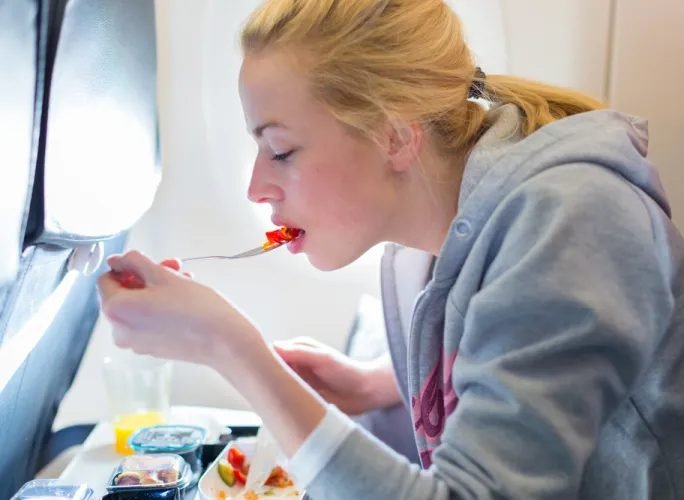
Control the meals you can and the rest gets easier. At 30,000 feet, the rule is ordering: special meals are requested at booking, not at the gate — airlines need 24–48 hours’ notice, the special meals are loaded or they are not, and they are often fresher than the standard service besides. Carry your own food regardless; a delayed flight turns a missed special meal into a hungry emergency for restricted travelers in a way it never is for others. At the hotel, the kitchenette is king: an apartment-hotel or Airbnb with even a two-burner setup and a fridge removes most of the stress from the trip, because breakfast and one other meal a day become entirely yours — shopped at markets and supermarkets, where labels (often multilingual in tourist regions) can be read at your own pace. This is precisely where the rental-versus-hotel choice stops being about space and becomes about food safety, so the reading skills in how to find good local restaurants while traveling pair with a grocery strategy rather than replacing one. Travelers routinely find that fixing breakfast alone — their own food, their own kitchen, no negotiation at 8 a.m. — changes the emotional weather of the whole trip.
What about cruises, tours, and other people’s itineraries?
Organized travel is where control goes to be negotiated, and the answer is to negotiate early and in writing. Cruise lines run the most developed special-diet machinery in travel: notify the line well before sailing, meet the maître d’ on embarkation day, and the galley will typically produce safe, varied meals all week — the system exists because ships cannot improvise at sea, which works in your favor. Group tours are the harder case: set menus, roadside stops, and a guide whose attention is divided among twenty people. The restricted traveler on a tour survives on pre-loading (a real breakfast), the permanently packed snack kit, and one private conversation with the guide on day one — guides rearrange more than travelers expect when they know early, and almost nothing when they learn at the table. Solo and self-guided travel remains the gold standard for control, which is why many restricted travelers drift toward it over the years: not from anxiety, but from the discovery that an itinerary built around markets, kitchenettes, and chosen restaurants is simply a better trip that happens to be a safer one.
Can you trust buffets, breakfast spreads, and labels?
Buffets are the restriction’s final boss, and the verdict is nuanced. The risks are mechanical: shared tongs migrating between dishes, sauces without ingredient cards, the nut bowl’s spoon resting in the fruit salad. The mitigations are also mechanical: arrive at opening, when the spread is fresh and uncontaminated; ask staff — who in hotels increasingly receive allergen training — what is in the unlabeled dishes; and build the plate from the stations where food is made to order in front of you (eggs, grilled items, plain rice and vegetables from the top of a fresh tray). Supermarket labels abroad deserve a calmer assessment than travelers give them: packaged food in the EU, UK, Japan, Australia, and much of Latin America carries allergen labeling that meets or beats home standards, with the major allergens bolded or listed by law — your own language may be absent, but the allergen icons and the learned vocabulary of your top three dangers translate. The market hall, in the end, is the restricted traveler’s best institution on earth: ingredients visible, cooking to order, and questions answerable by pointing. Eat there often, and the trip tilts from managed to delicious.
How do restaurants actually go, day to day?
Better than feared, with tactics. Eat the main meal at lunch, when kitchens are calmer, staff have time for the conversation, and the chef is likelier to be present. Choose restaurants where the food is cooked to order in view — grill houses, noodle bars, market stalls with woks — over buffets, where cross-contact is a design feature. Learn the ten food words of your restriction in the local language, spoken, not just shown; the attempt itself recruits the room to your side. Carry safe snacks permanently — the bar, the nuts you verified, the rice cakes — because hunger is the enemy of judgment, and every restricted traveler’s worst meal was ordered hungry at a place chosen by desperation. And keep the emergency layer honest: medications (two sets, split between bags), the location of the nearest hospital noted once per city, and travel insurance that explicitly covers your condition. Then relax into the trip’s actual pleasures. The restricted travelers who thrive are not the most anxious; they are the most prepared — and preparation, done once, is indistinguishable from freedom.
One question remains, the emotional one: does all this planning not spoil the spontaneity that travel is for? Watch an experienced restricted traveler for a day and the answer shows itself. The system runs in the background — the card in the wallet, the snacks in the daypack, the breakfast that needs no discussion — and the foreground is exactly what everyone else’s foreground is: the market’s noise, the chef’s recommendation, the dish that becomes the trip’s story. Spontaneity was never the absence of preparation; it is what preparation buys. The traveler without a system is not spontaneous, merely exposed — deciding everything under pressure, hungry, in a language they do not speak. Build the rails once, and then ride them anywhere on earth, eating the whole way. Your restriction will still close a few doors — a dish here, a region there, the street stall whose wok you cannot audit. Count what it opens instead: the kitchens that cook your way and cook it brilliantly, the chefs who rise to the conversation, the market mornings that become the trip’s heartbeat. Travelers with restrictions do not travel less well than everyone else. Done right, they travel closer to the food — and food, in the end, is where a country keeps its heart.



2 Comments