The most beautiful seat in American travel never leaves the ground. It sits about ten feet above the rails, in a glass-walled observation car, rolling at 30 miles an hour through a canyon that no highway enters and no airplane passenger ever sees at window height. Scenic train rides are not really transportation — the plane is faster and often cheaper — they are the one form of travel where the journey itself is the destination, and the US happens to hold some of the best rail scenery on earth. The trick is picking the right line, because a great name on the timetable does not guarantee a great view, and two trains leaving the same city can deliver completely different trips.
The western long-distance greats
Three Amtrak routes compete for the title of most scenic run in the country, and each wins on different ground. The California Zephyr, from Chicago to the San Francisco Bay Area, is the usual answer and earns it: after Denver it climbs into the Colorado Rockies, follows the Colorado River through Glenwood Canyon — a stretch of river, cliff and rail with no road beside it — crosses the Utah desert at sunset hour, and finishes over Donner Pass in the Sierra Nevada. The full run is about 51 hours; the Denver-to-Grand-Lenwood portion in daylight is the heart of it, so westbound timing matters. The Coast Starlight runs Seattle to Los Angeles, pairing Puget Sound shoreline and the Cascade mountains with a long ocean-hugging finale along the California coast, where the tracks sit on bluffs directly above the Pacific. The Empire Builder, Chicago to Seattle or Portland, crosses the northern plains — prettier than their reputation — and threads Glacier National Park’s southern edge and the Columbia River Gorge. If a trip combines rail with park time, it pairs naturally with knowing how to plan a national park road trip on a budget, since several of these trains stop within shuttle distance of park gates.
The Southwest in daylight
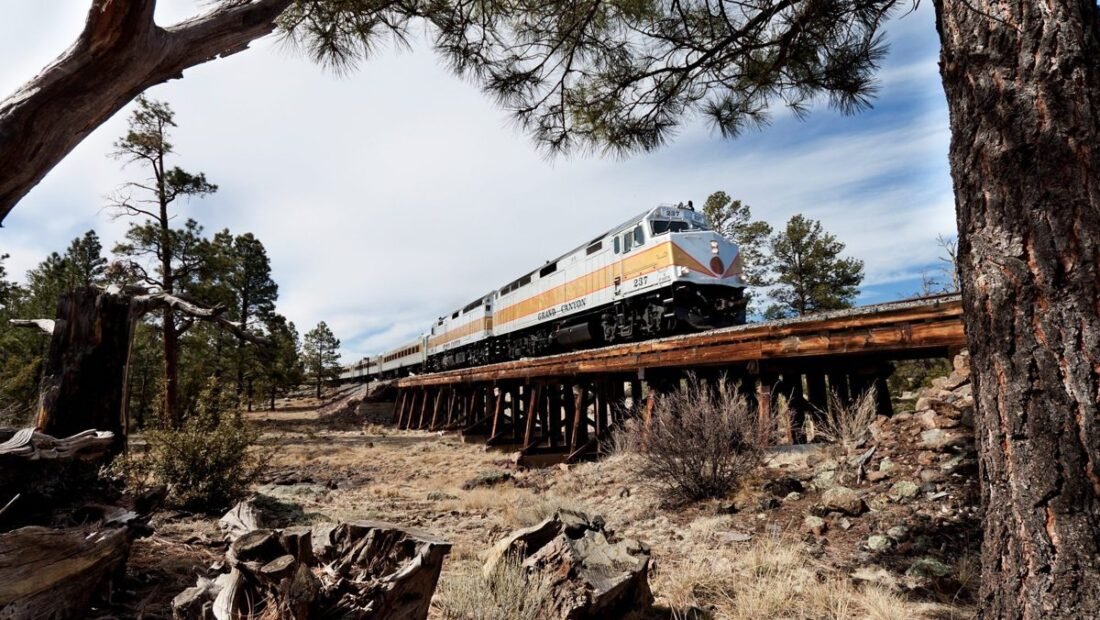
The Southwest Chief runs Chicago to Los Angeles through the high desert of New Mexico and Arizona, crossing Raton Pass and red-rock country that reads like a geology lesson at speed. Its sleeper secret is Flagstaff: from there, the Grand Canyon is a short drive or shuttle away, and a separate heritage line, the Grand Canyon Railway, runs from Williams, Arizona straight to the South Rim, delivering passengers to the canyon without a car at all. Further north, the Durango and Silverton Narrow Gauge in Colorado is a half-day steam trip up the Animas River gorge on tracks laid in the 1880s — slow, smoky, open-air, and unlike anything else operating in the country. These shorter heritage runs suit travelers who want one spectacular rail day inside a road trip rather than two nights aboard.
Mountains, gorges and steam in the East
The East cannot match western distances, but it has concentrated drama. Amtrak’s Adirondack from New York City to Montreal hugs the Hudson River, then Lake Champlain, for hour after hour of water-level scenery. In West Virginia, the New River Gorge — now a national park — is served by Amtrak’s Cardinal on its Chicago–New York run, crossing the gorge on a high bridge with the river far below. The Great Smoky Mountains Railroad in North Carolina and the White Pass and Yukon Route out of Skagway, Alaska — a narrow-gauge climb past waterfalls and gorges built during the Klondike gold rush — round out the heritage list, along with the Alaska Railroad’s Denali Star, which on clear days delivers what its name promises: Denali itself, filling the window.
Coach versus sleeper: the honest math
On long-distance Amtrak routes, coach is the bargain of American travel: fares often run under $150 for journeys that cost $500 or more in a roomette, and the seats are wide, reclining, and far roomier than any airline seat. The catch is nights. One night in coach is an adventure; two nights is an endurance event, and the Zephyr asks for two. A roomette buys a door that closes, beds made up by an attendant, and — the part people underestimate — all meals in the dining car included, which quietly erases $40 to $70 a day of food spending. Families should price the family bedroom against two roomettes before assuming. The sensible middle path for a first trip: take the scenic daylight segment in coach — Denver to Grand Junction, say — and let a shorter overnight ride elsewhere carry the sleeper experiment. Package operators bundle exactly these segments; Amtrak Vacations’ scenic rail packages are a useful price benchmark even if you end up booking the pieces yourself.
Booking and riding tactics that change the trip
Direction and daylight decide more than class does. Westbound Zephyr passengers get the Rockies in full daylight; eastbound riders can sleep through part of the best canyon country depending on the season, so choose direction around the scenery you care about most. Book sleepers early — roomette prices climb steeply as they sell, and the cheapest sleeper fares appear months out, not weeks. On boarding, go early to the Sightseer Lounge car on western routes: seats there are unreserved, the windows wrap up into the ceiling, and the best light is the first two hours after a scenery stop. Pack as if the train were a small hotel with no shop: snacks, a refillable bottle, a light blanket for coach, downloaded entertainment for the long signal-free stretches, and layers, because observation cars run cool. Delays of one to three hours are normal on freight-shared track, so never schedule a same-day connection, cruise departure, or wedding off a long-distance arrival — give the trip a buffer day and treat the slack as part of the holiday.
One more number belongs in that math: time. A cross-country train consumes two to three days that a flight consumes in hours, so the honest comparison is not train fare against airfare — it is train fare against airfare plus the hotel nights and restaurant meals of a short scenic holiday, because the train replaces those too. Priced that way, a roomette on the Zephyr competes with a mid-range road trip, not with a plane ticket, and coach competes with almost nothing else on earth for scenery per dollar.
Seasons: the same route is four different trips
Scenery has a calendar, and it changes the ranking. Late spring and early fall are the all-round sweet spots for the western trains: long daylight for the passes, snow still on the high peaks for contrast, green river valleys, and none of the peak summer crowds in the lounge car. Summer itself buys the longest evenings — the Zephyr crosses the Sierra in full light — but books out sleepers fastest and brings the highest fares and the most crowded observation cars. Autumn belongs to the East: the Adirondack in mid-October, with the lake shore and the Hudson valley turning color, is arguably the single best fall ride in the country, and it sells out around peak weekends. Winter is the connoisseur’s season on the western routes. The Rockies in fresh snow, seen from a warm lounge car with the river steaming below, are spectacular — with two honest warnings: short days mean some famous segments pass in darkness depending on direction, and mountain weather causes the year’s worst delays. Choose winter for the atmosphere and the low fares, not for a tight schedule.
Food, sleep and the small print
Dining is the sleeper passenger’s quiet luxury and the coach passenger’s planning problem. Traditional dining-car service on the western routes serves sleeper passengers included in the fare; coach passengers buy from the cafe car, where the food is serviceable but repetitive across two days — another argument for a well-stocked snack bag and a real meal at a long stop. Sleep quality follows a simple ladder: a bedroom is a hotel room that moves, a roomette is a snug and genuinely restful cabin once the beds are down, and a coach seat is roughly a recliner’s worth of sleep, workable for one night with a pillow and eye mask. Families with small children should know that the family bedroom sits by the car’s restrooms and spans the full width of the train — space to spread out that no airline product at any price can match. Two final pieces of small print: checked baggage is only offered at larger staffed stations, so carry-on discipline matters at small stops; and pets, bikes and oversized gear each follow their own Amtrak rules that are worth checking before the ticket, not at the platform.
Which ride, for whom
First-timers who want the definitive American rail trip should take the California Zephyr westbound, in a roomette if the budget stretches, between Denver and California if it does not. Ocean lovers belong on the Coast Starlight’s southern half. Travelers with two days rather than four should skip the cross-country runs entirely and build around one great segment — Denver to Glenwood Springs, the Grand Canyon Railway, or Durango to Silverton — then rent a car and keep moving. The mistake is treating all famous trains as interchangeable: they are not rides on the same product. Each is a different landscape moving past the glass at the speed it deserves, and choosing by landscape, not by fame, is the whole secret.