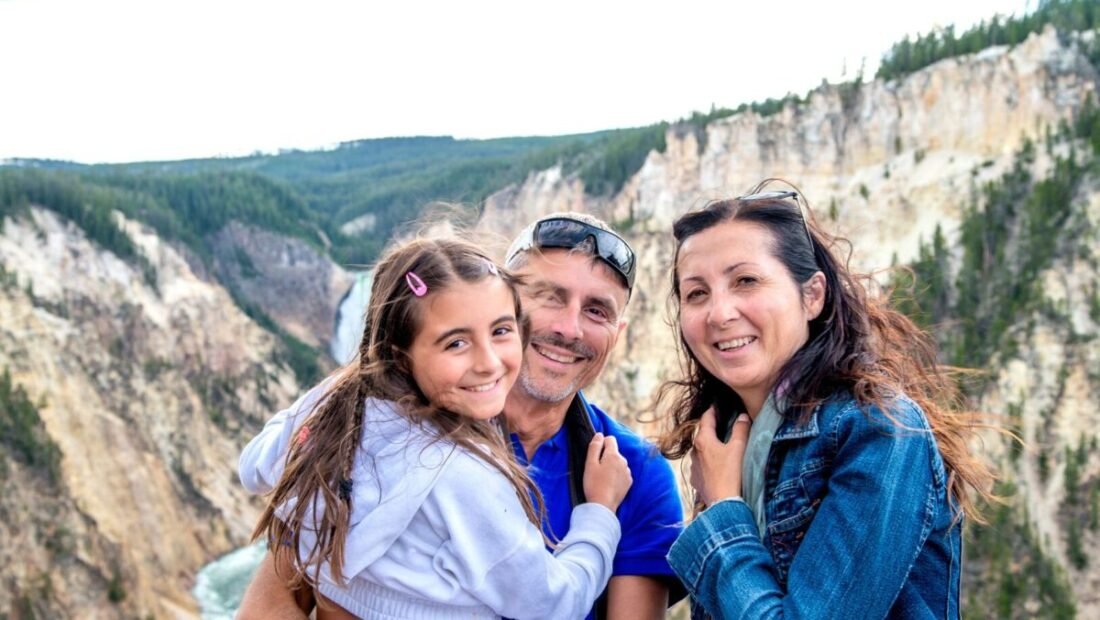
Yellowstone asks the same question of every family and accepts wildly different answers: the same geysers, the same bison jams and the same canyon can cost one family of four about $2,500 for five days and another family $9,000 — and both families come home happy. The difference is not luck or secret discounts. It is about six decisions, made months apart, each quietly multiplying or dividing the total. This guide compares the three honest ways families do this trip — camping-lean, gateway-town middle, and in-park lodge — line by line, so the number at the end is a choice rather than a surprise.
The middle tier: gateway towns and a kitchen
Most families land here, and the realistic range for five days is $3,000 to $5,500 for four people. The anchor decision is sleeping just outside the gates. West Yellowstone and Gardiner, the two main gateway towns, offer motels and vacation rentals at roughly $150 to $300 a night in summer; a two-bedroom cabin or rental for five nights typically runs $1,000 to $1,500 total and comes with the single most valuable appliance in Yellowstone travel: a kitchen. Park entrance is $35 per vehicle for a seven-day pass — or the $80 America the Beautiful annual pass, which covers every national park for a year and pays for itself if any second park, including nearby Grand Teton, is even a possibility; current pass details sit on the National Park Service’s Yellowstone fee page. Gas is a real line, not an afterthought: the park’s figure-eight loop is over 140 miles, wildlife detours add up, and a family should budget $200 to $300 across five days. Food is where the kitchen earns its keep — families who pack breakfasts and picnic lunches and cook some dinners spend $60 to $80 a day, while three restaurant meals a day inside the park pushes past $150 daily. Add $100 to $300 for one or two paid activities, and the tier totals itself: transport aside, roughly $2,200 to $3,300 on the ground.
The lean tier: camping and a cooler
Campers change the arithmetic completely. Park campgrounds run about $30 to $50 a night, so five nights of lodging cost less than one night in a gateway motel, and a camping family that drives in, cooks most meals and travels in September — after the crowds, while most facilities remain open — can do five days for under $2,000 on the ground. The trade-offs are honest ones: most park campgrounds are first-come or book out the day reservations open, nights are genuinely cold even in July at Yellowstone’s elevation, and cooking every meal while bears require strict food storage is a discipline, not a detail. Families new to camping often do best with a hybrid: two or three campground nights for the experience and the savings, bookended by motel nights for showers, laundry and a real bed. Anyone planning the driving itself should work through how to plan a national park road trip on a budget before fixing dates, because the route and the gateway airport change this tier’s transport costs more than any other choice.
The lodge tier: sleeping inside the park
Staying inside Yellowstone — Old Faithful Inn, Canyon Lodge and their sisters — costs $250 to $550 a night in summer, and rooms release a year ahead and sell out accordingly. What the premium buys is not luxury; rooms are famously plain, many without air conditioning or televisions. It buys position: dawn at Old Faithful with the day-trippers still an hour away, evenings in the Lamar Valley when the wildlife moves and the parking lots empty, and an hour a day not spent commuting through a gate. A family flying in, sleeping in-park, eating in the dining rooms and booking a guided wildlife tour can pass $7,000 without a single extravagance. The tier is worth it for photographers, wildlife obsessives and anyone whose trip is short and once-only; it is poor value for families who will spend their days driving the loops anyway, since a bed’s location matters least to people who are never in it.
Getting there: the swing factor
Every tier above excludes the journey to the park, and for flying families it rivals lodging as the biggest cost. The gateway airports — Bozeman, Billings, Jackson, Idaho Falls, Salt Lake City for the committed — price very differently on the same dates, and fare gaps of $200 or more per ticket between them are common, which across four tickets can exceed the entire food budget. Compare all of them before booking anything else, and price the rental car at each too, because a cheap flight into an expensive rental market is a shell game. Driving your own car from home, if home is within a long day’s drive, quietly deletes airfare and rental costs and adds cooler space for the lean tier’s groceries. However a family arrives, book lodging nine to twelve months ahead for summer: in Yellowstone, availability is a cost, because the rooms that remain in March are the expensive ones.
Where families waste money
The waste is rarely dramatic — it accumulates at the edges. Eating every meal in park restaurants is the classic one: the food is serviceable, priced for a captive audience, and one packed picnic lunch a day saves a family of four roughly $50, every day, with better views from a pullout than from any dining room. Second is the single-base mistake in reverse: moving hotels every night to chase the map burns hours and deposits; two bases, one north and one south, is the sweet spot. Third is buying gear at park stores — sunscreen, hats, bear spray at gateway prices, when the same items cost half in town (and bear spray cannot fly home anyway, so rent it near the gate). Fourth is skipping the cheap insurance of a rest day pattern: families who try to see everything in three days pay for guided tours and extra nights later, tired. Finally, the quietest waste is the annual pass left unbought by a family that then pays single-park fees again at Grand Teton on the way home.
One worked example, dollar by dollar
To see how the middle tier actually assembles, price a concrete version of it — a family of four, five days in late June, driving their own car, sleeping in a West Yellowstone rental. Lodging: five nights at $240, $1,200. Park pass: the $80 annual, because Grand Teton is on the drive home. Gas: $260 for roughly 900 miles of loops and gateway runs. Groceries and food: $420 — breakfasts and two dinners cooked, picnic lunches packed, two restaurant dinners out. Activities: $180 for one ranger-led program donation-stop and a half-day wildlife outing booked locally, with the park’s free ranger talks filling the rest. Incidentals — bear spray rental, ice, sunscreen, one souvenir allowance: $120. Total on the ground: $2,260, before the cost of driving to the park. Move the same family into an in-park lodge at $380 a night and restaurant meals throughout, and only those two lines change — lodging to $1,900 and food to $750 — lifting the total to roughly $3,660 on the ground and past $7,000 once flights and a rental car join. The example’s lesson is the article’s: Yellowstone’s total is two or three decisions wearing a long tail of small ones, and the small ones matter less than families fear.
Timing: when the same trip costs less
Every tier above is priced at summer rates, because summer is when most families go. The calendar is a cost lever of its own. Late May and September deliver the park with most facilities open and crowds — and some rates — stepping down; September is the connoisseur’s month, with elk in rut, golden aspens in the high country, and gateway rooms easing off peak pricing. Winter closes most in-park lodging and many roads, and belongs to specialists. Within summer, midweek arrivals soften both lodging rates and gate lines. The one timing rule with no exceptions is the booking window: in-park lodges release rooms a year ahead and the desirable ones go within weeks, while gateway rentals reward the same early habit with the best stock rather than the leftovers. A family that books in October for the following July is not being anxious — it is shopping in a cheaper store than the family that books in March.
The verdict
Pick the tier by temperament, then defend it. Camp, and five days can cost under $2,000 plus transport, with the park at its most immersive. Take the gateway towns and a kitchen, and $3,000 to $5,500 buys the trip most families picture — comfortable, flexible, and honest. Sleep in the lodges, and $7,000 or more buys position and dawn light rather than thread counts. What no family should do is drift: booking lodge nights, restaurant habits and a peak-season flight while expecting a camping total. Yellowstone charges for indecision at every register, and rewards — at every tier — the families who chose their number on purpose.