
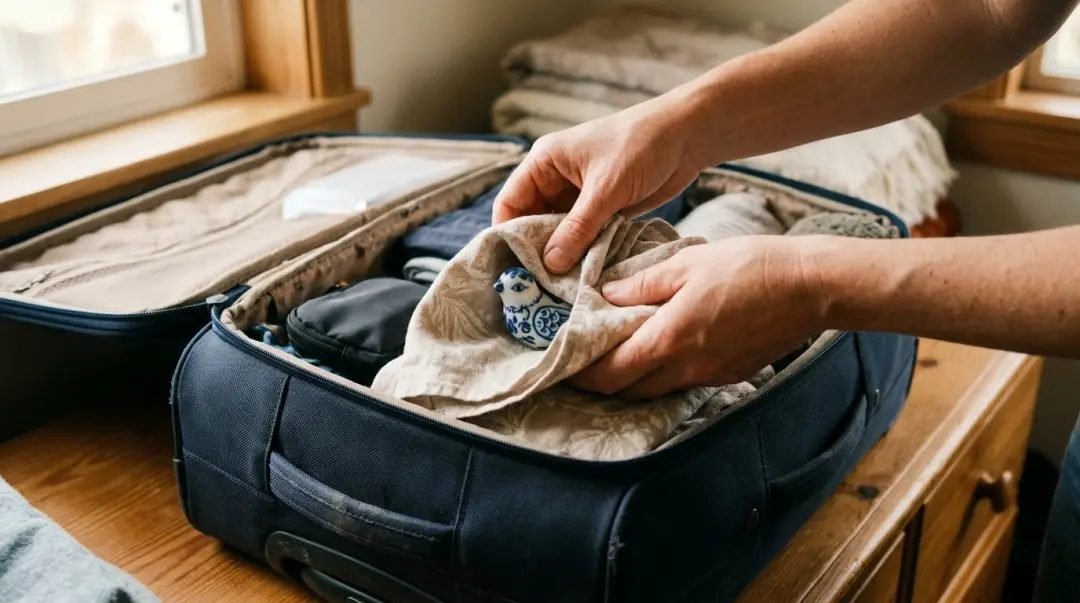
Souvenirs rarely break in the market, the museum shop or the hotel room. They break in the last twenty minutes of the trip — in the taxi queue, the airport shuttle, the moment a suitcase comes off the carousel and lands on its corner with everything you loved inside it. Fragile things survive astonishing journeys when they are packed on purpose, and die on short ones when they are tossed in hopefully. The system below treats packing souvenirs as a small logistics problem with four variables: what you buy, what you wrap it in, where it rides, and when you give up and ship it instead.
Step 1: Pack for souvenirs before you leave home
The time to plan souvenir space is before departure, when the suitcase is still yours to arrange. Leave roughly a fifth of your bag empty, or pack a flat duffel that unfolds into a second bag for the trip home — the second-bag trick also solves the oldest souvenir problem, which is that things multiply. Carry a small kit: a roll of bubble wrap or a few sheets of packing foam, zip-top bags in two sizes, a handful of rubber bands, and painter’s tape. The whole kit weighs almost nothing and replaces the hotel-room improvisation of wrapping a vase in a sweater and hoping. The discipline behind the kit is the same one behind knowing what to pack for a 10-day trip: the bag is a fixed space with a plan, not a pile that absorbs purchases until it bursts.
Step 2: Triage what you buy
Not everything fragile needs the same armor. Sort purchases into three classes at the moment of buying. Class one, the true fragiles — ceramics, glass, thin pottery, artwork under glass — get full wrapping and hard-case treatment. Class two, the sturdy-but-dentable — wooden carvings, metalwork, books, thick leather — need only padding against each other. Class three, the indestructibles — textiles, magnets, spices in sealed tins — are not packing problems at all; they are packing material, and step 4 puts them to work. Ask sellers to wrap purchases for travel before you leave the shop: market vendors and museum stores do this daily, have the right paper and boxes within reach, and their wrap job is usually better than yours at midnight. Keep receipts and a phone photo of each fragile piece in case a damage claim ever becomes necessary.
Step 3: Wrap each fragile like it will be dropped
Because it will be. Wrap each piece individually: bubble wrap or foam sheet around the object, tape closed, then a second layer for anything thin-walled. Fill hollow items — bowls, vases, mugs — with socks or underwear so pressure is supported from inside; a hollow ceramic crushed is almost always crushed inward. Seal anything with liquid risk, from olive oil to perfume, inside a zip-top bag, then inside a second one, because a leak ruins more souvenirs than breakage does. For bottles, padded wine-shipper sleeves exist for a few dollars and turn a bottle into a checked-bag-safe package; without one, build the same thing from a wrapped core of clothing with the bottle at the center. Label the outermost layer of the most precious item with its contents in marker — the note is for the tired person unpacking, who may be you.
Step 4: Load the bag in layers, fragiles at the core
A suitcase has safe zones and kill zones, and they are fixed. The kill zones are the corners, the edges, and the layer against the wheels and telescoping handle, where impacts and pressure land. The safe zone is the center of the bag, cushioned on every side by clothing. Build the load accordingly: hard items flat at the bottom over the handle side if the bag is soft, then a clothing layer, then the wrapped fragiles nested in the middle with at least two inches of soft material between them and every wall, then more clothing above. Stuff shoes and class-three souvenirs around the edges as bumpers. Nothing fragile should touch anything else fragile — two ceramics wrapped separately can still crack each other through the padding if they collide, so separate hard objects with soft ones, always. A hard-shell suitcase upgrades every layer of this system; a soft bag demands one extra inch of padding everywhere.
Step 5: Decide what rides in the cabin
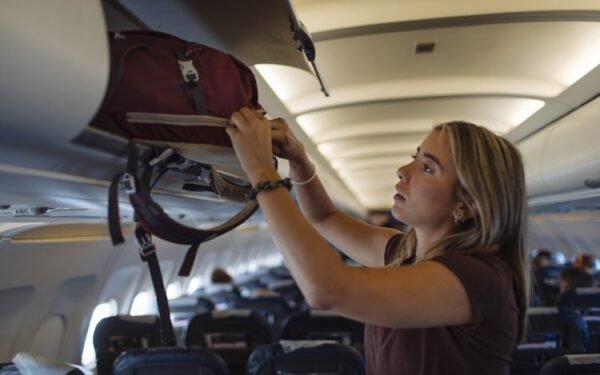
The most precious, most fragile one or two items should travel in your personal item or carry-on, where the only handler is you. This is where the truly irreplaceable piece belongs — the one whose loss would actually sting. Mind the rules as you load: liquids in the cabin are limited, snow globes are a notorious confiscation item because of their liquid, and sharp or heavy objects can draw attention at screening; the the TSA’s what-can-I-bring list settles questions before they become arguments at the belt. Food souvenirs deserve their own honesty: many countries restrict meat, fresh produce and unpasteurized cheese on entry, so declare food items and keep them sealed and shelf-stable. A carry-on should also hold one wrapped fragile as a decoy-free zone — no liquids beside it, no hard camera body pressed against it, and the bag stored upright under the seat rather than crushed in an overhead bin if the piece truly matters.
Step 6: Know when to ship instead
Some purchases should never enter a suitcase: the oversized, the extremely fragile, the case of wine, the framed print bigger than the bag. Shipping is the grown-up answer, and the arithmetic is kind — a $25 shipping fee beats a broken $80 vase, and a shop’s own shipping service, where offered, usually packs better than you can and carries the breakage risk itself. When self-shipping, double-box: the wrapped item in a small box with two inches of cushioning on all sides, that box inside a larger one with the same treatment, because carriers’ machinery is rougher than any airline belt. Photograph the packed box, keep the tracking number outside the shipped luggage, and insure anything whose value would make its loss a story. The decision rule is simple: if the item cost more than twice the shipping quote, or cannot be replaced at any price, it ships or it rides in the cabin — it does not go in the hold and hope.
The journey’s stress points: security, transfers and the last bag check
Pack for the three moments bags get hurt. Security screening is the first: carry-on fragiles may be unwrapped and handled by officers, so cabin pieces should be wrapped in a way that survives opening — layers that lift off and go back on, rather than a tape-sealed cocoon that gets destroyed at the belt and never rebuilt. The second is the transfer: a checked bag on a connecting itinerary is loaded and unloaded at least twice more than a nonstop’s, and every handling doubles the corner-drop lottery; tight connections add the sprint factor, where bags are quite literally thrown. The third is the one travelers forget — the bag’s time on the carousel and the ride home, when a tired owner drags it off curbs and hoists it into a trunk by one handle. The pack that survives is built for all three: fragiles centered, corners armored with shoes and textiles, nothing precious riding against a wall of the bag. It takes ten extra minutes at the hotel desk. It is the difference between a shelf of whole souvenirs and a drawer of almosts.
Special cases: bottles, artwork and awkward shapes
Three categories defeat generic advice and deserve their own rules. Bottles — wine, olive oil, spirits — are heavy, liquid and glass at once: cap the neck with tape so a loosened cork or cap cannot walk out, bag each bottle twice against leaks, and pack bottles upright in the bag’s center surrounded by the softest clothing you own; in checked luggage, a bottle against the bag’s spine side survives better than one against the outer wall. Framed artwork and prints travel best flat, face protected by cardboard on both sides, and ideally in the cabin flat against the back of a carry-on — glass in a checked bag is a coin toss no frame deserves, and removing the glass and framing at home is a legitimate, often cheaper answer. Plants, seeds and wooden items face a different risk entirely: customs. Many countries, the US included, restrict or seize plant material, untreated wood and certain foods on entry, so the souvenir that survives the flight may still be confiscated at the border. Buy the poster instead of the cutting, declare anything organic without exception, and let the ceramic rooster be the trip’s fragile problem — it is the easier one.
When something breaks anyway
Even good systems lose one occasionally, and a break is not always the end. Clean breaks in ceramic and glass repair well with clear two-part epoxy applied sparingly to a dry, test-fitted joint; repaired pieces hold decorative value honestly if you accept the visible line as part of the object’s story — travelers have kept repaired pieces for decades. Chips in pottery can be stabilized the same way. What is not worth doing is discarding a broken souvenir in the hotel bin in the first annoyed hour: wrap the pieces, bring them home, and decide at the kitchen table, where glue, patience and perspective all live. The pieces you saved are also your evidence if a shipping or baggage claim is possible — photograph the damage before you touch it. In the end, the goal was never a perfect record. It is a shelf at home where nearly everything you carried across the world made it — because you packed like the last twenty minutes were the dangerous part. They are.



1 Comment