I used to land from long-haul flights feeling like I’d been in a minor car accident — neck seized, back aching, brain foggy for two days. Then I treated airplane sleep as a skill to learn instead of a misery to endure, and everything changed. I now regularly sleep 5–6 hours in economy, and I arrive functional. Learning to “sleep comfortably on a long-haul flight” transformed my travel — I went from dreading red-eyes to actively preferring them.
Sleeping comfortably on a long-haul flight is a system: the right seat, the right gear, the right timing, and a routine that tricks your body into believing the aluminum tube is a bedroom. Here’s the complete system.
No, you won’t sleep like at home. But you can sleep like a competent camper — which is plenty.
Seat Strategy: Location Matters More Than Class
In economy, seat choice is everything. Window seats win for sleep — you get a wall to lean on and nobody climbs over you. Avoid the last rows (limited recline, near bathrooms, noisy galley) and exit rows (often non-reclining despite the legroom). Bulkhead seats offer legroom but have immovable armrests and crying-baby proximity — a trade-off. Use SeatGuru or aeroLOPA to check your specific aircraft’s seat map before selecting.
Timing your flight matters too: overnight flights aligned with your destination’s nighttime give you the best shot at real sleep. If you can’t get an overnight, the next best is a flight where you can at least align a 4+ hour sleep block with your body’s night. Eastbound (US to Europe) is the classic red-eye for a reason — sleep on the plane, land in the morning.
Upgrade math: premium economy’s extra recline and legroom meaningfully improves sleep for roughly $200–$400 more on long-haul — worth it on 10+ hour flights if the budget allows. Business class lie-flats are transformative but priced accordingly. For the rest of us, the gear below closes much of the gap. Our jet lag guide covers the timing strategy in depth.
The Sleep Kit: Gear That Earns Its Space
The non-negotiables: a real neck pillow (the memory-foam wraparound kind, not the sad U-shaped inflatable — the Trtl and Cabeau Evolution are the frequent flyer’s choices), a contoured sleep mask that blocks 100 percent of light (the Alaska Bear or Manta — total darkness is transformative), and noise-cancelling headphones or high-quality earplugs (engine drone is the enemy; silicone or foam earplugs work if headphones are bulky).
The force multipliers: compression socks (long flights + immobility = swollen ankles at best; DVT risk is real — the CDC’s travel health pages cover prevention), a soft blanket or large scarf (airline blankets are thin and questionably clean), and an inflatable footrest or foot hammock (elevating your feet changes economy sleep dramatically — it mimics the business-class leg position). Lip balm and moisturizer combat the desert-dry cabin air.
Pack the kit accessibly — top of your personal item, not buried in the overhead bin. You’ll want it the moment you settle, and digging through luggage in a dark cabin is nobody’s idea of a sleep routine. Everything here also fits the personal-item packing philosophy: compact, multi-use, essential.
The In-Flight Sleep Routine
Treat it like bedtime: after the meal service, run your routine — bathroom, teeth brushed, face washed, comfortable clothes (change into them; sleeping in jeans is self-sabotage), sleep kit deployed, seat reclined. The ritual signals your brain, even at 35,000 feet. Decline the second meal service if it interrupts your sleep block — you can eat on landing; you can’t re-sleep.
Time your sleep to your destination: use an app like Timeshifter (built on circadian science) for a personalized sleep/wake schedule. General rule — sleep during destination nighttime, stay awake during destination daytime, even if your body disagrees. Strategic caffeine: have coffee timed to destination morning, not when you’re merely tired. And hydrate aggressively — cabin air dehydrates, and dehydration masquerades as fatigue.
Should you use sleep aids? Melatonin (0.5–1mg, timed to destination bedtime) helps many travelers reset; it’s the most evidence-backed option. Prescription aids are a personal medical decision — talk to your doctor, test at home first (never experiment at altitude), and beware the groggy landing. Alcohol is the worst sleep aid — it sedates then fragments sleep, leaving you more tired. The nightcap is a lie at cruising altitude too.
Sleep Comfortably on a Long-Haul Flight: The Window Seat Trick
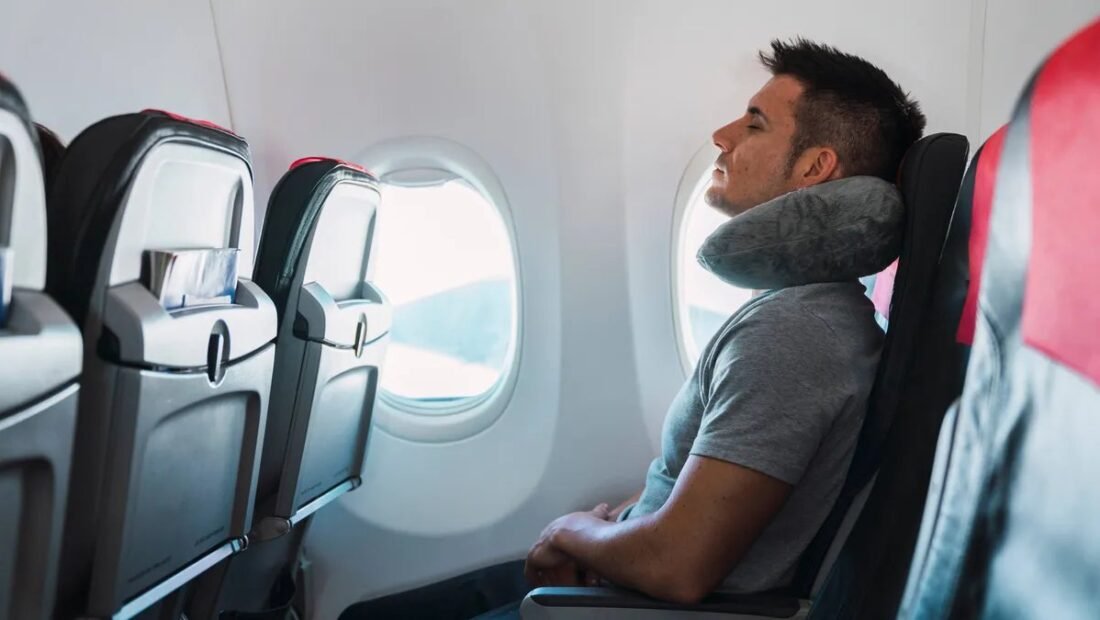
The window seat has a hidden sleep advantage beyond the wall: control. You control the shade (no neighbor blasting light at 3 a.m.), you avoid the aisle’s disturbances (no drink carts, no climbing passengers), and you get the fuselage curve as a headrest supplement. The pro move: inflate the neck pillow, wedge a small pillow or bundled jacket between your head and the wall, recline, and let the wall do the work. Side-sleepers do best here — the wall becomes the bed’s edge. It’s not business class, but it’s the best sleep economy offers, and it’s free with seat selection.
The other free upgrade is timing your bathroom trips strategically. Go right before your sleep block (not during — waking mid-block fragments the sleep), and choose the aisle… no, stay window, but time it: the cabin’s quietest period is 2–4 hours after the first meal service. Settle in then, and don’t get up until the pre-landing bustle. Every interruption costs you a full sleep cycle to recover. Protect the block like it’s sacred — because at 35,000 feet, it is.
15 Long-Haul Sleep Tips
- Choose a window seat; avoid last rows and non-reclining exits
- Book overnight flights aligned with destination night
- Memory-foam neck pillow (wraparound style)
- Contoured 100% blackout sleep mask
- Noise-cancelling headphones or quality earplugs
- Compression socks for circulation
- Inflatable footrest to raise feet
- Change into comfortable clothes after boarding
- Run a bedtime routine: teeth, face, kit, recline
- Skip the second meal service to protect sleep
- Time sleep to destination night (Timeshifter app)
- Caffeine timed to destination morning only
- Hydrate aggressively; avoid alcohol
- Melatonin 0.5–1mg at destination bedtime
- Premium economy worth it on 10+ hour flights if budget allows
Arrive Human
The goal isn’t perfect sleep — it’s landing functional instead of destroyed. Five decent hours in economy with the right setup beats eight restless hours without it, and the difference compounds: good flight sleep means less jet lag, which means your first two days aren’t wasted.
Build the kit once, use it for years. Your future self — the one stepping off the plane clear-eyed while everyone else shuffles like zombies — will thank you.