
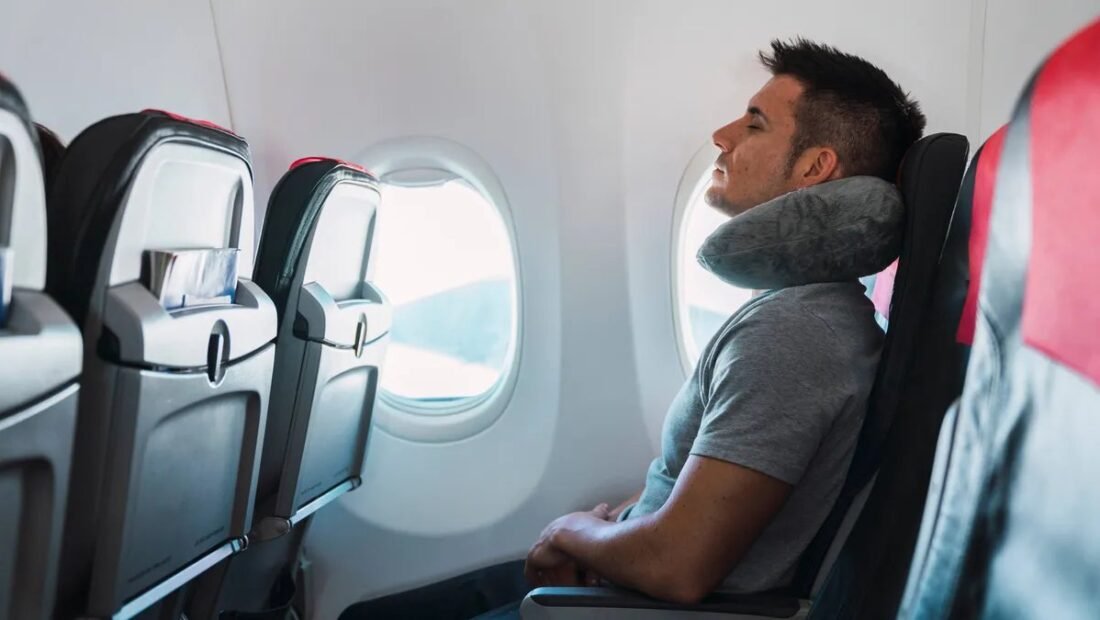
The flight leaves at nine in the evening and lands, eleven hours later, at what your body insists is three in the morning. Everything about the next two days of the trip — the meetings, the sightseeing, the simple ability to enjoy dinner — depends on what happens in seat 34A during those eleven hours. Follow one traveler through the flight: not a business-class sleeper, just an economy passenger with a system, who will land tired the way a person is tired after a short night, instead of destroyed the way people are after red-eyes they left to chance. Sleeping well in economy is not a talent; it is a sequence, and it starts before the airport.
The booking decisions that pre-load the sleep
Our traveler chose the window seat, and chose it on purpose. The window is the economy sleeper’s best friend: a wall to lean the pillow against, a view nobody climbs over you to reach, and control of the window shade — which is control of light, which is control of sleep. The seats she avoided matter as much: the last rows (limited recline, galley noise, the queue for the toilets forming beside your head) and the exit rows whose armrest-mounted tables and upright requirements quietly tax rest. She booked an overnight flight aligned, as nearly as the schedule allowed, with night at the destination — because the entire strategy of the flight is to sleep on destination time, not home time. And she ran the upgrade math honestly: premium economy’s extra recline and legroom genuinely improve sleep, and at roughly $200–$400 more on a flight of ten hours or longer, it is worth it when the budget stretches — on a six-hour hop, the kit below does the job for the price of a sandwich.
She also made peace with the seat map’s toll booths. On many airlines the good economy seats — exit rows, bulkheads, the quiet front of the cabin — now carry fees, and her rule is to pay for location before paying for anything else on the ticket: the window seat in a quiet row is worth more sleep than a checked bag, a lounge pass, or a marginally better meal. Where the choice was between a fee for an exit row and the premium-economy upgrade on an eleven-hour flight, she took the upgrade; on a seven-hour flight, she would take the exit row and the kit, and pocket the difference. Sleep, like everything else on a plane, is a budget line — the skill is spending it on the hours, not the amenities.
The day of the flight, and the kit
The system starts on the ground. She exercises in the morning, gets daylight, and cuts caffeine off by early afternoon — caffeine is a tool with a schedule, and today’s schedule says it works again tomorrow morning, destination time. The kit she carries is small and each item has survived a brutal audition. A real neck pillow, the wraparound memory-foam kind (the Trtl and Cabeau styles are the ones frequent flyers actually keep), because the free inflatable U-pillow supports nothing and deflates by hour four. A contoured sleep mask that blocks light completely — total darkness is not a luxury, it is the mechanism by which the brain accepts that this metal tube is a bedroom. Noise-cancelling headphones or serious earplugs, because engine drone is a sleep tax levied by the hour. Compression socks for circulation on a flight this long, an inflatable footrest that raises her feet and changes the whole geometry of the seat, and a change into soft, warm, non-office clothes after boarding — both for comfort and because the ritual of changing is itself a signal, and signals are how you talk a brain into sleeping somewhere absurd.
The routine: boarding to lights-out
Once seated, she runs a compressed version of her home bedtime routine, in her home order: wash face, brush teeth, kit out — pillow placed, mask ready, earplugs in reach — seat reclined as far as it goes. It feels theatrical the first time and works anyway, because the brain takes its cues from sequence more than from place. Dinner is eaten if it comes early and skipped without regret if it doesn’t; the airplane meal’s schedule serves the airline, not her destination clock. Then the discipline that separates the sleepers from the zombies: she declines the second meal service and the mid-flight ice cream entirely. The cabin’s quietest period runs from about two to four hours after the first service ends, when the lights are down, the carts are parked, and the whole plane exhales — and that block is sacred. Travelers who protect it arrive human; travelers who spend it watching a third film because it was there arrive as cautionary tales. Somewhere in the routine, timed to destination bedtime, sits the small white tablet many travelers swear by: low-dose melatonin, half a milligram to one, is the most commonly used sleep-timing aid on long-haul routes — worth discussing with a doctor beforehand like anything else medicinal, and no substitute for the light and darkness management that does the real work, the same principles laid out in the NHS guide to jet lag.
What she does not do
The negative list is short and non-negotiable. No alcohol: it fragments sleep architecture even as it shortens the time to unconsciousness, so the nightcap produces a nap and a headache rather than rest, and the dehydration of cabin air compounds both. No sleeping pill experiments at altitude — a first dose of anything strong belongs on the ground, at home, on a weekend. No heroic hydration theater either, though steady water matters: cabin air is desert-dry, and waking with a headache and a desert mouth is usually dehydration wearing a jet-lag costume. And no checking the time with home-time math. The watch goes to destination time at boarding, and every decision after that — sleep, wake, caffeine, light — is made in the new zone, because jet lag is largely a negotiation and you do not negotiate with two clocks at once. The broader strategy continues after landing in how to avoid jet lag on a long international flight, which picks up where the wheels touch.
Position, neighbors, and other turbulence
Two practicalities complete the system. The first is geometry. In the window seat, the wraparound pillow braces against the fuselage wall and the body leans at an angle spines tolerate for hours; the footrest, inflated to fill the gap under the seat ahead, turns the whole arrangement into something close to a recliner’s poor cousin. Tray-table sleepers — face down on folded arms — swear by their method and wake with creases and a stiff neck in about equal measure; it works best as a nap position rather than a night’s strategy. Traveling as a pair, booking the window and the aisle of a three-seat row is the oldest gamble in economy: an empty middle is a lie-flat upgrade in disguise, and if the gamble fails, the middle-seat stranger will almost always trade for your aisle. The second practicality is courtesy, because your sleep system operates in shared space: recline slowly and after a glance behind, keep the glow of your screen at its floor once the cabin dims, and treat the shared armrest as a treaty. A cabin where everyone runs a light version of this etiquette is measurably quieter by hour six — and every sleeper in it, including you, collects the benefit.
Moving, circulation, and waking on purpose
One obligation interrupts the sleep block and should: every few hours, when awake between sleep cycles, stand, walk the aisle, and move the ankles and calves. Long flights punish stillness — stiffness at best, and circulation risks that grow with flight length and personal factors, which is what the compression socks are quietly for. Treat wakefulness between sleeps as maintenance, not failure: water, a walk, a stretch at the back of the cabin, then the routine again — mask, pillow, darkness — for the next block. Two decent blocks of two to three hours, which is what this system realistically produces in economy, beat one heroic attempt at eight that turbulence, neighbors, and a bladder conspire to shred. Judge the flight by the sum, not by the fantasy.
Landing like it matters
She wakes — or is woken by the cabin lights — about ninety minutes before landing, groggy and human rather than shattered. Breakfast, such as it is, gets eaten. The window shade goes up on descent whatever the hour feels like, because destination daylight is the strongest drug in this entire guide and it is free. On the ground: movement, light, a real coffee timed to destination morning, and a strict refusal to nap before early evening, however eloquently the hotel bed argues. She will be asleep by nine that night, local time, and awake at something like a civilized hour — which is the entire prize. The goal was never perfect sleep at thirty-five thousand feet; that seat does not contain it. The goal is landing functional instead of destroyed, and on the evidence of everyone who flies these routes monthly, the difference between the two outcomes is rarely the seat, the airline, or luck. It is a window seat, a dark mask, a protected quiet block, and a watch set to where you are going.



1 Comment