
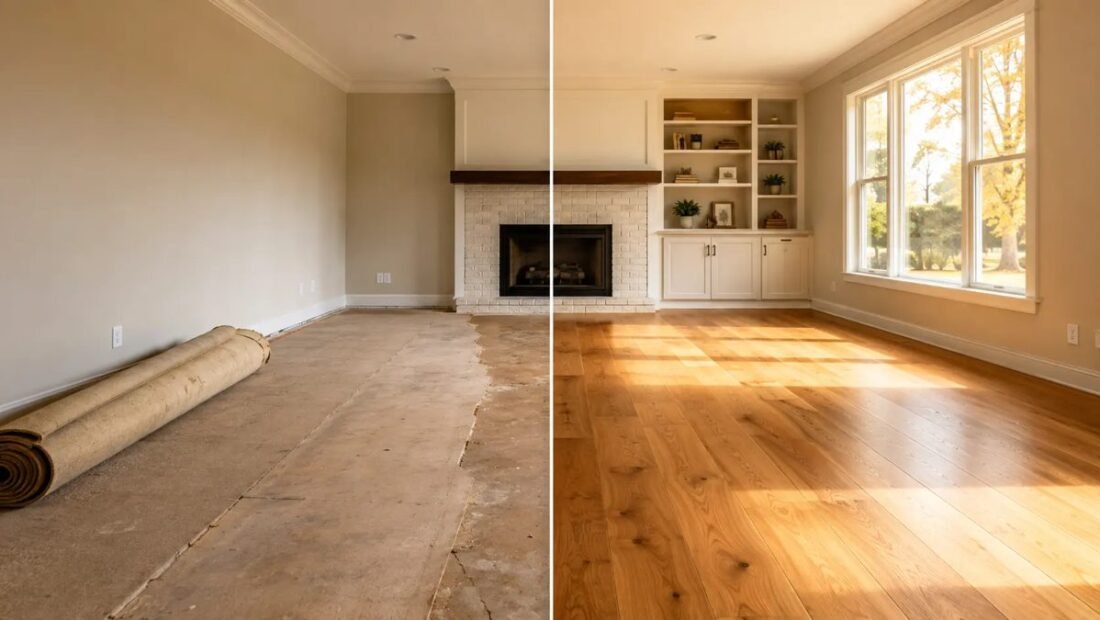
Replacing carpet with hardwood is priced in a range so wide it sounds evasive: $8 to $18 per square foot, all in — $8,000 to $18,000 for a typical 1,000-square-foot job. The range is real, and where a particular floor lands inside it is decided by three choices, not by luck: solid wood or engineered, prefinished or site-finished, and what the crew finds under the carpet. This guide stacks the full cost honestly, compares the two constructions on the things that actually differ, and ends with the choice most houses should make. One anchor for every quote you collect: a figure below $8 a square foot, installed, is leaving something out, and the something is usually discovered mid-job, at change-order prices.
The cost stack, line by line
Materials first. Solid hardwood runs $5 to $12 per square foot for the wood alone — domestic oak and maple at the lower end, exotics like Brazilian cherry at the top. Engineered hardwood, a real-wood wear layer over a plywood core, runs $4 to $9. Installation labor adds $4 to $8 per square foot, and inside that figure hide the tasks shoppers forget: carpet removal and disposal alone is $1 to $2 per square foot, plus subfloor preparation, the installation itself and any finishing. Then come the conditionals. Damaged subfloor, old asbestos tile, or concrete that needs leveling adds $1 to $4 per square foot for remediation. Stairs are priced separately and steeply — typically $100 to $200 per step, which is why a staircase can add the cost of a small room. Finally, acclimation is not optional or billable drama: the wood must sit in your home for three to seven days before installation to equalize with the house’s humidity, and any installer eager to skip it is telling you how the gaps will look in February. Total timeline for planning: three to five days of work for prefinished floors across 1,000 square feet, seven to ten for site-finished once sanding, staining and curing are counted.
Solid versus engineered: the decision that matters
The prestige argument says solid; the physics argument is pickier. Solid hardwood is one piece of wood, refinishable many times across a century of life, and the right answer for most above-grade rooms over wood subfloors in stable humidity. Its limits are dimensional: it expands and contracts with moisture, dislikes basements and concrete slabs, and comes in narrower widths for a reason. Engineered hardwood is a genuine wood surface — not a photograph, not laminate — bonded to a plywood core that barely moves, which makes it the correct choice below grade, over concrete, in wide planks, and in climates with violent humidity swings; its wear layer refinishes once or twice rather than indefinitely, against an expected life of 30 to 50 years. Guidance from the National Wood Flooring Association consistently frames the choice this way — construction follows the room’s conditions, not the showroom’s hierarchy. Houses deciding for specific rooms rather than whole floors should also weigh household traffic: the calculus changes in a home with big dogs, which is why the best flooring for homes with dogs sometimes outranks hardwood altogether in the rooms dogs actually live in.
Prefinished versus site-finished
The second fork is finish. Prefinished boards arrive with a factory-cured coating that is harder than anything applied in a living room, install in days, and let furniture return almost immediately — the default choice for occupied homes and tight timelines. Site-finished floors are sanded, stained and coated in place: slower, dustier, and off-limits while coats cure, but they deliver a perfectly flat surface with no micro-bevels between boards, plus custom stain colors no factory offers. The cost difference is usually modest; the lifestyle difference is not. Households that cannot vacate for a week, or that are flooring one room at a time around their own furniture, should treat prefinished as the default and site finishing as the connoisseur’s exception.
The resale case, stated carefully
Hardwood is one of the few renovations where the financial case is nearly as good as the aesthetic one. Realtors commonly estimate 70 to 80 percent cost recovery at resale, with an additional effect that does not fit in a percentage: homes with hardwood in the main living areas tend to photograph better, show better and sell faster than carpeted equivalents, because buyers mentally price carpet as a project and hardwood as an asset. Two cautions keep the case honest. Recovery percentages are market averages, not promises, and overbuilding past the neighborhood’s standard — exotic species in a starter-home street — returns less, not more. And the value assumes competent installation: a gappy, cupped floor installed over an unprepared subfloor reads to buyers as a future bill, which is the most expensive outcome of all.
How to buy it without overpaying
Get three itemized quotes and insist each one separates materials, removal, prep, installation and finishing — a single lump sum is a place for surprises to hide. Ask which line covers subfloor surprises and at what rate, because that is where the $8 job becomes a $13 job. Buy prefinished domestic oak or maple in standard widths if value is the goal; that combination repeatedly lands at $8 to $12 per square foot installed and wears its age gracefully. Schedule in the installer’s slow season where your market has one, confirm the acclimation days are in the plan, and keep one unopened box of the exact product against future repairs — discontinued lines are the tax on everyone who did not.
Room by room: where hardwood earns it, and where it does not
The whole-house question usually dissolves into room questions. Living rooms, dining rooms and hallways are hardwood’s home turf — dry, visible, and trafficked by shoes rather than water — and engineered or solid both serve for decades. Bedrooms take hardwood beautifully and reward bare feet with warmth carpet-owners forget wood can have. Kitchens are the argued room: hardwood works and looks superb, but it lives one plumbing leak or one dropped ice-maker line away from cupping, so households choose it with mats at the sink and a leak sensor under the fridge, or choose tile and LVP without apology. Bathrooms are where hardwood goes to be replaced — engineered products rated for powder rooms survive splashes, but full baths’ daily water belongs on tile. Basements belong to engineered, or to no wood at all. Deciding room by room also lets a budget phase the project: hardwood where guests see it this year, alternatives where water rules, and a single product family linking them visually so the house still reads as one idea.
Maintenance reality: the twenty-year view
Ownership costs decide whether the install price was a bargain. Solid hardwood asks for a screen-and-recoat every several years in traffic areas and a full refinish perhaps once a decade or two — each refinish erases a decade of wear and is the dividend no other floor pays. Engineered floors accept their one or two refinishes and then age honestly. Both ask the same daily discipline: felt pads under furniture, grit kept at the door (sand on shoe soles is the true enemy of every finish), spills wiped promptly, and humidity held in the middle range so boards neither gap nor cup. Households should also know the acclimation rule cuts both ways — wood installed dry and tight in a humidified winter house will tell the story in July. None of this is burdensome; it is simply the rent on the warmest, longest-lived surface available, and over twenty years it totals far less than one carpet replacement cycle in the same rooms.
The comparison worksheet: three quotes, one page
Flooring quotes diverge the way painting quotes do — by hidden scope — so force them onto one page before choosing. For each bidder, record: product (species or wear layer, grade, width, finish type), materials price per square foot, removal and disposal as its own line, subfloor preparation and the rate for surprises, installation labor, stair pricing by the step, acclimation days scheduled, and the timeline from start to furniture-back. The exercise routinely dissolves the “cheap” quote: its materials line is thinner because the product is a lower grade, its labor excludes removal, and its surprise rate is where the missing money waits. The winning bid is usually the middle one with the fullest page — complete scope, named product, contingencies priced in daylight. Keep the final worksheet with the leftover box of flooring; together they are the floor’s service manual for the next twenty years.
The verdict
For dry, above-grade rooms on wood subfloors, solid prefinished hardwood is the durable default and the best value over a long ownership. For basements, slabs, radiant heat or wide-plank ambitions, engineered is not the compromise — it is the correct engineering. Budget $8 to $18 per square foot with the contingencies named above, decide construction by subfloor rather than by prestige, and the floor that replaces the carpet will still be the best-looking surface in the house when the carpet would have been replaced twice.

1 Comment