
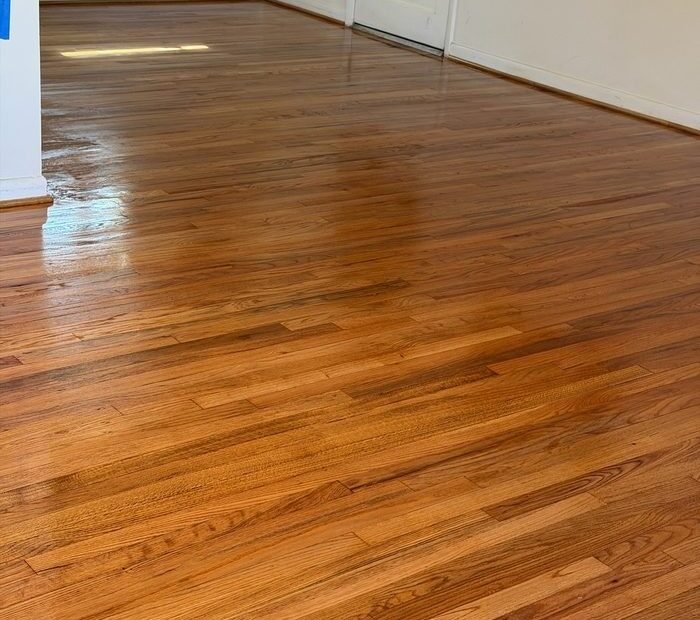
A drum sander forgives nothing. Pause it for two seconds in one spot and it digs a hollow that raking light will reveal for the next fifteen years; tilt it slightly and the edge cuts a groove across a dozen boards. That is the honest starting point for pricing this job, because refinishing hardwood floors has two completely different cost structures depending on one variable: whose hands are on the machine. Professional refinishing runs about $3 to $8 per square foot. Doing it yourself runs about $0.50 to $1.50 per square foot in rentals and materials — $500 to $1,000 total for 1,000 square feet against $3,000 to $8,000 professionally. The gap is so wide that the real question is not the price of either path. It is whether the mistakes below, each of which has converted a DIY bargain into a professional rescue job, can be avoided. They can — but only by knowing them in advance.
Mistake 1: Renting the sander before the room is truly empty
The rental clock starts when the machine leaves the store, and every hour of furniture wrestling, tack-strip pulling and subfloor repair that happens after that moment is paid for twice — once in rental fees, once in a rushed sanding job at the end of a long day. The correct sequence inverts it: the room gets emptied completely, baseboards removed or masked, nail heads set below the surface, squeaks and loose boards fixed, and the floor vacuumed and inspected before the rental is booked. Drum sanders and edgers run $75 to $100 a day for the pair’s neighborhood; plan two to three days for a first-timer across 1,000 square feet, and remember the rental return deadline is not a sanding schedule. Floors should be refinished from the room’s state of readiness, not from the shop’s opening hours.
Mistake 2: Wrong grit sequence — skipping steps or starting too fine
Sanding is a progression, and each grit exists to remove the scratches of the one before: a typical path for a worn floor is 36-grit to strip finish and level, then 60, then 80 or 100 to finish. Two errors ruin floors here. Starting too fine on a floor with old finish and deep wear accomplishes nothing but glazing — hours of sanding that polish the old finish rather than removing it, tempting the operator to press harder, which is how dips and chatter marks are born. Skipping a grit to save time leaves the coarse scratches in place, invisible in raw wood, and then the stain — if used — prints them in high contrast across the whole floor. The sander must also keep moving at a steady walking pace whenever the drum is down; the drum touches the floor only in motion. Sandpaper itself is a real budget line, $100 to $150 across the grits for a large job, and fresh paper cuts twice as fast as tired paper, which makes frequent changes a speed decision as well as a quality one.
Mistake 3: Sanding against the plan — stain choices made mid-job
The refinishing decision tree forks early: sand and clear-coat the wood’s natural color, or sand, stain, then coat. Stain adds $50 to $100 in materials and a full dimension of risk, because stain magnifies every sanding flaw, blotch in soft grain, and lap mark from uneven application, and it cannot be locally corrected once the polyurethane seals it. First-time refinishers are strongly served by the clear finish path: the wood, freshly sanded and coated with quality water-based polyurethane ($150 to $250 for the quantity a big job needs), is usually more beautiful than the stained fantasy that prompted the project. Three coats is the professional standard — with the patience the coats demand: stay off the floor 24 hours after the final coat, keep rugs off for two weeks while the finish fully cures. Deciding all of this after the sander is already rented is how budgets and weekends die; decide at the quote stage, and get a flooring professional’s assessment ($0 to $100) before committing if the floor’s condition is uncertain.
Mistake 4: Assuming every worn floor needs full sanding
The screen-and-recoat alternative is the most underused money-saver in this category. If the wear is in the finish only — dull traffic lanes, surface scratches — while the stain and wood beneath are intact, a professional screening (a light buffing that abrades the old finish) plus a fresh topcoat of polyurethane runs about $1 to $2.50 per square foot, finishes in a day with minimal dust, and resets the floor’s appearance for years. It cannot fix deep scratches, pet stains or color changes, which is the honest test: damage through the finish into the wood demands sanding; damage in the finish demands screening. Maintenance screening every 7 to 10 years extends the interval between full sandings — themselves needed only every 15 to 25 years — so dramatically that many floors should be sanded bare perhaps twice in a house’s lifetime. Skipping the diagnosis and sanding a floor that needed screening spends three times the money and removes wood the floor can never get back; each full sanding consumes a measurable layer of the boards, and floors have a finite number of them.
The dust problem, taken seriously
No part of this job is romanticized more dangerously than the dust. Sanding a floor produces fine wood dust in industrial quantities, and it migrates through a whole house on air currents unless the work zone is sealed: plastic sheeting taped across doorways, returns and vents covered, a fan exhausting outward from a window to keep the room under negative pressure. Modern rental sanders have decent dust collection, and dustless systems are a feature worth asking professionals about explicitly, because the cleanup difference between a contained job and an uncontained one is measured in weeks of finding grit on shelves. The dust is also a genuine health and safety input — wear a proper respirator rather than a paper mask, and know that finish dust from pre-1978 floors can carry the same lead concern as old paint, one more reason a floor of unknown vintage in an old house deserves a test before it deserves a sander. Budget a full day of cleaning between the final sanding and the first coat regardless: finish laid over settled dust has a texture no amount of buffing fully redeems, and a tack-cloth pass over the whole floor, on hands and knees, is the cheapest quality control in the project.
Edges and special cases the averages hide
Per-square-foot pricing assumes a big rectangle, and real floors charge extra for their geography. Edges and corners — the edger’s domain, on knees, at a slower pace — are where both DIY time and professional line items concentrate, and a room chopped into alcoves and closets costs disproportionately more than its area suggests. Stairs are their own line item entirely, often priced per tread and nosing, and a full staircase can cost as much as a bedroom’s whole floor. Patterned floors — borders, inlays, herringbone — punish sanding errors visibly and belong in experienced hands. Engineered wood is the silent trap in this whole category: its real-wood wear layer may be only a few millimeters thick, enough for one careful sanding at most, and in budget products sometimes none at all; sanding through the veneer into the core is an irreversible, room-wide injury. Establish what your floor is — solid, engineered, how thick the wear layer is — before any other decision, ideally from an offcut in the attic or a vent cutout where the layers can be counted; the association’s guidance includes wear-layer thickness and sanding limits for exactly this determination.
One last piece of pricing honesty: the figures above assume a floor that is a candidate at all. Floors with widespread pet-stain blackening sanded into the wood, boards cupped from a long-undetected leak, or wear layers at their sanding limit may price out as repair-plus-partial-replacement jobs that no per-foot average describes, and the only way to know is the pre-project assessment this article keeps returning to. Get it in writing before the rental, not after it.
So what should you budget?
For the professional path on 1,000 square feet, budget $3,000 to $5,000 for sanding, optional staining and three coats at standard specification, climbing to $6,000 to $8,000 with repairs, custom stains or difficult layouts — a pro crew takes three to five days including drying. For the DIY path, budget $500 to $1,000 and a long weekend, and buy the insurance of honest self-assessment: the mistakes above are all knowledge problems, not character flaws. Set the result against replacement — $8 to $18 per square foot for new hardwood, the figure detailed in how much it costs to replace carpet with hardwood floors — and refinishing is almost always the rational spend when the wood itself is sound. Refer to the National Wood Flooring Association’s homeowner resources for the care and refinishing guidance the trade works from, including how to evaluate whether your floor has enough thickness left to sand at all. Price the floor you have, respect the machine, and the wide gap between the DIY and professional numbers can be captured safely — which is the entire opportunity this project offers.

1 Comment