
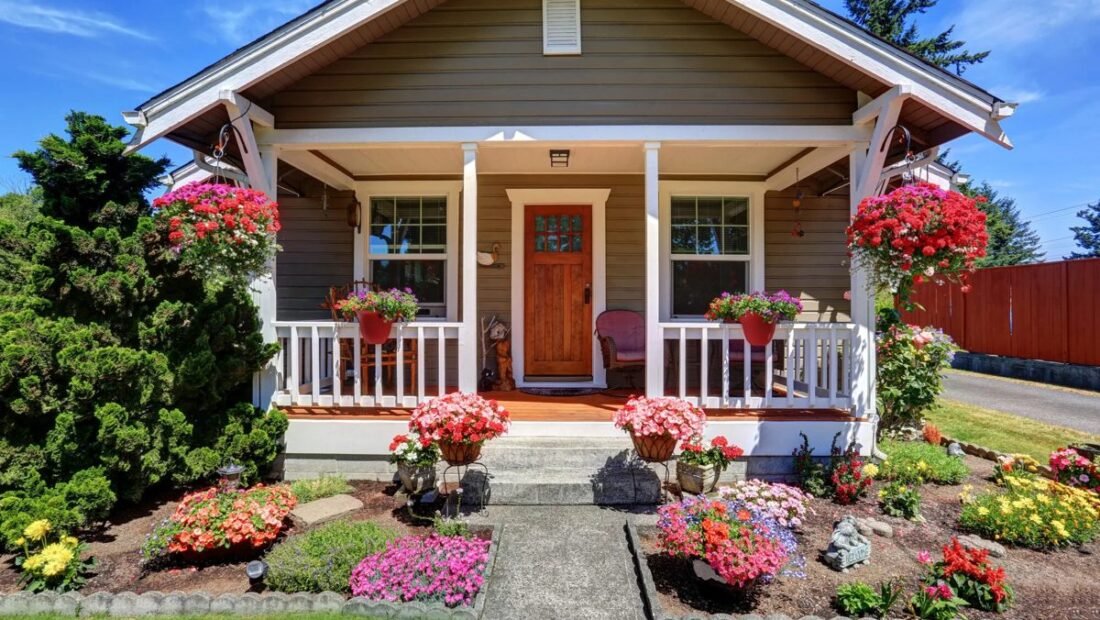
Picture two near-identical houses on the same street. Same builder, same tired siding, same overgrown shrubs. One of them gets photographed for its sale listing on Friday, and its owner has a weekend and a few hundred dollars to change what the camera — and every driver slowing down on the street — sees. That weekend is the purest form of the curb appeal question, because it forces the real ranking: not what could be improved, but what a stranger’s eye actually registers first from the curb, cheapest first. Walk it in the order a visitor’s gaze travels.
Saturday morning: the front door becomes the headline
The eye lands on the front door before anything else; it is the face of the house. A quart of paint in a confident color — deep red, navy, black, forest green — costs about $40 and an afternoon, and it transforms the personality of the whole facade disproportionately to its size, because every other element gets judged against it. While coats dry, the small hardware cluster around the door gets replaced in one sweep: large modern house numbers at about $20, a new mailbox around $30, a fresh welcome mat for $25, and, if the budget allows one more step, a new porch light fixture in the $30 to $60 range. Call it roughly $115 to $145 of door-zone work. It reads, from the street, as a house that is cared for — and that single impression is what buyers and neighbors actually carry away. Nothing else on this list produces as much perception per dollar.
Saturday afternoon: mulch, edges and the frame of the picture
With the door drying, the beds get their turn, because untidy beds make even a painted door look like makeup on a messy room. Fresh mulch — about $50 buys several bags — laid over weeded beds instantly darkens and unifies the ground plane, the way a frame finishes a picture. Shrubs get pruned back off the windows and the walkway, which costs nothing but an hour and reveals the house’s actual shape; overgrown shrubs are the most common way a decent house hides from its own street. The lawn’s edges get cut clean with a $30 manual edger, because a crisp line between lawn, bed and pavement is another of those signals the eye reads as “maintained” before it can name why. Two symmetrical planters flanking the door, around $60 with plants, close the composition. The total for the framing work: about $140 and the rest of the day.
Sunday: water, light and the finishing removals
Sunday is for subtracting grime and adding light. A rented pressure washer at roughly $75 for the day erases years from siding, the driveway, walkways and the fence — of all the tasks on this list, washing produces the largest square footage of visible change per dollar, and it also reveals which surfaces were merely dirty rather than actually worn. Work top-down, keep the wand moving, and respect delicate siding and old mortar with distance and a fan tip. Then the removals: a $40 lattice screen hides the trash cans and the air-conditioning unit, the two objects whose presence no amount of paint can excuse. If any budget remains, solar or low-voltage path lights along the walk do double duty — safety and a listing photo at dusk that looks staged on purpose. By Sunday evening the house has not been renovated; it has been presented, which is a different and much cheaper art.
What not to bother with
The weekend discipline matters as much as the weekend work, because the tempting expensive items barely register from the curb. A new garage door, a repainted whole facade, replaced windows, a rebuilt porch — each costs thousands and changes the street view less than the door-mulch-wash combination does, because the eye is not auditing the house, it is glancing at it. Decorative shutters on windows that never had them read as costume. Elaborate flower beds in mixed colors read as effort but also as maintenance debt to a buyer. And anything structural that is genuinely failing — a sagging step, a heaved walkway — outranks cosmetics entirely; safety defects are the one category where “cheaply” stops applying. The honest rule of the exercise: spend on the signals of care (door, edges, cleanliness, light) and defer the substance for its own budget and its own weekend. One more temptation deserves a specific warning: painting things that should not be painted to make them look new — brick that was handsome bare, stone veneer, vinyl siding with paint not rated for it. These moves cost weekend money, frequently peel within a few seasons, and subtract value in the meantime. Clean masonry; paint wood and metal. The curb can tell the difference. Much of the planting side of that presentation, incidentally, becomes permanent if it follows the best low-maintenance landscaping ideas rather than a bedding-plant binge that dies by August.
Before spending anything: the stranger test
The weekend plan above was built by a specific diagnostic, and it takes ten minutes: walk to the street, turn around, and look at the house as if you have never seen it. Better, photograph it from the curb and from across the street, then look at the photos — the camera is ruder than the eye, because the eye edits out the familiar. Owners stop seeing the peeling door paint, the shrub swallowing the porch and the stained walkway precisely because they see them daily. The photographs restore the stranger’s view, and they enforce the ranking: whatever your eye lands on first in the photo is project one, whatever it lands on second is project two. Most households that run this test discover their list reorders itself — the garage door they meant to replace turns out to be visually silent, while the rusty mailbox and the mildewed walkway were shouting. Curb appeal money spent before this test is spent on guesses.
If the budget is $100, and if it is $1,000
The same hierarchy scales in both directions, which is how you know it is a hierarchy and not a shopping list. At $100, the weekend compresses to its essence: the door painted ($40), mulch in the front beds only ($40), house numbers ($20), and the free work — pruning, edging with a spade, washing the walkway with a hose and stiff brush. That is genuinely most of the effect; the remaining items mostly add polish. At $1,000, the extra money does not buy bigger versions of the same things — it buys the next tier of permanence: a proper walkway repair instead of a wash, matching exterior light fixtures at both doors, a professional tree pruning that opens the house to the street, and quality planters and plants that survive the season instead of decorating it briefly. What it still does not buy, at any sensible point, is the facade repaint or the window replacement; those belong to the maintenance budget, justified by the surfaces’ condition, and their curb-appeal contribution will arrive as a side effect. Presentation money and preservation money are different wallets, and mixing them is how $1,000 weekends become $8,000 disappointments.
Selling, renting or staying: same weekend, three audiences
The ranking holds for all three reasons a household does this work, with the emphasis shifting slightly. A seller is buying a photograph and a drive-by: the listing image and the ten seconds a buyer’s car spends in front of the house, which is exactly why the door, mulch and wash — the camera-visible items — dominate. A landlord is buying durability of impression: tenants judge care by the same signals, but the landlord should choose the versions that survive tenancy — painted metal numbers rather than delicate ones, mulch and hardy shrubs rather than seasonal flowers, and light fixtures that take standard bulbs. An owner staying put is buying their own daily arrival home, and for them the order bends toward what they personally pass and touch: the walkway’s feel underfoot, the porch light’s warmth, the door they unlock every evening. All three audiences punish the same sins — visible neglect at the entry, grime, chaos in the beds — because all three are reading care, not construction. That is the deep reason cheap presentation works: neglect is cheap to display and, fortunately, cheap to stop displaying.
The total, and why it works
Add the weekend up: roughly $400 and two days, with the door cluster and mulch doing most of the talking. It works because curb appeal is not a renovation metric — it is a first-impression metric, and first impressions are formed from contrast and care signals: one strong color, clean edges, dark fresh mulch, working light, nothing visibly neglected in the foreground. HouseLogic’s curb appeal and home value guides return to the same hierarchy from the real-estate side: modest exterior presentation projects routinely punch above their cost at appraisal and sale time, while the big-ticket exterior replacements recover far less of their price. Our imagined house still has its old siding and its old roof. But the photograph taken on Friday shows a home someone looks after — and that, from the curb, is the whole ballgame.

2 Comments